Cheetah
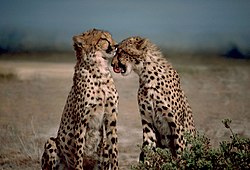
Cheetahs are built for speed, with a whip-like spine, long legs, and a long tail that acts as a rudder for sharp turns. As the world's fastest land animal (the fastest animal overall is the peregrine falcon) the cheetah can chase its prey for up to 559 meters (more than a third of a mile) at the speed of about 100 kilometers (roughly 62 miles) per hour at the fastest. Both the male and the female of the species are referred to as "cheetahs," unlike in the case of many other animals. Cheetahs can generally live up to seven years. They can also see as far away as 5 kilometers (about 3 miles), which helps with hunting.
Where do cheetahs live?
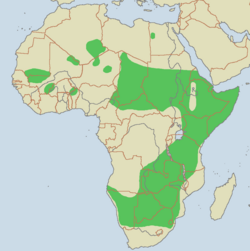
Today, most cheetahs are found in sub-Saharan Africa (the Eastern and Southern region of the continent), though a few are still seen in Iran. In the past, cheetahs were found throughout northern India and Iran, as well. They prefer to live in semi-arid deserts, savannas, prairies, and thick shrublands. As they rely upon speed to hunt, they avoid dense forests. Conservation efforts are required in order to prevent cheetahs from becoming an endangered species. As humans build more towns and cities in cheetah habitats, there has been an increase in cheetahs coming into contact with humans, and sightings of the big cats in urban areas.
What do cheetahs look like?
Cheetahs are medium-sized spotted cats with long legs and slender, but muscular, bodies. They have white bellies, and dark stripes that looks like tear stains on both sides of their faces. In contrast to leopards, which have rosette shaped spots, cheetahs have dark, round spots on their fur. Adult cheetahs weigh between 40 to 65 kilograms (90 to 140 pounds), and are around 112 to 135 centimeters (four to five feet) in length. Cheetahs are built to do what they are most known for: to run! Their long tail provides them with balance. They have a large chest, a narrow waist, and powerful muscles in their hind legs. They have small heads and muzzles; large nostrils for increased oxygen intake; and small, round ears. All of this makes the cheetah more aerodynamic, which helps them to run faster than most other animals.
What do they eat, and how do they catch their prey?
Cheetahs mostly eat herbivore mammals like gazelles, impalas, gnu calves, and hares, which are all about the same size or smaller than an adult cheetah.
Cheetahs stalk their prey until they are within about thirty meters, and then begin to chase them. The chase is usually over in less than a minute, and if the cheetah doesn't catch its prey quickly it will often give up, rather than waste energy. This is because cheetahs use a lot of energy when chasing prey at high speeds. About half of all cheetah chases are successful.
Cheetahs must eat their catch quickly or risk losing their food to other stronger predators. They will not usually fight with a larger animal (such as a lion or hyena), as risking an injury means starvation—if a cheetah breaks its leg, it cannot chase its prey.
Cheetahs are well-adapted to living in dry environments. In the Kalahari desert, they have been estimated to travel an average of 82 kilometers (51 miles) between drinks of water. They have been seen getting their water from the blood or urine of their prey, or by eating Tsamma melons.
Fun facts
See how much you know about the world's fastest land mammal:
- After running at full speed, a cheetah must rest at least 15 minutes before running again.
- Cheetahs do not roar, but they make a number of very un-catlike sounds, many of which resemble bird chirps. These chirps can be heard from a mile away (more than 1.5 kilometers)! Other cheetah sounds include purrs, bleats, barks, growls, and hisses. Cheetahs and pumas are the only big cats that purr.
- Cheetahs were called "leopards" before leopards were! In the past, cheetahs were called "leopards", and leopards were simply "pards". "Leo-pard" comes from a mix between the Latin word for lion, "leo," and "pard," then the name of leopards.
- Many cheetah cubs are killed by a lack of food, or by their natural enemies: lions, leopards, and hyenas. An old African legend says the tear stain marks on the cheetah's face are from the mother weeping for her lost cubs.
- Cheetahs do not usually eat the skin or bones of their prey.
- Occasionally, hyenas, leopards, and lions steal the cheetah's prey after the cheetah has killed it.
For more information
- Wikipedia: Cheetah
NewPP limit report Parsed by mw‐web.codfw.main‐747b7b5879‐87vjm Cached time: 20260915025725 Cache expiry: 2592000 Reduced expiry: false Complications: [no‐toc] CPU time usage: 0.025 seconds Real time usage: 0.029 seconds Preprocessor visited node count: 108/1000000 Revision size: 5182/2097152 bytes Post‐expand include size: 397/2097152 bytes Template argument size: 136/2097152 bytes Highest expansion depth: 11/100 Expensive parser function count: 0/500 Unstrip recursion depth: 0/20 Unstrip post‐expand size: 0/5000000 bytes Lua time usage: 0.006/10.000 seconds Lua memory usage: 653408/52428800 bytes Number of Wikibase entities loaded: 0/500
Transclusion expansion time report (%,ms,calls,template) 100.00% 16.973 1 Template:BookCat 100.00% 16.973 1 -total 10.36% 1.759 1 Template:BOOKCATEGORY 4.67% 0.793 1 Template:NAIVEBOOKNAME
Render ID 2dd7a39d-b0b1-11f1-a453-5dc285335d49
Saved in parser cache with key enwikibooks:stable-pcache:18620:|#|:idhash:canonical and timestamp 20260915025725 and revision id 4630886. Rendering was triggered because: unknown