The Ancient Romans
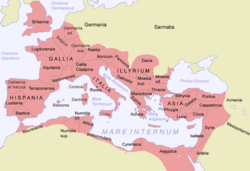
What country did they live in?
At the start, the Romans lived in a region that now forms part of Italy. Through conquest of nearby peoples, the Roman Empire expanded. At its peak, the empire controlled most of Western Europe, North Africa, Greece, the Balkans, and the Middle East. The capital Rome grew from a simple village to a thriving metropolis. Even today, some 2500 years later, Rome is still a major world city.
What did their buildings look like?
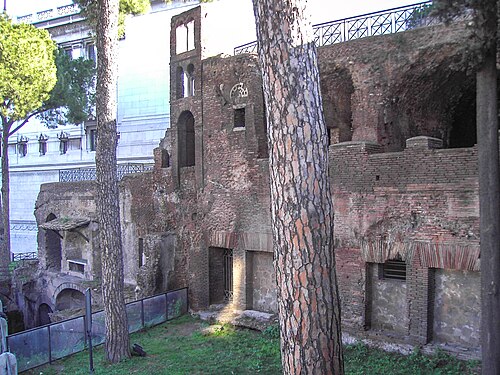
Many public buildings built by the Romans were huge works of white marble complete with arches and grand architecture. The average house, by comparison, was smaller and plainer, being built of bricks and timber. Much of our extensive knowledge of Roman Buildings comes from ruins and remains left in the ground.
Inside a middle class home (a domus), there were many rooms, with distinct functions.
These ranged in size, from small cubicles in which they slept, through medium sized rooms in which they eat, to large halls in which they would receive and entertain guests. The rooms in the house
normally opened out onto a courtyard. Despite its often small size, the purpose of this courtyard was to provide light and air to the rooms. As well as a courtyard, most wealthy people would also have
kept a garden behind the house, in which flowers, fruit, vegetables, and even grape vines would have been grown.
In the city of Rome most people lived in two or three-story apartment buildings called Insulae. Here a whole family lived in only one or two rooms, spending much of their time outside in the courtyards and streets. Water came from nearby public fountains and aqueducts.
The Romans also constructed many public buildings, including temples, marketplaces, forum, and amphitheaters. These public works also included things required for city living like aqueducts and sewers.
Military building was also undertaken, the largest construction being Hadrian's Wall at the northern Fringes of the Roman Empire. Even today, the remains of these roads are still visible in Northern England.
What did they eat?
Both the rich and poor ate bread and porridges made from wheat, barley and other grains. This was their main staple food. Some of the other common foods that they would have eaten were chicken and other birds, beans, lentils, walnuts, eggs, apples, cheese, milk, wine, figs, dates and grapes.
While most of their food would be familiar to us, Romans did have their share of strange or unusual feast items, including wild boar, peacock, snails, and a type of rodent called a dormouse. Another difference was that while the poor people and the woman ate their food while sitting in chairs, the rich men liked to have banquets together where they would lounge on their sides while they ate their meals.
Ancient Roman meals couldn't have included foods that came to Europe from America or from Asia in later centuries. For instance, they didn't have corn, nor tomatoes, nor potatoes, nor cocoa, and no ancient Roman ever tasted a turkey.
What did they wear?

People in Rome had three types of clothing. Firstly, they wore a loin cloth. This was worn like underwear. Then, over their loin cloth they would wear a tunic and women would sometimes wear two tunics. A tunic was usually made out of wool but occasionally linen. It was a loose garment that fitted over a person's head and was joined at the shoulders and sides. It would resemble a nightgown in our society. Finally, on top of a man's tunic he would wear a toga whenever he went into public, if he could afford one. Togas were large pieces of wool fabric that were wrapped all around the body. Interestingly, only Roman citizens were permitted to wear togas. It was symbol of peace because Roman soldiers also didn't wear togas. Togas were decorated in different ways to indicate rank, like a uniform. For example, a purple fringed toga indicated that the person wearing it was a leader.
Women in Rome also had an outside garment that corresponded to the male toga. It was called a stola and was also made of a large piece of fabric but it was wrapped and attached differently. Woman also wore a warm shawl called a palla when they went out.
Fashion changed as the empire progressed. Initially in Rome both men and woman wore togas but that changed fairly early in the Roman empire. Also, cloaks that were like large ponchos were first primarily used by poor people and soldiers but eventually became the standard dress for even the wealthy. Togas in that era had become purely ceremonial.
Roman men and woman also wore shoes or sandals unless they were extremely poor. They were completely made of leather, even the soles. When visiting one another they would wear them into their friend's home but remove them before eating.
What did their writing look like?

Romans developed what is now called the Latin alphabet for their writing. The Latin alphabet is nearly the same as the current English alphabet but originally it only consisted of capital letters. Also, the Romans didn't use a few of the letters that are a part of the modern English alphabet such as j, x and w. The Latin alphabet is the basis for most European languages.
The Romans also invented a way to write the capital letters in cursive. They didn't use punctuation the way that we do today.
Roman numbers were written with letters as well. These are called Roman numerals.
- M = 1,000
- D = 500
- C = 100
- L = 50
- X = 10
- V = 5
- I = 1
2008 is written as MMVIII in Roman numerals.
When a smaller value followed a larger this indicated addition. E.g. VI means V+I = 5+1=6. But the other way around it meant subtraction: IV means V-I = 5-1= 4.
This made it very hard to do maths with these numbers, and Arabic numbers (the ones we use today) began to be used in the Middle Ages. People found that banking and doing maths was much easier with these new number symbols.
What did they believe?
The Romans, like many other ancient civilizations, were polytheistic; this means they worshiped many gods. Each god or goddess, a female god, would be connected to a certain part of people’s life. If you were a fisherman you might pray to Neptune, the god of the sea. However if you were a warrior you would pray to Mars the god of war. All these gods and goddesses had different stories. These long stories of the gods have lived on in writings on pots and in scripts, or books, by ancient people. Most of the Roman gods were taken from the Greek culture. For example, the Roman god Neptune was considered the same as the Greek god Poseidon. Today, the names of the Roman gods are still used as names for planets!
Romans were generally tolerant of other polytheistic religions and often adopted foreign gods into their religion including Egyptian gods. Emperors sometimes declared themselves to be descended from heroes or gods. Monotheists such as Christians, who believe in only one god, were distrusted because they refused to worship the emperors and were often persecuted.
Are some of them famous even today?
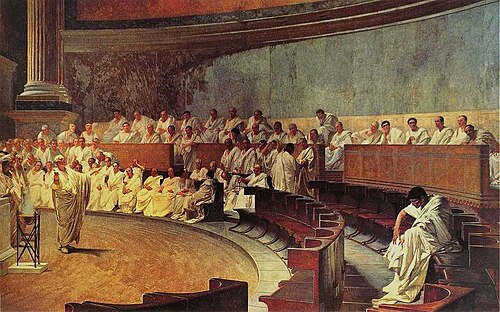
Roman history and literature have had a strong and continuous influence on Western culture for thousands of years, so many Roman statesmen, poets, and philosophers remain famous today.
Julius Caesar is probably the most famous Roman of all time. He was a Roman military and political leader and one of the most influential men in world history. As a general, he led invasions of France and Britain. Most people in Rome thought Caesar was a hero, but his enemies said that he only cared about winning fame and power for himself. When the Senate ordered Caesar to disband his army, he was afraid of what they would do to him, so he began a civil war. Four years later, Caesar won the war and became dictator for life. A group led by Cassius and Brutus, who called themselves the Liberators, killed Caesar at a meeting of the Senate because they thought it was the only way to save the republic. However, Caesar's friends defeated the Liberators in the ensuing civil war, and the Roman Republic became the Roman Empire. Caesar is also famous for reforming the calendar and for several books he wrote about his military campaigns.
Marcus Tullius Cicero was another famous Roman statesman. Many of Cicero's books, speeches, and letters have survived, and we know more about him than any other Roman. Cicero didn't come from a noble family, but he rose rapidly in politics because of his talent for public speaking. Cicero began his career in public office as a quaestor, a low-level official who managed the finances of the state. Because the people of Sicily found him to be honest and fair, they asked him to prosecute the corrupt governor of their island. Cicero prepared for a full trial, but after his opening speech, the governor saw that there was little chance of winning against Cicero and chose to leave the country. Cicero became known as Rome's greatest public speaker, and his successful prosecution entitled him to take the governor's seat in the Senate, giving him a freedom to speak that would not normally have been available to such a young member. Cicero gave some of his most famous speeches denouncing a plan by Catiline, an impoverished nobleman, to murder Rome's ruling class and seize power by force. Cicero was called "father of his country" for stopping the conspiracy. After the fall of the Roman Republic, the new rulers had him killed for speaking out against them. One of Cicero's most famous books is On Duties, which was considered the greatest work of moral philosophy through the Middle Ages and the Renaissance. When printing was invented, it was the second book to be printed after the Bible.