The six simple machines
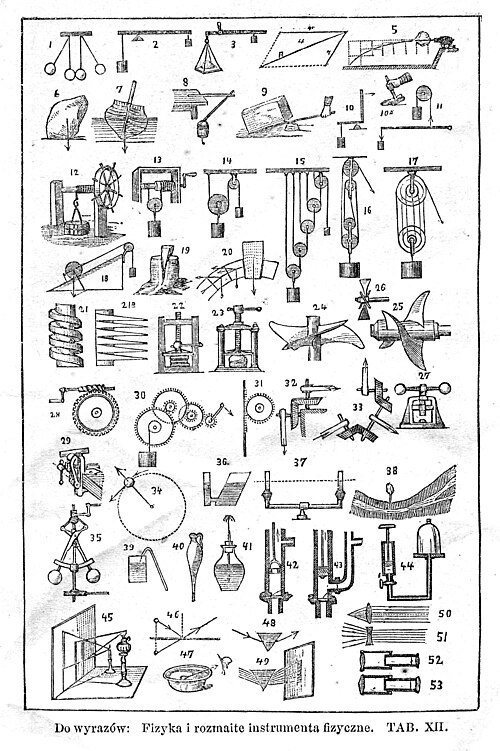
A simple machine is a device that changes the direction or amount of a force. They are the building blocks used to build more complex machines. For example, wheels, levers, screws, and pulleys are all used in a bicycle.
The six simple machines are:
Simple machines are the most basic mechanisms that use mechanical advantage (also called leverage) to multiply force. How do they do that? It's actually because of a concept called work. You know that if you walk 2 miles to school, it's harder than if you had to walk 1 mile to school. How much effort does each step take? The effort is however much it takes to move your body. Scientists and engineers call how much effort you use over a distance 'work'.
A simple machine uses a force to do work on a load. If there was no friction, the amount of work done on the load is equal to the work done by the applied force. Simple machines are often used to increase the amount of the output force. But there is a trade-off, the more force is increased, the less distance is covered. The ratio of the output to the input force is called the mechanical advantage.
The idea of a "simple machine" originated with the Greek philosopher Archimedes. He studied the lever, pulley, and screw. He also discovered the principle of mechanical advantage in the lever. During the Renaissance the classic five simple machines (excluding the wedge) began to be studied as a group. The complete theory of simple machines was worked out by Italian scientist Galileo Galilei in 1600. He was the first to understand that simple machines do not create energy, only transform it.
NewPP limit report Parsed by mw‐web.codfw.main‐7676dd75dd‐zr2tj Cached time: 20260904021216 Cache expiry: 2592000 Reduced expiry: false Complications: [] CPU time usage: 0.020 seconds Real time usage: 0.026 seconds Preprocessor visited node count: 101/1000000 Revision size: 2092/2097152 bytes Post‐expand include size: 634/2097152 bytes Template argument size: 235/2097152 bytes Highest expansion depth: 11/100 Expensive parser function count: 0/500 Unstrip recursion depth: 0/20 Unstrip post‐expand size: 0/5000000 bytes Lua time usage: 0.006/10.000 seconds Lua memory usage: 662394/52428800 bytes Number of Wikibase entities loaded: 0/500
Transclusion expansion time report (%,ms,calls,template) 100.00% 16.458 1 Template:BookCat 100.00% 16.458 1 -total 11.26% 1.853 1 Template:BOOKCATEGORY 5.57% 0.917 1 Template:NAIVEBOOKNAME
Render ID 0c9bccd3-a806-11f1-acd3-fbde37785a05
Saved in parser cache with key enwikibooks:pcache:221546:|#|:idhash:canonical and timestamp 20260904021216 and revision id 4232837. Rendering was triggered because: diff-page