We call her Ba - A Biography of Kasturba Gandhi
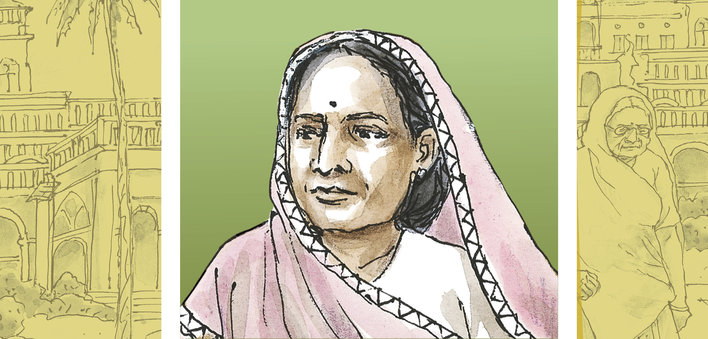

In many photographs of Mahatma Gandhi you will see her sitting right behind him. A small woman with delicate features, wearing a khadi sari, covering her head. People who knew her remember she would sit silently, hardly ever saying a word but you could not forget that face.
She was Kasturba, wife of Mohandas Karamchand Gandhi.
She was not educated or sophisticated but she had a strong personality and people loved her for her kindness and simplicity. She was a wife, mother, grandmother, friend and freedom fighter.
The British officials would address her as ‘Madame Gandhi’ but to Indians she was ‘Ba’, their beloved mother. Even Gandhiji called her by that name!
And in the middle of all the hurly burly of the freedom struggle, in protest marches, Satyagrahas and fasts, she was his anchor. She was the calm centre of his universe and Gandhiji could not have achieved so much without her support.
She was also a woman who had her own identity. She was tough, courageous and practical and like Gandhiji, she suffered and sacrificed a lot for her country. She became a freedom fighter who led protest marches, faced police lathis and went to jail. She also ran Gandhiji’s Sabarmati Ashram and welcomed all the leaders of the freedom struggle there. For every freedom fighter, young and old, she was an understanding friend.
Kasturba Gandhi was simply ‘Ba’ or mother to all of them just as Mahatma Gandhi was ‘Bapu’ or father. And they made quite a pair!
At Sabarmati Ashram
At Sabarmati Ashram, Kasturba and Gandhiji were always surrounded by children who were called their ‘Vanar Sena’ or monkey army. Gandhiji taught them to grow vegetables, take care of the cows and goats and spin thread on the charkha. One day they had a charkha contest to see who could spin the most thread and both Kasturba and Gandhiji lost to one of their granddaughters!
Gandhiji told the kids that they should always obey Kasturba like he did, because he was very scared of her! One day, after everyone had eaten lunch, Kasturba went off to have a nap. Just then some guests arrived and Gandhiji wanted to give them lunch but he did not want to disturb her. So he told the children to cook some food, but to do it very, very quietly, making sure Kasturba did not wake up and then he quickly left. Soon disaster struck when one boy dropped a brass plate with a huge clannnggg!
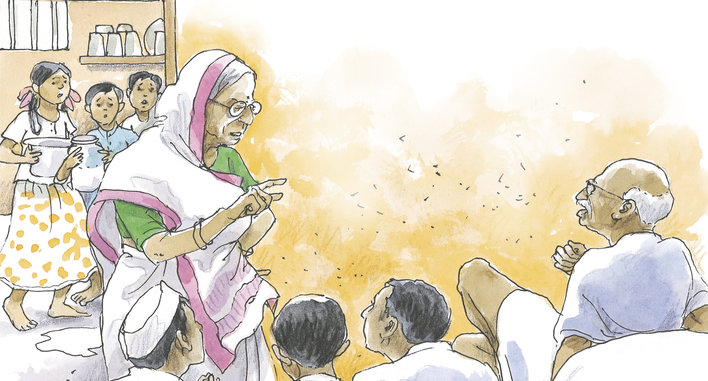
It woke up Kasturba and she wanted to know why she had not been called. If Bapu thought he could escape her anger, he was mistaken because she walked into his prayer meeting and gave him a scolding in front of many people!
A child bride
Kasturbai Makhanji was born on 11th April 1869 at Porbandar in Gujarat. Her father was Gokuldas Makhanji and her mother was Veraj Kunver Ba. We know very little about her childhood but her father was a prosperous businessman, so she grew up in a comfortable home. Gokuldas’ good friend was a man named Karamchand Gandhi and they decided that Kasturbai should be engaged to marry Karamchand’s youngest son, Mohandas.
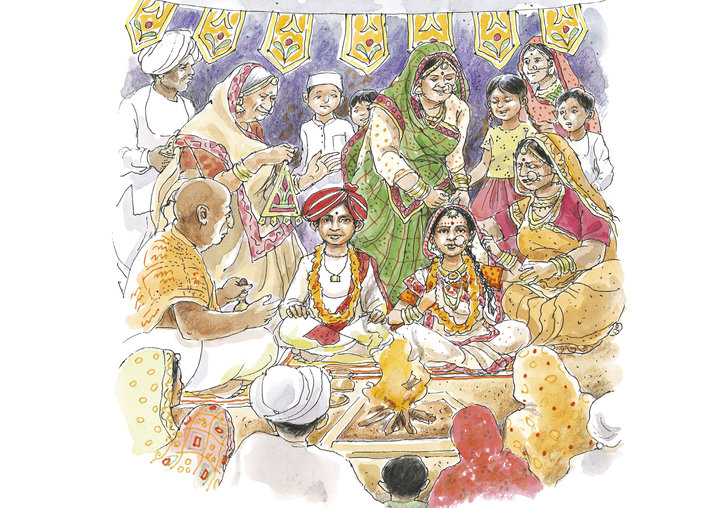
When the engagement ceremony took place, the boy and girl were both seven years old! As a matter of fact, Mohandas was born on 2nd October 1869 and so he was a few months younger than his bride. And Kasturba, who was always quick and independent, never let him forget it.
In 1882, when they were both thirteen, Kasturba and Mohandas were married and she came to stay in the Gandhi home. Karamchand was the Dewan or Prime Minister of the Raja of Porbandar and this was a prosperous household. It was a joint family headed by Karamchand and his wife Putlibai. She was a religious person and a very gentle and kind woman who was close to her youngest son.

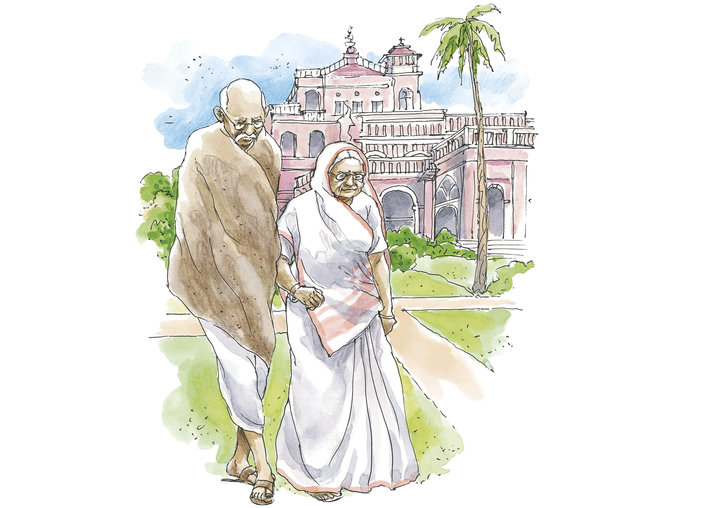
Mohandas went to school, but in those days girls were rarely educated. Kasturba could not read or write and she was not very interested either. Mohandas tried very hard to teach her and she managed to learn Gujarati, but refused to learn English. As a matter of fact, when they were both in their seventies, sharing two years of imprisonment at the Aga Khan Palace, he was still trying to teach her geography and she would not listen to him at all.
One day, Mohandas would become Mahatma Gandhi, a brave leader of freedom fighters, but at thirteen he was not very brave.
He was painfully shy, nervous of sleeping in the dark and scared of ghosts and snakes. In contrast, Kasturba was not scared of anything, not even her young husband who tried his best to bully her. Mohandas decided that Kasturba had to take his permission before she went out to play with her friends or visited a temple. Kasturba just ignored his orders and did exactly as she pleased.
As a matter of fact, all their lives she would stand up to her famous husband who could be quite bossy. He had to convince her before she listened to him. She would stand there grimly silent, refusing to fight and Gandhiji said that he got his first lessons of Satyagraha from his strong-willed wife. Satyagraha and Ahimsa were at the heart of our freedom movement. Satyagraha was the fight for truth and freedom and it was to be achieved through Ahimsa, which was non-violence. He said, “She ultimately made me ashamed of myself and cured me of my stupidity in thinking that I was born to rule over her; and in the end she became my teacher in non-violence.”
In 1886, when she was seventeen, her son Harilal was born. Soon after, Mohandas left for England to study law and returned only five years later. He came back and began to practise in Rajkot where their second son Manilal was born in 1892. The young lawyer’s career was not going too well because he was still very shy and would get so nervous while addressing a judge that he often lost his voice! Luckily in 1893, he was offered a job in South Africa and once again leaving his family behind, he left for Durban. It was only three years later that he came back to collect his family.
At the age of twenty seven, the mother of two boys, Kasturba boarded a ship in Bombay to travel to a strange land. She must have hoped to return to India soon, but in fact it would be eighteen years before she could finally come home. And these years in South Africa were a time of both great happiness and also much struggle and sacrifice. She would evolve over time and become a freedom fighter.

Food Fads and Fasting
Gandhiji was very fussy about what he ate and he also kept experimenting with his food. He was a vegetarian and usually ate chapatis, vegetables, dals and lots of fruits and nuts, but he would not stop his experiments.
One day, he started living on nuts, on another, he asked for dishes cooked without oil or spices and wanted to have his rotis with a horrible neem and garlic chutney. It was a huge headache for Kasturba who supervised the kitchen at Sabarmati Ashram.
Once he decided he would only eat raw food because then people would not have to work for long hours in the kitchen. So he and some of his followers began to munch raw vegetables and fruits. Their meals included wheat sprouts, spinach, raisins, flavoured with peanut paste and honey and they drank lemon juice and coconut water. Of course all this had to be prepared by poor Kasturba. After a few days they became very weak, began to suffer from dysentery and finally to her relief, the experiment was called off.
Kasturba used to have a very anxious time when Gandhiji went on a fast and would often beg him not to do so. Then he decided he would not drink cow’s milk. Once when he fell very ill, the doctors wanted him to drink milk but he refused and would not listen to anyone. Finally Kasturba convinced him to drink goat’s milk. Gandhiji also gave up taking salt in his food. So when he went on the Salt March to Dandi to make salt, it must have made Kasturba smile!

Kasturba herself ignored her husband’s food fads. He disapproved of people drinking tea or coffee but she enjoyed both. Gandhiji once confessed, “Ba takes tea in spite of the fact that she lives with me. She also takes coffee. I would even lovingly prepare it for her.”
In a strange land
Durban, South Africa. For young Kasturba, who had lived a gentle, protected life within her family, it must have been a very strange and scary world. The society in South Africa was deeply divided. The country was ruled by white-skinned people who kept the Africans and Indians at the level of servants. The Africans were the original inhabitants of the land and the Indians had gone there to work on farms. Even though the majority of the population was African, they had no rights at all. Neither did the Indians.
It was a white man’s world with Africans and Indians facing a violent police who would beat them at the slightest excuse and put them in prison without a trial. They had a racist law called Apartheid by which Africans and Indians could not travel freely or own property. They were not allowed to enter many places like hotels, shops or hospitals. They even had to drink from separate water taps. If a white man was walking towards them, they had to step off the pavement and once Gandhiji was beaten up for refusing to do so.
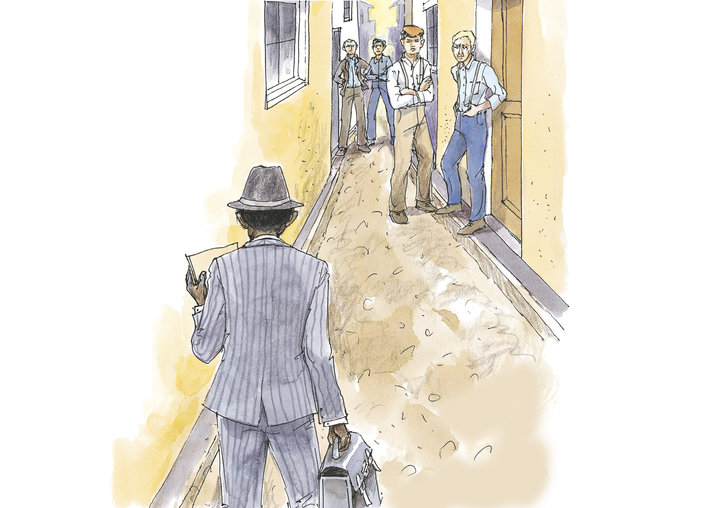
Gandhiji was shocked because even in England he had not faced such prejudice based on the colour of one’s skin. He soon began to help the Indian labourers who worked in the farms and were often not paid properly and beaten by the owners. He fought their cases in court and was successful in freeing many of them from this bondage. He became very popular among the labourers who were called ‘coolies’ and so he began to be called the ‘coolie barrister’.
When Gandhiji came to India to collect his family, he also wrote about what he had seen in South Africa and gave speeches criticising an inhuman law like apartheid. These lectures were reported in South African newspapers and the whites were furious. They were determined not to let him enter South Africa and planned to make him go back from Durban. The Gandhis did not know anything about this when they boarded their ship which was carrying many other Indians. When the ship arrived at the port in Durban, the officials refused to let them leave the ship. The excuse they used was that they suspected the Indians of having been infected by the plague in India.

For twenty three days the ship sat outside the port before the passengers were allowed to leave. Then they discovered that a huge crowd of angry whites had collected, shouting slogans against Gandhiji. They didn’t want them to get off the ship and shouted at them asking them to go back to India.
Can you imagine what poor Kasturba must have felt? For the first time in her life, she feared for the life of her husband and children and she would live with this fear for the rest of her life.
A friend came on board and suggested that they should wait for the night and leave the ship under the cover of darkness, but Gandhiji was not going to slip away like a coward. He sent Kasturba and the boys with the others to Jivanji Rustomji’s house who was a a Parsi businessman and his friend. He then calmly left the ship in full view of the angry mob.
His plan was to walk to Rustomji’s house, but he was immediately surrounded and people began to punch and kick him. He would have died if Mrs. Jane Alexander, the wife of the police superintendent, had not come and saved him. Gandhiji joined his family but their troubles were not over.
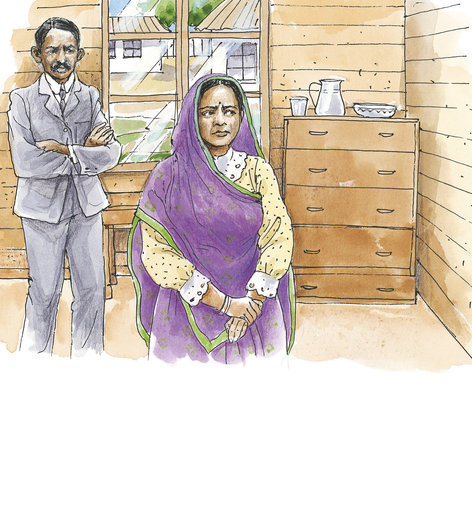
Now the mob surrounded their house and taunted Gandhiji, yelling at him to come out. Then the police managed to smuggle him out wearing the uniform of a constable. So when the white men forced their way inside, they only found the Rustomji family, Kasturba and the boys.
She must have been quite afraid. So it was quite a dramatic welcome to South Africa and any other woman would have immediately wanted to head back home. Not Kasturba!

Things improved after that. Gandhiji was becoming very successful as a lawyer and they lived in a large house near a beach. There are photographs of the family with Kasturba wearing an expensive embroidered sari and the boys and Gandhiji in western formals.
The problem was that Gandhiji was constantly experimenting with his life and things changed again and suddenly they all were shifted to a farm because he wanted to live very simply. At first there was the Phoenix Farm near Durban and then Tolstoy Farm near Johannesburg and soon, many people had joined them.
Here the rule was that all the work had to be done by the members of the farm. So they grew vegetables, milked the cows, cooked, washed and cleaned. Gandhiji even taught himself to bake bread, make marmalade, do carpentry and make shoes. It was very environment-friendly but also a lot of hard work. He also took the boys out of school and decided to teach them at home. It caused a lot of heartache to Kasturba and it also led to their eldest son Harilal rebelling against his father, as he could not accept such drastic changes. He would soon leave the family and return to India and never reconcile with Gandhiji.
Sometimes it got too much for poor Kasturba. She became very angry when Gandhiji said that everyone had to clean the toilets. She had a big fight with him, but as always, finally, she gave in. From now on, her life became an endless stretch of working and caring for people that continued in India when he set up the Sabarmati Ashram in Ahmedabad. She lived so simply and had such few possessions, that her travelling bag was even smaller than her husband’s. She had become a true Satyagrahi.

This was the time that Gandhiji started a battle for the rights of Indians in South Africa and founded the Natal Indian Congress Party. They held protest marches where many people were arrested and jailed, including Gandhiji.
In prison they were starved and whipped and he was kept in solitary confinement in a dark cell. The protesters were released when there was criticism in newspapers in India and Britain.
All the while Kasturba managed the farm alone. She now had four sons – Harilal, Manilal, Ramdas and Devdas. The next protest was against a new law that said that only Christian marriages were legal. Kasturba was furious. She had married according to proper religious rites and who were these white men to say it was not legal? Now she and her women friends were going to march in protest!
This time it was a bigger Satyagraha with thousands of men and women joining the protests and facing the police. They were hit with sticks by the police and some people even died. Kasturba led a team of women into the province of Transvaal and was arrested and sent to prison. She was kept in a filthy cell in the company of criminals for three months and when she was released she fell very ill. Finally the law was repealed.

Kasturba was now a freedom fighter. In 1915 the Gandhi family left for India, to greater challenges and a bigger struggle.
Gandhi Fashions
As Gandhiji experimented constantly with his lifestyle, it also included changing the clothes he wore. If you study their photographs, you can spot the changes in the fashions adopted by the Gandhi family over the years. In London, he wore suits, fancy cravats and top hats. When he came back to India, he insisted that Kasturba and the boys go for long walks, have oatmeal porridge and cocoa for breakfast and wear socks and shoes. After a while, they all refused to wear the socks as it made their feet stink!
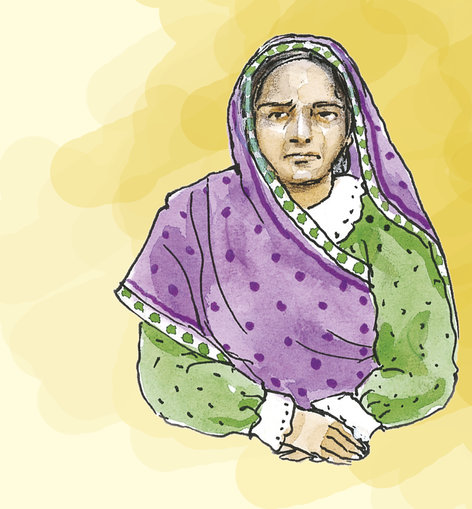
In South Africa, in the beginning he wore western formals and Kasturba wore Parsi saris. Then as they headed back to India, he decided to dress like an Indian farmer in dhoti, kurta and a huge turban teetering on top of his head and Kasturba was now clad in a simple cotton sari.
It was not easy for a beautiful young woman like her to give up wearing pretty clothes and jewellery and perhaps that is why she rarely smiles in the photographs!
Coming home
Finally Kasturba was home, but she knew Gandhiji had come back to India with plans to join the freedom struggle. So she was prepared for more hardships. By now, the news of his achievements in South Africa had reached India and he was given a hero’s welcome at the docks of Bombay (now Mumbai). They were welcomed with garlands, taken out in a procession and the Indian National Congress gave a big reception in their honour. At the reception, surrounded by Bombay’s high society, with the women clad in silks and jewels, a dignified Kasturba in a simple handloom sari, stood beside her husband waiting to see what would happen next.
Gandhiji had been away from India for nearly twenty years and the Congress leader Gopal Krishna Gokhale suggested that he should learn about his country first. So he began a long journey of discovery by train and Kasturba went with him. They travelled in crowded and dirty third class compartments and she found it all very difficult, but was amazed at how the poor people greeted them with love everywhere. All that these simple people knew was that here was a leader who was ready to listen to them, fight for them and was on their side. Gandhiji was becoming Mahatma Gandhi and he was now their beloved Bapu and Kasturba became Ba.
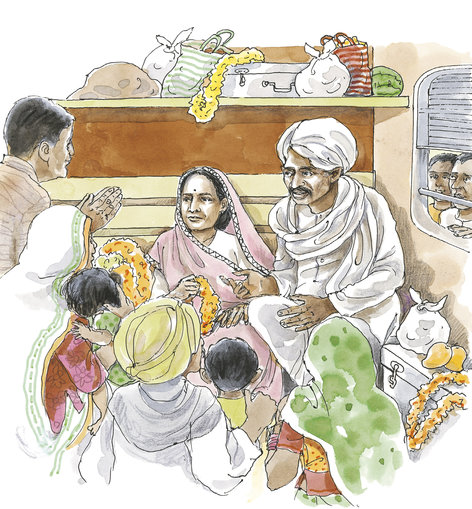
People in hundreds would be waiting for them at railway stations and would fill their compartment with flowers and fruits. At Shantiniketan, the poet Rabindranath Tagore welcomed them with music and dance.
Kasturba enjoyed her stay there among the gardens and mango orchards, where students sat under trees for their classes. It must have reminded her of Tolstoy Farm.
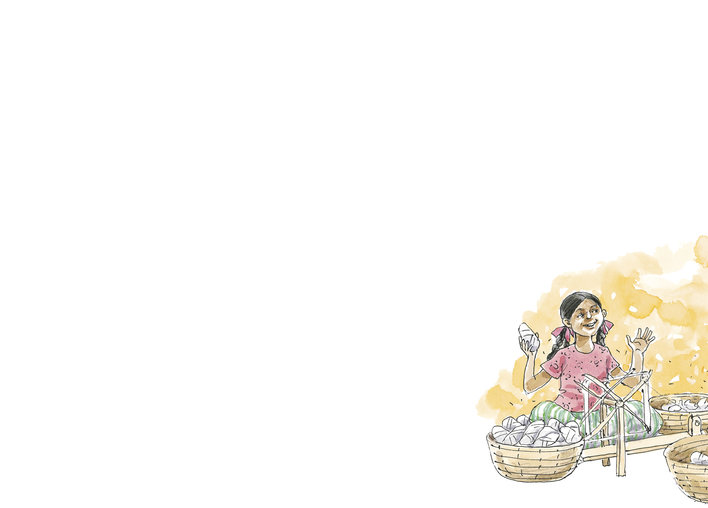
Gandhiji now started Sabarmati Ashram near Ahmedabad and this was Kasturba’s new home. Many people joined the ashram. It had its own school and library. They grew their own fruits and vegetables and there were cow sheds. They all spun cotton thread on charkhas and weavers used them to make saris and dhotis.
Kasturba and the other women had to manage the kitchen. Gandhiji was often away and Sabarmati became his place of rest. When he was exhausted by the work of the freedom struggle, Kasturba was there to take care of him and help him revive his spirits.
The American journalist Louis Fischer, who wrote a wonderful biography of Gandhiji, watched her at Sabarmati and wrote, “At meals and prayers she sat slightly behind his left shoulder fanning him solicitously. She always looked at him; he rarely looked at her, yet he wanted her nearest to him and there appeared to be perfect understanding between them.”
She also ignored many of his rules. She would often feed sweets to the ashram children when Gandhiji wanted them to live on very boring vegetarian food cooked with little spices. He also had very strange theories about medicine. Once when his four year old grandson Arun had a fever, he ordered that he should not be fed anything for seven days. Soon the fever was gone and the little boy was crying for food. Kasturba glared at her husband and said firmly, “I’m not going to let the child starve!” and immediately fed some orange juice to the wailing Arun.
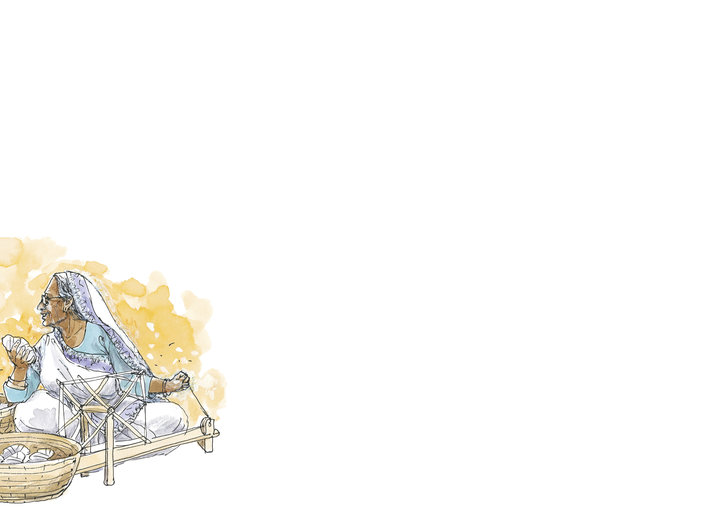
Over the years, after leading protests on her own and going to prison, she also became very independent. Once when she was very ill, she travelled by train to meet her doctor Sushila Nayar. At the railway station, Nayar was shocked to find that Kasturba had travelled alone. When she protested, Kasturba laughed and said, “What is the problem? They put me on the train in the care of the passengers and you are here to receive me.”
Gandhiji and Kasturba travelled together to Champaran in Bihar where he tried out his Satyagraha to help indigo farmers who were being exploited by white owners. At times his life was in danger as they moved from village to village talking to the people. She was shocked to see the poverty in the villages. A practical woman, Kasturba sat and talked to the women, and tried to make them understand the need for cleanliness, good nutrition and the benefits of educating their children.
Kasturba was a traditional woman who believed in the practices of Hindus and so she believed in the caste system. At the same time, Gandhiji was fighting the caste system and the practice of untouchability, which he knew was against humanity. When he invited a Harijan, Dudabhai, his wife Danibehn, and their daughter Lakshmi to come and live at Sabarmati, Kasturba refused to let Danibehn enter the ashram kitchen. Many other members of the ashram including Gandhiji’s nephew, Maganlal, left. It took Gandhiji a while to make Kasturba understand and she gave in when he said he was going to adopt Lakshmi.
Kasturba’s Family
Gandhiji was a very strict father and he was very tough on his sons. He insisted on educating them at home and they had to live a very simple, disciplined life. His eldest son Harilal could not accept these rules and drifted away from the family and it caused a lot of heartache to poor Kasturba.
Harilal led a very troubled life, even criticising his father in public and she tried and failed to bring him back into the family. When Harilal’s wife died, Kasturba brought his four children to Sabarmati and she brought them up. As Gandhiji had not wanted it, none of her sons joined politics after India became independent.
In the winter of 1930, Gandhiji and his followers began to prepare for the Dandi March. The plan was very clever. The Salt Law said that no Indian was allowed to make or sell salt and everyone, even the poorest Indian, had to pay a salt tax. They were going to march from Sabarmati to the seashore at Dandi, pick up salt and sell it.
Gandhiji and seventy eight young men would walk for twenty five days, stopping at villages on the way. Then people all across the country would also break the law by making and selling salt. Thousands were to be arrested. Markets, law courts, schools, colleges and offices would close and the whole country would come to a halt. It was a true Satyagraha, a peaceful, non-violent protest and a very clever way to make the British government listen.
The lives of the marchers were in danger as they could be beaten, shot at or arrested. Kasturba knew that. So on the morning of 12th March 1930, as the marchers prepared to leave Sabarmati, they discovered that Kasturba had decided to join them. The march promptly came to a halt as Gandhiji persuaded her to stay back. For Kasturba, her place was always beside her husband and at the age of sixty, she was not afraid of marching for weeks on rough country roads and facing police batons. After the march, Gandhiji was sent to prison and she began to visit the hospitals to help the people who had been injured in the protests.
In 1942, the Congress party passed a resolution asking the British to quit India. All the Congress leaders were arrested the same night and sent to prison. Gandhiji was taken to the Aga Khan Palace near Pune and Kasturba requested the government to allow her to join him. When they refused, she threatened to address a public gathering and lead a march. They had no choice but to allow her to stay with Gandhiji.
Kasturba and Gandhiji shared this imprisonment for two long years. There were other leaders with them, like Gandhiji’s secretary Mahadev Desai, Sarojini Naidu and Mira Behn. Kasturba found it very difficult being separated from her family, especially her grandchildren and missed them all the time. She wanted Gandhiji to do something about it and once asked him, “Why do you ask the British to quit India? Our country is vast, we can all live here. Let them stay if they like, but tell them to stay as our brothers.”
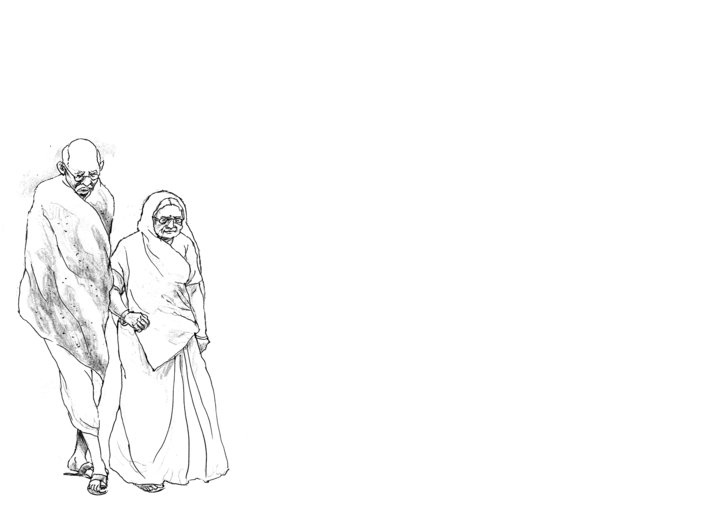
An amused Gandhiji agreed that he had no problem with the English staying in India as citizens of a free country.
They would take long walks in the garden and even at this ripe old age, he was still trying to educate her. While teaching her geography he was trying to make her remember the names of the capital cities of countries and she kept mixing them up!
The stay at the Aga Khan Palace was a very tragic time for Gandhiji. First his old friend and comrade, Mahadev Desai died, and then in 1944, Kasturba fell seriously ill with a lung infection. Many kinds of treatments were tried but nothing worked. But thankfully, her sons were allowed to visit her. Gandhiji spent all his time beside her, caring for her and praying. On 22nd February, 1944 Kasturba Gandhi passed away with her head in Gandhiji’s lap. As she had requested, she was cremated in a sari woven with the thread spun by him. Gandhiji took a long time to recover from her death. They had been companions for sixty two years and as Mira Behn wrote in a letter, “With Ba, it was as if a part of Bapu departed.” Kasturba had fought and sacrificed so much and it is unfortunate that she did not live to see India become free.
On the grounds of the Aga Khan Palace, there are two memorials to the martyrs of our freedom struggle. Two persons who were the closest to Mahatma Gandhi, one is of Mahadev Desai and the other of Ba, Kasturba Gandhi.