How Heavy Is Heavy?
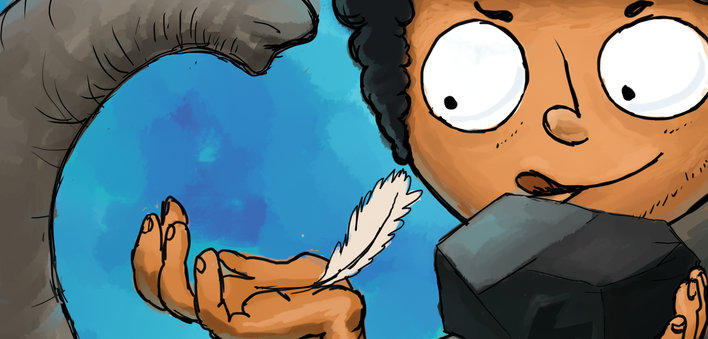
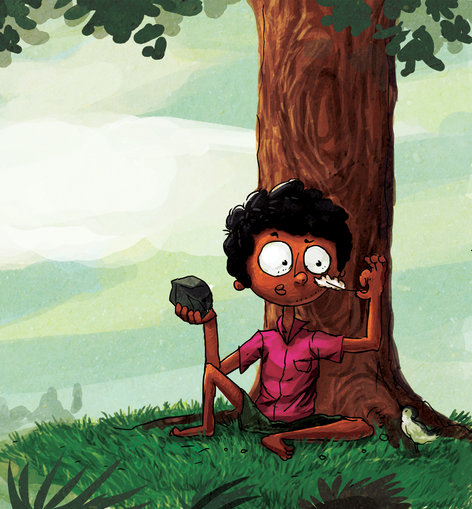
Here is a feather and here is a stone.
Which is heavy and which is light?
What a silly question, you say. The stone is heavy and the feather is light, of course!
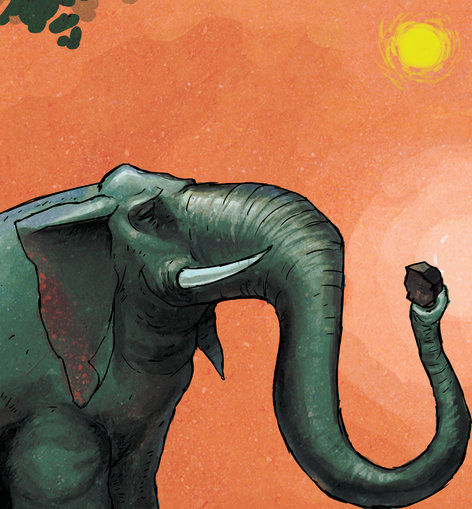
Here is an elephant and here is the same stone.
Which is heavy and which is light?
What an absurd question, you say. The elephant is heavy and the stone is light, of course!
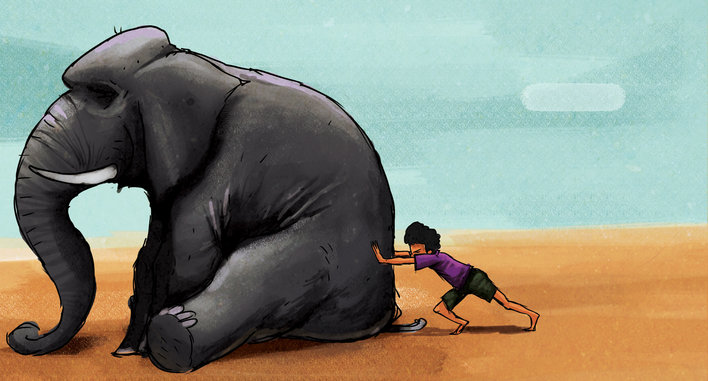
Wait, didn’t you just say that the stone was heavy?
Yes, that was because it was heavier than the feather! But it is MUCH lighter than an elephant.

So maybe it is best not to say, “This is heavy,” or “This is light.”
Maybe it is better to ask: Is this heaviER than something else? Is this lightER than something else?

But what about the question - How heavy is this stone? Can we find the answer without talking about elephants or feathers? Yes, we can!
We can compare the weight of the stone to something called a kilogram*. A kilogram is used to find out how heavy or light a thing is.
A good question to ask then is - How much heavier than a kilogram is the stone? Or How much lighter than a kilogram is our stone?
*A ‘kilogram’ is the same thing as ‘kilo’ or ‘kg’. From now on, let’s say kg when we mean kilogram – it’s shorter.
But how heavy is a kg? Let's see.
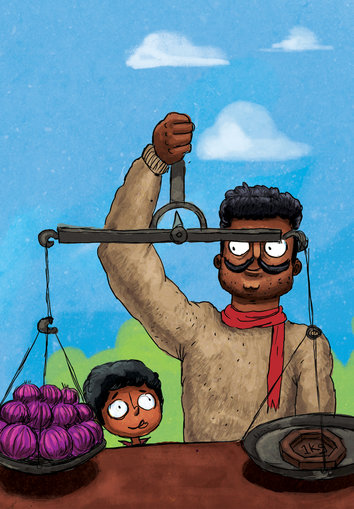
You tell the vegetable vendor at the market, “Please give me 1 kg of onions."
The vendor puts a 1-kg weight on one side of the scale and piles onions on the other side until the two sides are level.
You count the onions on the scale. There are 13 onions. That tells you that 1 kg is as heavy as 13 onions.
But this is not entirely reliable. When the onions are small, 1 kg may be as heavy as 16 onions. When they are big, 1 kg may be only as heavy as 10 onions.
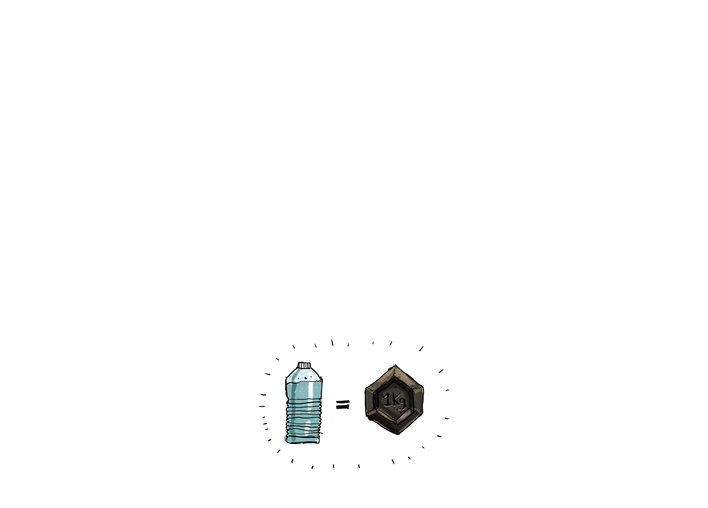
We need to find something that weighs EXACTLY 1 kg.
I know! A 1-litre bottle of water weighs exactly 1 kg.
Now that we know this, let’s get back to our elephant. How heavy is an elephant in kgs?
Around 4,000 kg! So if you could get an elephant to sit on one side of a pair of scales, you would need a whopping 4,000 1-litre water bottles to balance its weight.
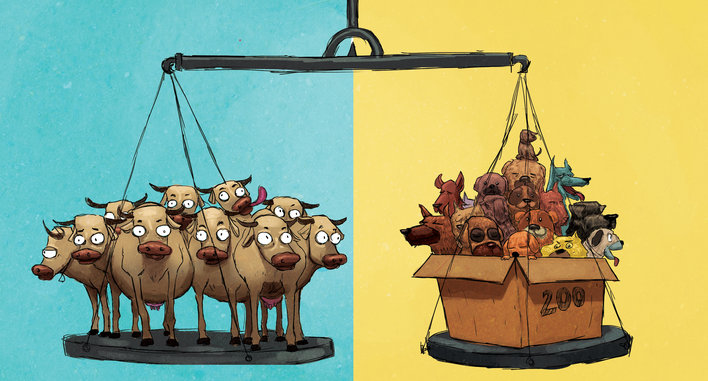
4,000 kg is also the weight of 10 cows, or 200 medium-sized dogs.

Now that we have talked about some Very Heavy things, let us ask a bolder question - How heavy is the Earth?
The Earth, including all the creatures in it, weighs ...
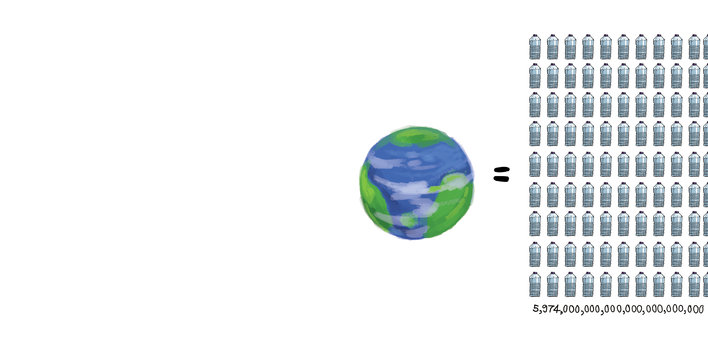
... 5,974,000,000,000,000,000,000,000 kgs!
Or as much as 5,974,000,000,000,000,000,000,000 1-litre water bottles! That is very, VERY heavy!
Even if we used all the water on earth, there would not be enough to fill them all.
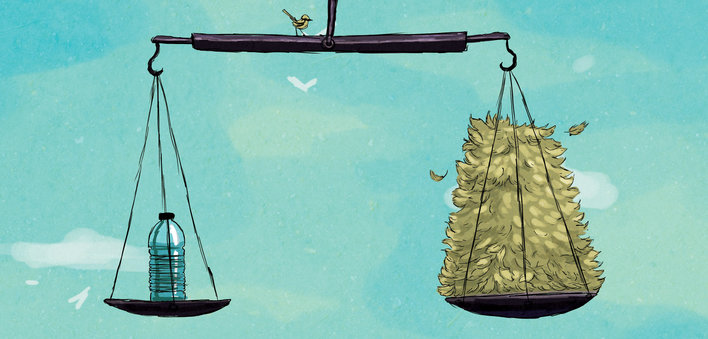
Uff. This conversation is getting too heavy. Let us bring the feather back. How light is a feather? It is roughly 2,00,000 times lighter than a kg. If you put a 1-litre water bottle on one side of a scale, you would have to put about 2,00,000 feathers on the other side to make the two sides balance.

A raindrop is about 30,000 times lighter than a kg. Roughly 30,000 raindrops will weigh as much as a 1-litre bottle of water. A grain of salt is about 2,00,00,000 (two crore) times lighter than a kg. That is very, VERY light!
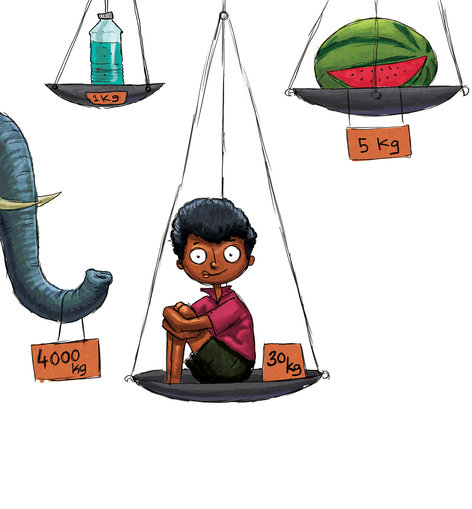
Phew! You must be feeling quite light-headed now. And your brain must be buzzing with questions. Questions like: How do we weigh a grain of sand? How on earth did people weigh the Earth? Who decided the weight of 1 kg?
Bet you can’t wait to find the answers when you grow up!
Guesstimate It
Perfect for both classroom and home, this activity will help children get a feel for weight estimation.
You will need: - A pair of scales with two pans and weights* - A 1-litre bottle filled with water - Objects of different weights found in school or at home - a small bag of vegetables, a book, a duster, a packet of rice, and so on.
What to do: 1. Pass the bottle of water around the class asking each child to feel its weight. This gives them a sense of how heavy a kg is.
2. Pass the other objects around one by one, asking each child if the object feels heavier or lighter than 1 kg. Also ask each to guess the actual weight of each object and write it on the board.
3. Weigh each object on the scales, first against the 1-litre bottle (to answer the question 'Is it heavier or lighter than 1 kg?') and then against the actual weights, to see how good each child's guesstimate was.
*If it is difficult to find a pair of scales, invite the local vegetable vendor to your classroom (with his scales!). In Step 2 above, pass bags of vegetables (of different weights) around.

Think About It
1. On page 8, you found out that a 1-litre bottle of water weighs exactly 1 kg. How many water bottles would add up to YOUR weight?
2. You now know that an average-sized Indian elephant weighs about 4,000 kgs. If we told you that a train loaded with passengers weighs the same as 250 elephants, can you find out how many kgs it weighs?
3. Which is heavier–1 kg of iron or 1 kg of cotton wool?
Answers:
2. 10,00,000 (ten lakh) kgs (250 x 4000 = 10,00,000)
3. They are both EQUALLY heavy because both weigh the same–1 kg! But 1 kg of cotton wool would take up a LOT more space than 1 kg of iron.