How Far is Far?
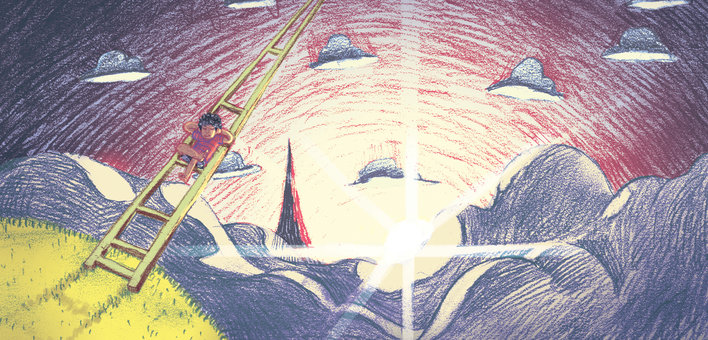
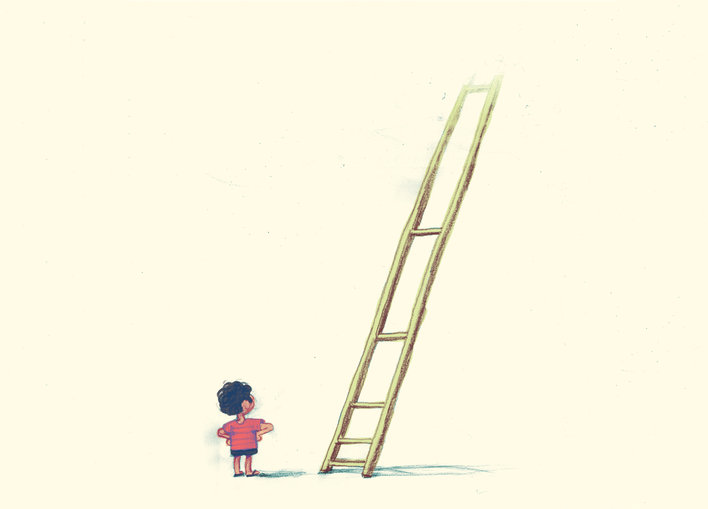
Today, we will climb up a ladder together. It is a rather unusual ladder. In this ladder, the distance between the rungs gets bigger and BIGGER and BIGGER as you climb up the steps, growing 10 times at each step. Sometimes we will climb one step at a time and at other times we will skip many steps at one go.
The funny thing is that we are not even sure which the last step is or whether the steps go on forever. Let the exciting journey begin!
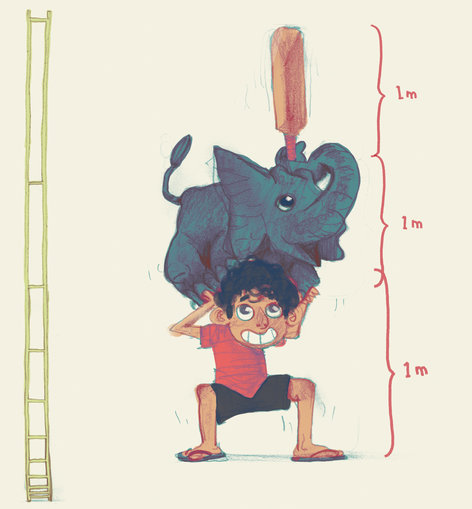
Step 0: 1 metre
What do a five year old boy, a cricket bat and a newborn baby elephant have in common?
All of them have a height of about 1 metre (or 1m for short)! It would be awkward to say that the ceiling of a room is 3 baby elephants high. So we make the sensible choice of saying that the height of the ceiling is 3 metres.
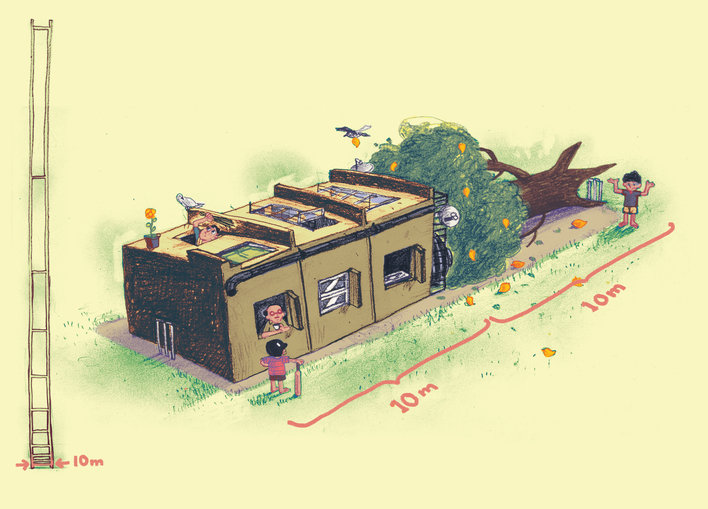
Step 1: 10 metres
Now that you have a feel for the size of one metre, we are ready to climb to the next step of our ladder, at 10 metres. A three storey building or a mango tree is roughly 10 metres high. A cricket pitch is about twice that length.
Can you think of other objects that are about 10 m long or high?
Step 2: 100 metres
Have you noticed that with every step we add a zero to the right of the number we had before and the step number matches the number of zeroes? Keep track of that as we climb along.
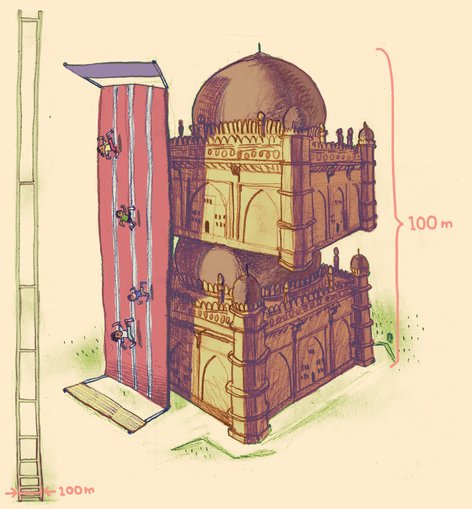
If you have run the 100m race on school sports day, or watched sprinters do it on TV, you know exactly how far that is. Now imagine if the 100m track stood up! That would be about the height of two Gol Gumbaz*-es.
*The Gol Gumbaz in Bijapur, Karnataka, is the tomb of Mohammed Adil Shah. When it was built in 1656, it had the largest dome in the world. It held the record until 1881!
Step 3: 1000 metres
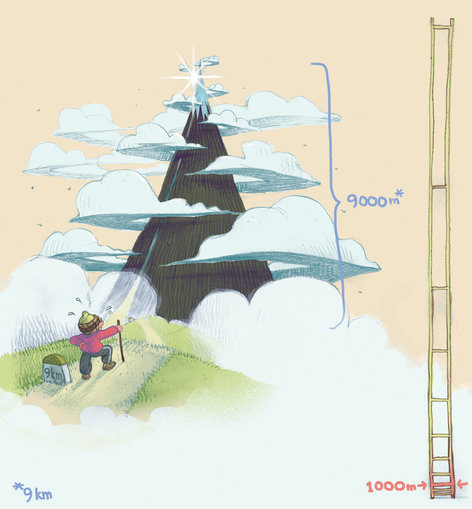
Thousand metres has a special name - it is called 1 kilometre or 1 km.
You would cover this distance if you ran the 100 metre race 10 times - phew! You would need to climb about 9 km to reach the top of Mount Everest.
Step 6: 10,00,000 metres
Now let's skip 2 steps and go to step 6, which has six zeroes to the right of 1.
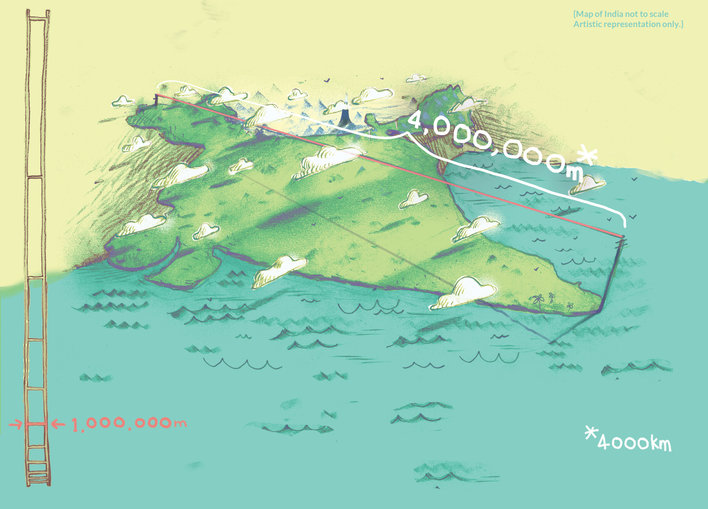
The distance from the northern tip of India in Kashmir to the southern tip at Kanyakumari is about 4 times this distance, or 4 times 10,00,000 m, or 40,00,000 m. Because 40,00,000 m is quite a mouthful, we usually say 4000 km, which is the same thing.
Step 8: 10,00,00,000 metres
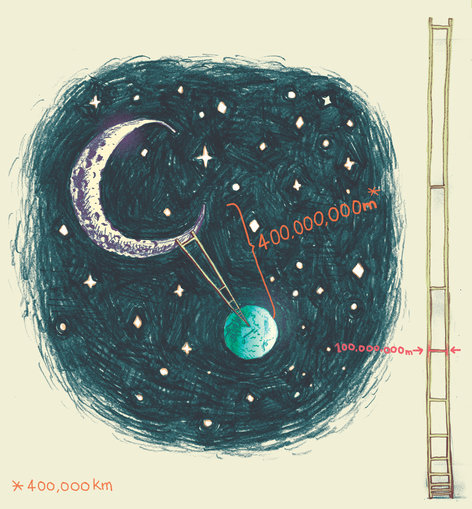
How far away is the bright, beautiful moon?
It is right there on the 8th step of our distance ladder at about 4 times 10,00,00,000 m, or 4,00,000 km away from the earth!
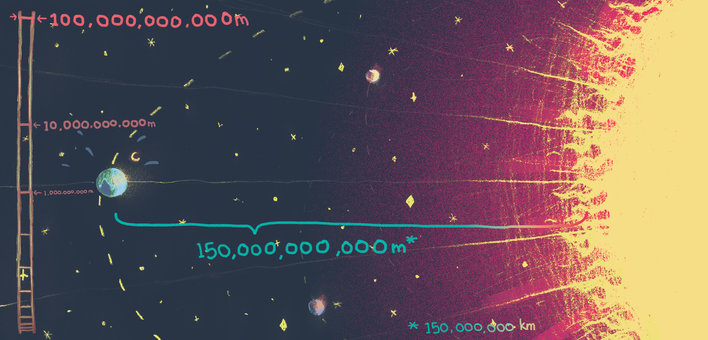
Step 11: 1,00,00,00,00,000 metres
Let us skip two more steps and race to the blazing hot Sun. How far away is it? It is about 10,00,00,000 km PLUS another 5,00,00,000 km. That is very, VERY far away indeed! But the far, far away sun still lights up the world and makes us sweat in summer. Amazing, isn't it?
Last Step???
Is there a last step on the ladder? We don’t know yet! But with powerful telescopes, scientists have been able to see way beyond the sun. The farthest object that they have been able to spot is on the 26th step, 10,00,00,00,00,00,00,00,00,00,00,00,000 m away! That is SERIOUSLY FAR!
Maybe when you grow up, you can discover something even further away, on the 28th or 29th step. Isn’t that an exciting thought?
Fun with Measuring
The following activity done in a classroom setting is a great way to give children a feel for large distances and can engage the children either in a single group, or in teams.
1. Ask the children to cut long strips (each about an inch wide) from old newspapers.
2. Ask them to stick the strips end to end with tape or glue to make longer strips, until they get a strip that is 1 metre long (they can use a measuring tape for this).
3. Now ask the children to use this 1 m long strip as a measure and make 10 similar strips and stick them end to end to make a 10 m long strip. They can lie down next to this strip, head to head and feet to feet, and see how many of them it takes to make 10 m.
4. They can then stick ten 10 m strips together to make a 100 m strip that goes round the classroom many times.
5. What about a 1 km strip? How many times does that go around the classroom? Which team was able to create a 1 km long strip fastest?
Notes for Parents & Teachers: - When writing down big numbers with lots of zeroes after the 1, it is very easy for children - and adults! - to make mistakes. That is why the 'Powers of 10' notation is such a useful thing. Through this book, children can be taught how to use it - all they need to do is to count the number of zeroes to the right of the 1, and write that number as a superscript of 10. For instance, 1000, which has 3 zeroes after the 1, can be written as 103. And 10000000 (7 zeroes after the 1), can be compactly written as 107. Simple!
- In this book, we stopped our 'How far is far?' game at the Sun. If you want to take the game further, you may want to bring in the nearest star beyond the Sun, Proxima Centauri, which is 1016 m away from the Sun. Or the distance from one end of the Milky Way to another, which is 1,00,00,00,00,00,00,00,00,00,000 (or 1021) m!
- One thing you should know is that the distances that are given in the book are approximate, not exactly accurate. For example, 3984 km is given as 4000 km. This is not 'unscientific'. Rough estimates are very useful in science! Maybe you can do an activity with the kids to emphasize this. Is the length of a pencil closer to 101 cm or 102 cms? Is the weight of the school bus closer to 103 kgs or 104 kgs? Let the children come up with their own questions for their classmates too.