# What Causes the Seasons?
- Source: NASA Space Place (spaceplace.nasa.gov), Public domain, NASA Space Place
- Reading level: Grades 3 and 4
- Subjects: Space, Nature
- Topics: earth, earth's, seasons, sun's, axis, northern
- Length: 599 words, about 4 min
- Published: 2025-07-29
- Original:
- Page:
- Open in Sprouts:
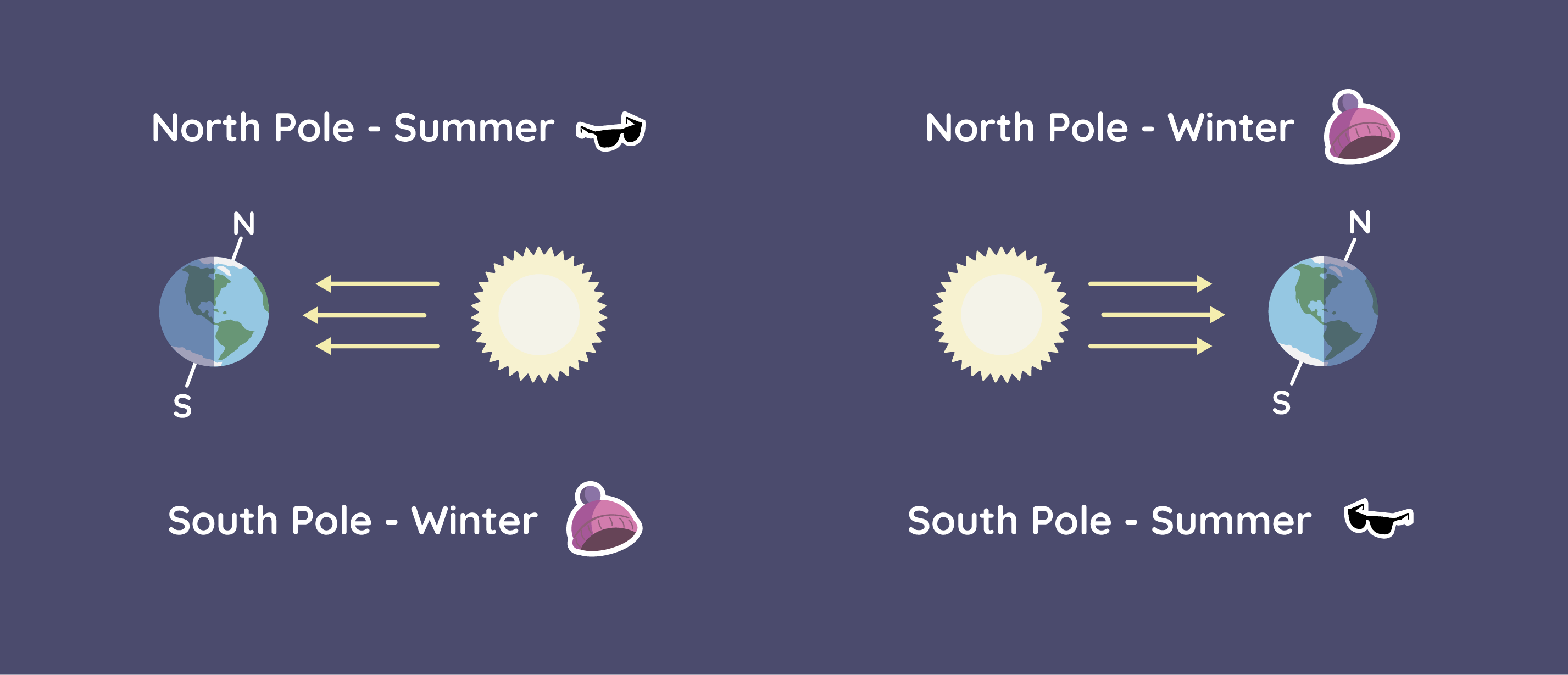
Earth’s tilted axis creates seasons. When the North Pole is pointing toward the sun, there is more sunlight reaching the northern half of the planet, leading to summer. When it is pointing away, there is less sunlight, leading to winter. As the poles are on opposite ends of Earth, they experience opposite timing for the seasons. Credit: NASA/JPL-Caltech
## It's all about Earth's tilt!
Many people believe that Earth is closer to the Sun in the summer and that is why it is hotter. And, likewise, they think Earth is farthest from the Sun in the winter.
Although this idea makes sense, it is incorrect.
It is true that Earth's orbit is not a perfect circle. It is a bit lop-sided. During part of the year, Earth is closer to the Sun than at other times. However, in the Northern Hemisphere, we are having winter when Earth is closest to the Sun and summer when it is farthest away! Compared with how far away the Sun is, this change in Earth's distance throughout the year does not make much difference to our weather.
There is a different reason for Earth's seasons.
Earth's axis is an imaginary pole going right through the center of Earth from "top" to "bottom." Earth spins around this pole, making one complete turn each day. That is why we have day and night, and why every part of Earth's surface gets some of each.
Earth has seasons because its axis doesn't stand up straight.
## But what caused Earth to tilt?
Long, long ago, when Earth was young, it is thought that something big hit Earth and knocked it off-kilter. So instead of rotating with its axis straight up and down, it leans over a bit.
By the way, that big thing that hit Earth is called Theia. It also blasted a big hole in the surface. That big hit sent a huge amount of dust and rubble into orbit. Most scientists think that that rubble, in time, became our Moon.
As Earth orbits the Sun, its tilted axis always points in the same direction. So, throughout the year, different parts of Earth get the Sun’s direct rays.
Sometimes it is the North Pole tilting toward the Sun (around June) and sometimes it is the South Pole tilting toward the Sun (around December).
It is summer in June in the Northern Hemisphere because the Sun's rays hit that part of Earth more directly than at any other time of the year. It is winter in December in the Northern Hemisphere, because that is when it is the South Pole's turn to be tilted toward the Sun.
## Earth's lopsided orbit
Earth's perihelion (point closest to Sun) = 91,400,000 miles from Sun
Earth's aphelion (point farthest from Sun) = 94,500,000 miles from Sun
While that is a difference of over 3 million miles, relative to the entire distance, it isn’t much.
And, believe it or not, aphelion (when Earth is farthest from the Sun) occurs in July, and perihelion (when we are closest) occurs in January. For those of us who live in the Northern Hemisphere where it's summer in July and winter in January, that seems backwards, doesn't it? That just goes to prove that Earth's distance from the Sun is not the cause of the seasons.
### Related Resources for Educators
Seasons (Educator Guide to go with Seasons Spotlite video)
Seasons (Nearpod Lesson to go with Seasons Spotlite video)
Our World: Sun's Position
Sun's Position (Educator Guide to go with Sun's Position Spotlite video)
Sun's Position (Nearpod Lesson to go with Sun's Position Spotlite video)
## Picture credits
- NASA Space Place, US government page; this picture's owner not checked ()
- NASA Space Place, US government page; this picture's owner not checked ()
- NASA Space Place, US government page; this picture's owner not checked ()
- NASA Space Place, US government page; this picture's owner not checked ()