How Many Moons Does Each Planet Have?
Watch this video about other moons in our solar system! Voiceover provided by NASA scientist Dr. Moogega Stricker. Click here to download this video (1920x1080, 56 MB, video/mp4).
A lot of moons or no moons at all?
We on Earth have just one moon, but some planets have dozens of them. Others don’t have any. Which planets have moons, and which don’t?
Let’s go in order from the Sun.
Mercury and Venus
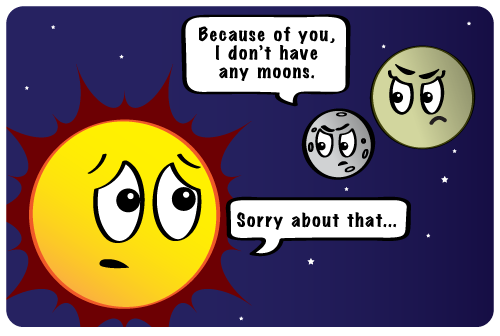
Because Mercury is so close to the Sun and its gravity, it wouldn’t be able to hold on to its own moon. Any moon would most likely crash into Mercury or maybe go into orbit around the Sun and eventually get pulled into it.
Why Venus doesn’t have a moon is a mystery for scientists to solve.
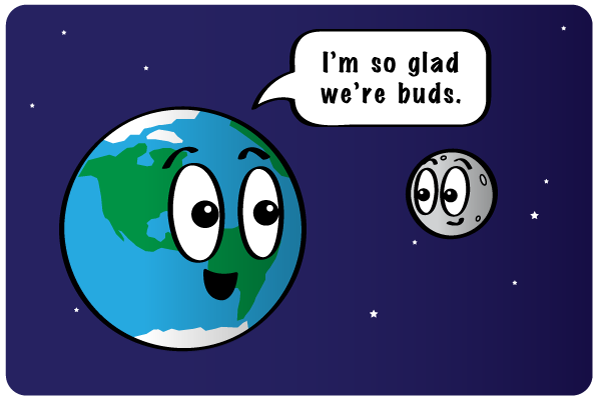
Earth (That's us!)
Mars
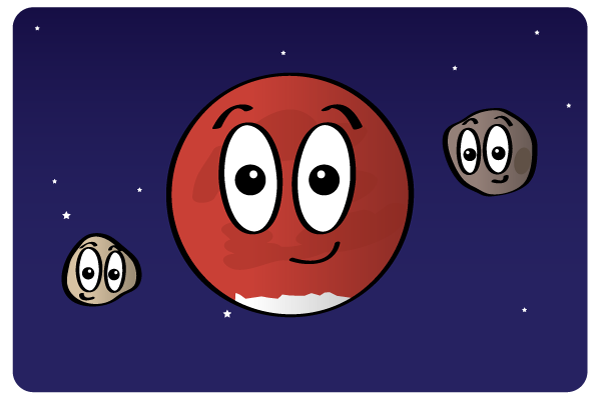
Mars has two moons. Their names are Phobos and Deimos. Don’t you wish our moon had a cool name like that?
Jupiter
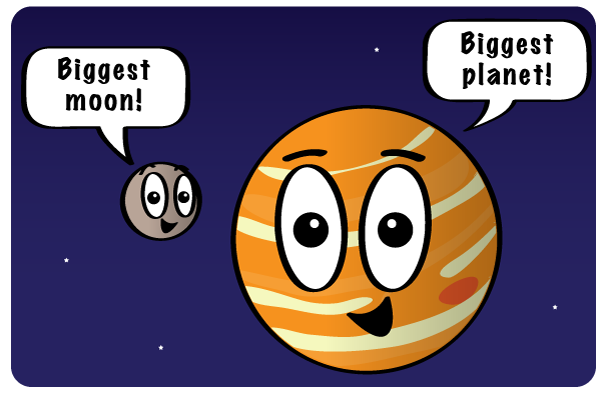
Next are the giant outer planets. They have lots of moons. Jupiter, for instance, has 115 known moons (as of April 2026)!
The most well-known of Jupiter's moons are Io (pronounced eye-oh), Europa, and Callisto. Jupiter also has the biggest moon in our solar system, Ganymede.
These moons are so big you can see them with just a pair of binoculars.
Saturn
As of June 2026, Saturn has 293 moons. And that’s not counting Saturn’s beautiful rings!
Saturn’s moons have great names like Mimas, Enceladus, and Tethys. One of these moons, named Titan, even has its own atmosphere, which is very unusual for a moon.
Uranus and Neptune
Uranus has 29 known moons. Some of them are made partly of ice.
Lastly, Neptune has 16 known moons. One of Neptune's moons, Triton, is as big as dwarf planet Pluto.
To learn more about the moons in our solar system, visit the NASA Solar System Exploration moons page.