# All About Mars
- Source: NASA Space Place (spaceplace.nasa.gov), Public domain, NASA Space Place
- Reading level: Grades 3 and 4
- Subjects: Space, Science
- Topics: mars, credit, earth, nasa, planet, rover
- Length: 711 words, about 5 min
- Published: 2024-01-25
- Original:
- Page:
- Open in Sprouts:
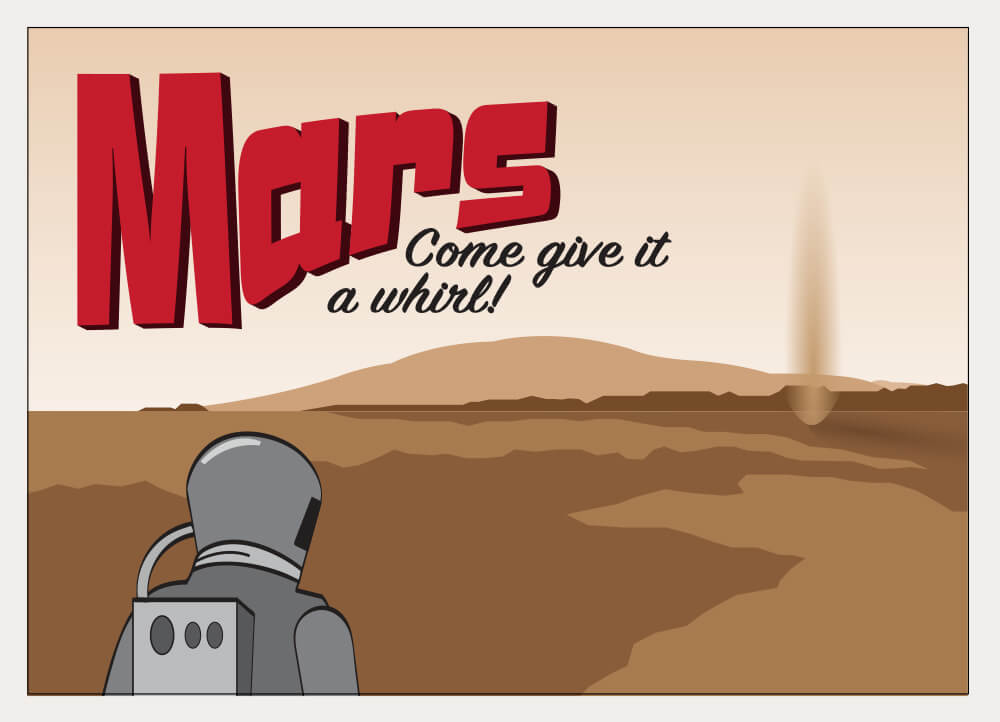
Mars’ atmosphere has clouds and wind just like Earth. Sometimes the wind blows the red dust into a dust storm. Spiraling dust storms–called dust devils–can look like tornadoes. Mars’ large storms sometimes cover the entire planet. Credit: NASA/JPL-Caltech
Mars is a cold desert world. The average temperature on Mars is minus 85 degrees Fahrenheit – way below freezing. It is half the size of Earth. Mars is sometimes called the Red Planet. It's red because of rusty iron in the ground.
Like Earth, Mars has seasons, polar ice caps, volcanoes, canyons, and weather. It has a very thin atmosphere made mostly of carbon dioxide, nitrogen, and argon. People would not be able to breathe the air on Mars.
There are signs of ancient floods on Mars, but now water mostly exists in icy dirt and thin clouds. On some Martian hillsides, there is evidence of liquid salty water in the ground.
Scientists want to know if Mars may have had living things in the past. They also want to know if Mars could support life now or in the future.

Credit: NASA/JPL-Caltech
## Structure and Surface
- Mars is a terrestrial planet. It is small and rocky.
- Mars has a thin atmosphere.
- Mars has an active atmosphere, but the surface of the planet is not active. Its volcanoes are dead.
## Time on Mars
- One day on Mars lasts 24.6 hours. It is just a little longer than a day on Earth.
- One year on Mars is 687 Earth days. It is almost twice as long as one year on Earth.
## Mars’ Neighbors
- Mars has two moons. Their names are Phobos and Deimos.
- Mars is the fourth planet from the Sun. That means Earth and Jupiter are Mars’ neighboring planets.
## Quick History
- Mars has been known since ancient times because it can be seen without advanced telescopes.
- There was even a flying helicopter on Mars. Seriously! The Mars Helicopter, Ingenuity, successfully tested powered, controlled flight on another world for the first time. It hitched a ride to Mars on the Perseverance rover and worked with the rover to explore Mars. Ingenuity was designed as a tech demo expected to fly no more than five times over 30 days. It ended its mission in early 2024 having completed 72 flights in just under three years. Thanks Ingenuity!
- Several missions have orbited, landed on, or roved around on Mars: InSight,MAVEN,Mars Reconnaissance Orbiter, andmany more! Mars is the only planet we have sent rovers to. They drive around Mars, taking pictures and measurements. Learn more about them and what they have discovered by clicking the pictures below!
## Mars Rovers
Perseverance
Curiosity
Spirit and Opportunity
Sojourner
## What does Mars look like?
This infographic uses composite orbiter images and an outline of the United States to show the scale of the Valles Marineris (a canyon system more than 2,000 miles long!). Swipe left and right to see how big this canyon system is compared to the United States. Credit: NASA/JPL-Caltech
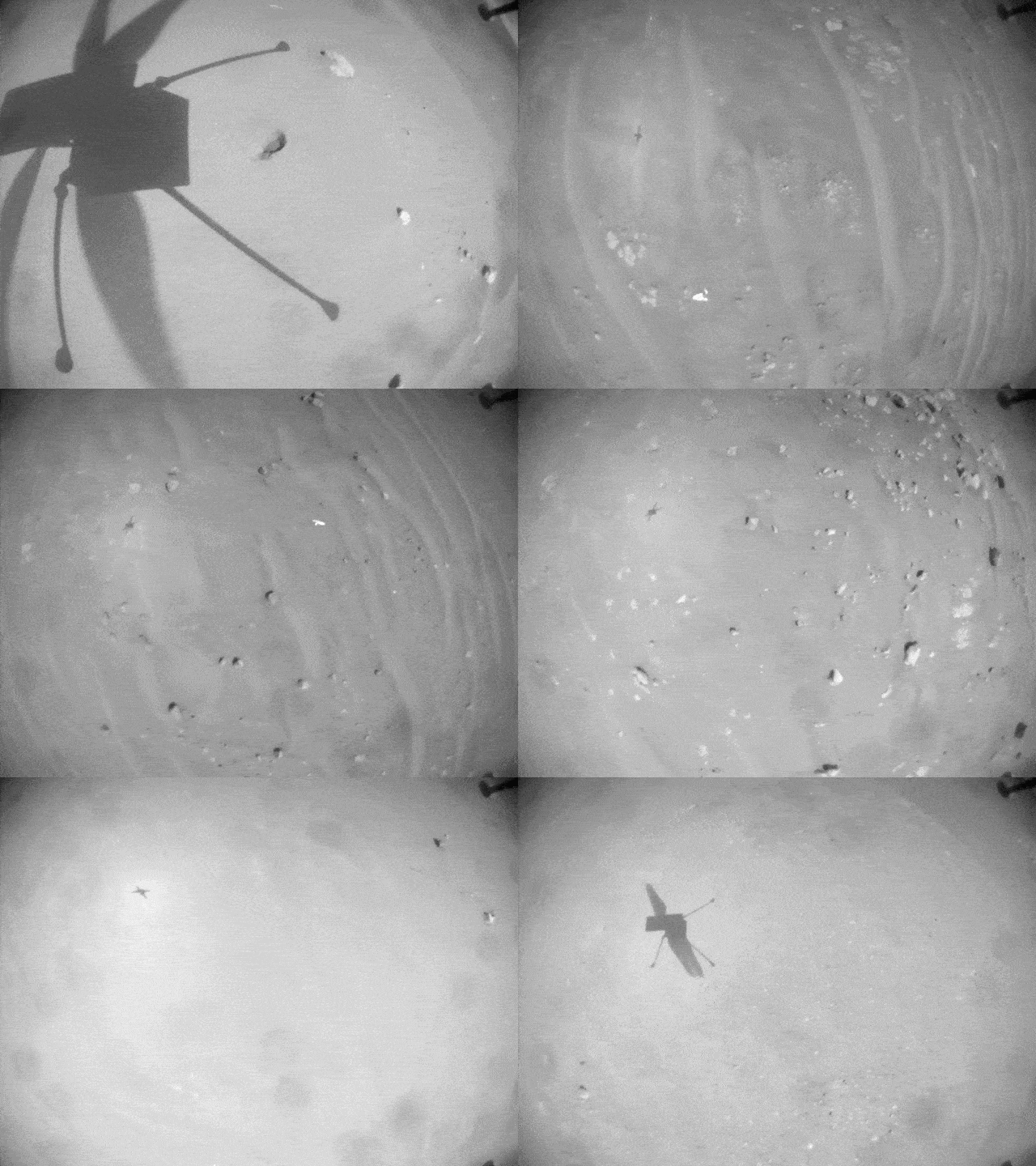
This animated GIF was created using footage taken by NASA’s Ingenuity Mars Helicopter during its 25th flight on April 8, 2022. Credit: NASA/JPL-Caltech
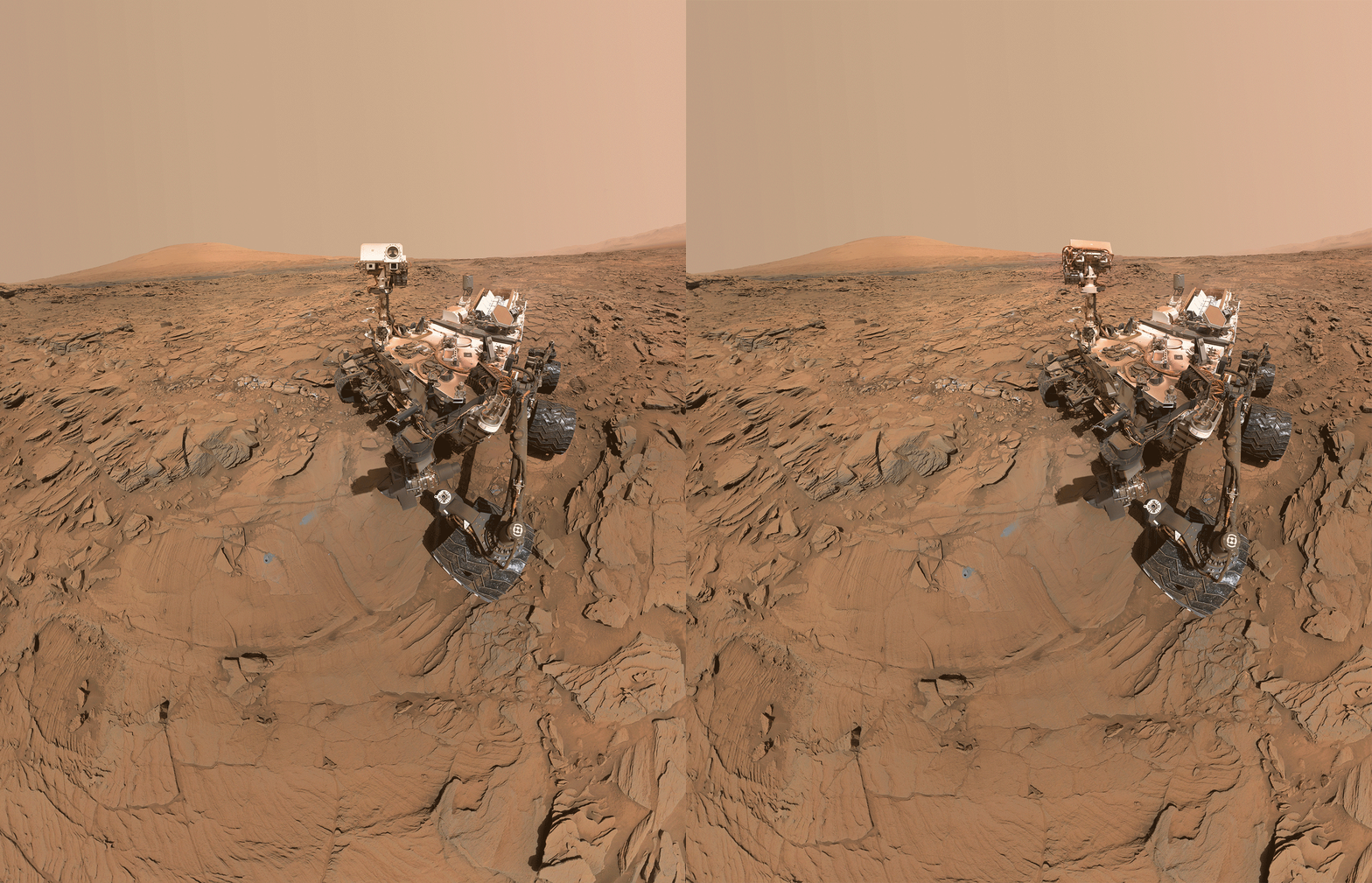
This animated image blinks two versions of a May 11, 2016, selfie of NASA's Curiosity Mars rover at a drilled sample site called "Okoruso." In one version, cameras atop the rover's mast face the arm-mounted camera taking the portrait. In the other, they face away. Credit: NASA/JPL-Caltech/MSSS
NASA's Curiosity Mars rover used its black-and-white navigation cameras to capture panoramas at two times of day on April 8, 2023. Credit: NASA/JPL-Caltech
## Mars Games
Explore Mars!
## Mars Activities
Make a Mask
Coloring Pages
Scavenger Hunt
## Picture credits
- NASA/JPL-Caltech, Public domain (US government work) ()
- NASA/JPL-Caltech, Public domain (US government work) ()
- NASA/JPL-Caltech, Public domain (US government work) ()
- NASA/JPL-Caltech, Public domain (US government work) ()
- NASA/JPL-Caltech, Public domain (US government work) ()
- NASA/JPL-Caltech, Public domain (US government work) ()
- NASA/JPL-Caltech, Public domain (US government work) ()
- NASA/JPL-Caltech/MSSS, not established ()
- NASA Space Place, US government page; this picture's owner not checked ()
- NASA Space Place, US government page; this picture's owner not checked ()
- NASA Space Place, US government page; this picture's owner not checked ()