Leonardo da Vinci
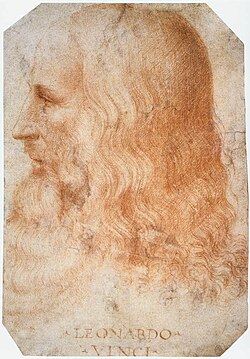
Leonardo Da Vinci (15 April 1452 – 2 May 1519) was an Italian polymath who lived during the Renaissance. He is famous for his paintings. He was also a scientist, mathematician, engineer, inventor, anatomist, sculptor, architect, botanist, musician, and writer. Leonardo wanted to know everything about nature, and wanted to know how everything worked. He was very good at studying, as well as designing and making all sorts of inventions.
The art historian Helen Gardner said that no one has ever been quite like him because he was interested in so many things that he seems to have had the mind of a giant, and yet what he was like as a person is still a mystery.
Leonardo was born in Vinci, a small town near Florence, Italy. He was trained to be an artist by the sculptor and painter Verrocchio. He spent most of his life working for rich Italian noblemen. In his last years, he lived in an expensive home given to him by the King of France.
Two of his paintings are among the best-known in the world: the Mona Lisa and The Last Supper. He did many drawings. His best-known drawing is Vitruvian Man. Leonardo often thought of new inventions. He kept notebooks with notes and drawings of these ideas. Most of his inventions were never made. Some of his ideas were a helicopter, a tank, a calculator, a parachute, a robot, a telephone, evolution, and solar power.
Life
Childhood, 1452–1466
Leonardo was born on the 15th of April, 1452, in the Tuscan hill town of Vinci, in the valley of the Arno River. His grandfather, Antonio da Vinci, wrote down the details of the birth. Leonardo's parents were not married. His father was a Notary, Ser Piero da Vinci. His mother, Caterina, was a servant. She may have been a slave from the Middle East, or from China. His father later took custody of Leonardo, and his mother remarried and had 5 more children. Leonardo's full name was "Leonardo di ser Piero da Vinci", which means "Leonardo, the son of Messer (Mister) Piero da Vinci".
Leonardo spent his first five years living in a farmhouse with his mother. After that, he lived in Vinci with his father, his father's new wife Albiera, his grandparents, and uncle Francesco. When Leonardo grew up, he only wrote down two memories from his childhood. He remembered that when he was lying outside in his cradle, a large bird flew from the sky and hovered over him. Its tail feathers brushed his face. Leonardo's other important memory was when he found a cave while exploring in the mountains. He was terrified that some great monster might be hiding there, but he was also very excited and wanted to find out what was inside.
Leonardo started painting major works when he was about 29 or 30 years old. His first major painting was the Adoration of the Magi, and his last major painting was The Virgin and Child with Saint Anne, painted when he was about 66 or 67 years old. Giorgio Vasari wrote about Leonardo's life shortly after his death. He tells many interesting stories about how clever Leonardo was. He says that Leonardo painted a round wooden shield with a picture of snakes spitting fire. Messer Piero took his son's painting to Florence and sold it to an art dealer.
Verrocchio's workshop, 1466–1476
In 1466, when Leonardo was fourteen, his father took him to Florence, to be an apprentice to the artist Verrocchio.
Florence was an exciting place for a young person who wanted to be an artist. Many famous artists had lived in Florence, starting with Cimabue and Giotto in the 1200s. Everywhere a person looked, there were famous and beautiful artworks. The huge cathedral had an enormous new dome. The church of St John had doors that gleamed with gold and were said to be the most beautiful doors in the world. Another church had statues all around it by the most famous sculptors, including one by Leonardo's teacher Verrocchio.
If an artist was lucky, they would find a rich patron who would buy lots of their paintings. The richest family in Florence were the Medici. They had built themselves the finest palace in Florence, and liked buying paintings, statues and other beautiful things. They were also interested in the study of literature and philosophy. Many young artists hoped to get work from the Medici and their friends.
Verrocchio had a big workshop that was one of the busiest in Florence. Leonardo was learning to be an artist, so he had to learn drawing, painting, sculpting and model-making. While he was at the workshop, he learned many other useful skills: chemistry, metallurgy, metal working, plaster casting, leather working, mechanics and carpentry.
Leonardo was not the only young painter at Verrocchio's workshop. Many other painters trained there, or often visited. Some of them later became famous: Ghirlandaio, Perugino and Botticelli. These artists were all a few years older than Leonardo.
Giorgio Vasari tells an interesting story from this time in Leonardo's life. Verrocchio was painting a large picture of the Baptism of Christ. He gave Leonardo the job of painting one of the angels holding Jesus' robe on the left side of the picture. Vasari said that Leonardo painted the angel so beautifully that Verrocchio put down his brush and never painted again. When the painting is examined closely, it is possible to see that many other parts of the picture, such as the rocks, the brown stream and the background may have been painted by Leonardo as well. Verrocchio made a bronze statue of David at this time. It is believed that he used Leonardo as his model.
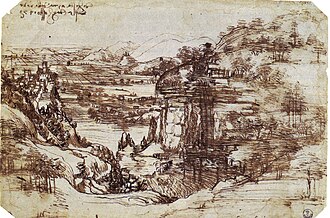
In about 1472, when he was twenty, Leonardo joined the Guild of St Luke, an organization of artists and doctors of medicine. Even after his father set him up in his own workshop, Leonardo still enjoyed working at Verrocchio's workshop. Leonardo's earliest known work is a drawing in pen and ink of the Arno River valley. It has the date 5 August, 1473. It is now in the Uffizi Gallery.
Working life 1476–1499
When Vasari writes about Leonardo, he uses words like "noble", "generous", "graceful," and "beautiful". Vasari tells us that as an adult, Leonardo was a tall handsome man. He was so strong that he could bend horseshoes with his bare hands. His voice was so beautiful that it charmed everyone that heard it. Almost everyone wanted to be his friend. He loved animals, was a vegetarian and would buy birds at the market to set free.
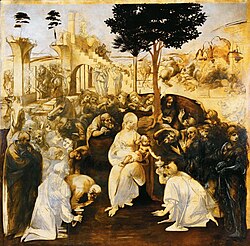
Very little is known about Leonardo's life and work between 1472 and 1481. People think he was busy in Florence. In 1478, he had an important commission to paint an altarpiece for the Monks of San Donato a Scopeto. The painting was to be the Adoration of the Magi (The Three Wise Men). The painting was never finished because Leonardo was sent away to Milan.
Leonardo was a very talented musician. In 1482, he made a silver lyre (a musical instrument) in the shape of a horse's head. At that time there was a new ruler in the city of Milan, in the north of Italy. Duke Ludovico il Moro was making other rulers nervous. Lorenzo Medici sent Leonardo to Milan as an ambassador. Lorenzo de' Medici wanted Leonardo to give Ludovico the lyre as a present from him. Leonardo wrote a letter to the Duke of Milan, telling him about all the clever and useful things that he could do, like making war machines. He wrote in the letter that he could "also paint". Leonardo did not know at the time that it was for painting that he would be mostly remembered. Leonardo stayed in Milan and worked for the Duke between 1482 and 1499. Part of his work was to design festivals and carnival processions. In Leonardo's notebooks are drawings of theatre costumes, amazing helmets and scenes that might be for the theatre.
Leonardo, like most other well-known artists of his time, had servants, young students and older assistants in his workshop. One of his young students was a boy whose name was Gian Giacomo Caprotti da Oreno. He was a handsome boy with beautiful long golden curls. He looked perfect as an artist's model for an angel. But he was such a difficult and dishonest boy that Leonardo called him "Salai" or "Salaino" which means "the little devil". Leonardo wrote in his notebook that Salai was very greedy, that he was a liar and that he had stolen things from the house at least five times. Salai stayed in Leonardo's household for thirty years as a pupil and a servant.
Gran Cavallo
Leonardo's most important work for Duke Ludovico was to make a huge statue of the previous ruler, Francesco Sforza, on horseback. He started with the horse. After studying horses and drawing designs, he made a huge horse of clay. It was called the "Gran Cavallo". It was going to be cast in bronze, and it was going to be the biggest bronze horse made in more than a thousand years. Unfortunately, the bronze horse was never made. In 1494, Ludovico had the bronze made into cannons because the French army was invading Milan. The huge clay horse was still standing when the French army invaded again in 1499. It was used for target practice and completely destroyed.