Flying Disc
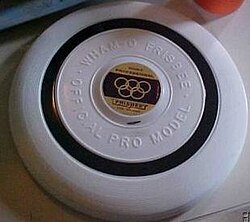
A flying disc is a round object with a flat shape and a thick rim. The rim helps with gripping and throwing the disc, and it also prevents it from flipping over while in the air. To throw the disc, the goal is to make it spin while it's in flight.
There is another type of flying object called a flying ring, which is sold under the brand name Aerobie. Although they have different designs, both flying discs and flying rings rely on air resistance to fly.
Flying discs are used in two popular sports, Ultimate Frisbee and Disc Golf. The Frisbee brand of flying disc is not commonly used in official competitions for these sports. In fact, the team sport of Ultimate Frisbee is officially known as "Ultimate." However, the term "Frisbee" is still widely used to refer to any flying disc, just like "Kleenex" was once used to mean "facial tissue."
The Aerobie
The Aerobie Superdisk is an alternative design of flying disc that, although somewhat differently shaped, still has very similar properties to the conventional disc. It has less air resistance. Because there is less resistance to motion, the Aerobie discs can fly farther than the conventional disc. The Aerobie flying ring has minimal drag and holds the world record for the longest flight by a human-thrown projectile. However, due to the lack of a rim, the Aerobie is less suited to angled, curved flights and air-bouncing. Archived 2023-06-13 at the Wayback Machine
Spin of the disc
The spin of the disc helps to keep the disc stable in flight and prevent unplanned tilting. This is because a large angular momentum stabilises the disc in the same way that it keeps a gyroscope steady, with the angular force forcing the mass of the disc away from the centre of mass, perpendicular to the axis of rotation. Any unequal force acting on a particular area of the disc is quickly redirected to be equal over the circumference of the disc. As the disc spins faster, it becomes more stable due to the rapidity of the equalisation of forces.
Mass of the disc
The force required to accelerate the disc is directly proportional to the mass of the disc. This decreases the acceleration of the disc, assuming that the force of projection is constant. Therefore, discs come in a variety of weights, although those used for Ultimate are mainly 175 g in mass, heavier than the majority of discs and considerably heavier than an aerobie.
Flying discs (including Frisbees) can be thrown in many ways. All involve spinning the disc to give it gyroscopic stability, and accelerating its mass to a certain velocity. Without spin, a disc will wobble and fall; without velocity, the disc will not go anywhere. Using these two guidelines, any number of throws are possible. Most discs are designed to create lift when thrown with the flat side up.
Techniques
Right-side up
Right-side up throws are all similar in that they react the same way to the tilt of the disc when it is released. A disc thrown right-side up will accelerate in the direction of the low end of the disc. A disc tilted leading-edge up will lose speed at the end of the throw and make a gentle landing; if tilted sideways (known in aeronautics terms as roll), it can curve around objects.
There is a language for describing throws that curve. Both descriptions are relative to the direction the person is facing and intends to throw. This axis is marked in red in the picture.
- Inside-out (i-o) throws (green paths) occur when the thrower releases the disc in such a way that it initially comes towards the throwing axis (inside-). However, the disc is tilted with the side closest to the body highest, which causes the disc to curve away from the thrower (-out).
- Outside-in (o-i) throws (blue paths, sometimes also called a bender) follow the opposite path. The thrower releases the disc moving away from the throwing axis (outside-), but with the side of the disc closest to the body lowest. This tilt causes the disc to bend back towards the thrower (-in).
Backhand
This is probably the most commonly learned throw, and also one of the most powerful.
- Grip: Fingers are curled under the disc's rim, and the thumb is placed on top of the disc to hold it in place. The index finger may either be on the edge of the disc (to help aim), or four fingers may be tucked underneath the rim (to aid power).
- Throw: The thrower draws the throwing arm across the body to build velocity for the disc. During this movement, the arm straightens out. As the arm becomes straight, the wrist is flicked, to impart spin.
Variations
- The High Release: Used to get around an object (or a person), the High Release is thrown above the thrower's shoulder, and relies more heavily on the flick of the wrist to impart power.
- The Air Bounce: This throw is released at a downward angle, but with a high angle of attack. This throw will move toward the ground at first before downwash causes it to rise, giving the visual effect of the disc "bouncing" in the air. This is done by pressing down with the thumb, which lowers the trailing edge at the instant of release.
- The Beach Backhand: Rather than reaching and throwing the disc across the body, the arm is curled and the disc is cocked next to the hip on the same side of the body as the throwing arm. The disc is released by extending the arm straight ahead and snapping the wrist. The term "beach backhand" is considered pejorative, as this release technique is uniformly inferior to a standard backhand.
Forehand
This throw is also known as the flick, two-finger, or the side-arm. Focused in the wrist, this throw takes little time to execute. Along with the backhand, it is one of the two most common throws used in Ultimate.
- Grip: The middle finger is extended and laid along the rim of the disc. The index finger is placed against the middle finger for power, or pressed on the bottom of the disc pointing towards the center for stability. The thumb is pressed against the top of the disc. The wrist is cocked back, and the arm is extended out from the body.
- Throw: A snap of the wrist imparts spin as the disc releases off the middle finger, as well as some forward velocity. Extension of the lower arm provides additional power, as does shoulder and upper body rotation.
Variations
The forehand is a versatile throw, and can be adapted to many different situations.
- Different wrist or arm angles on release can allow for inside-out or outside-in curves.
- Most upside-down throws (see below) use the forehand grip and use the same wrist snap and release, and are therefore variants of the forehand in some sense.
- The High Release: Used to get around an object (or a person), the High Release is thrown above the thrower's shoulder, and is powered by the flick of the wrist as well as the rising action of the arm on release.