Bunk bed
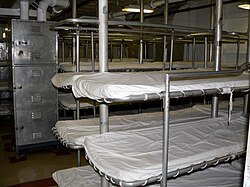
A bunk bed is a stack of two or more beds. Metal poles or wooden beams connect the bottom bed (called the bottom bunk) to the top bed (called the top bunk). A ladder is used to get up to the top bunk. The ladder is usually attached to the bed.
In the Philippines, a bunk bed is called a double deck. Bunk bed is a modern solution; crafted when a one-bed frame is placed on top of another, making a rigid structure of two or more beds.
This way two beds are compacted together to form a single bed which is efficient. A bunk bed occupies less floor area, it is equal to the space normally necessary for only one bed.
Use in homes
Bunk beds are often used in children's rooms. Since bunk beds allow a family to put two beds in the space of a single bed, bunk beds save space. Bunk beds help families with small apartments or houses to have enough beds for their children.
Use in institutions and public facilities
A bunk bed is also called ‘the wider bed’, which means both the top and bottom are of the same wider size. They are essential furnishing items that hostels, dormitories, colleges, and schools prefer to install.
Use in government and public facilities
Bunk beds are often used in institutions such as prisons. As well, they are often used in public facilities such as homeless shelters and bomb shelters. Bunk beds are also used in firehalls, to give firefighters a place to sleep. Many military organizations use bunk beds.
Navy ships and submarines use bunk beds for the sailors to sleep in. Army barracks sometimes have bunk beds for soldiers to sleep in.
Use in camps and hostels
Summer camps and winter cabins for children (such as boy scouts or girl scouts) often have bunk beds. Hostels, a type of inexpensive hotel for travelers, often have bunk beds. Some ski lodges have bunk beds in their rooms.
NewPP limit report Parsed by mw‐web.eqiad.main‐6cff5b77f8‐6flpg Cached time: 20260924194217 Cache expiry: 2592000 Reduced expiry: false Complications: [show‐toc, use‐parsoid] CPU time usage: 0.077 seconds Real time usage: 0.089 seconds Preprocessor visited node count: 6/1000000 Revision size: 2064/2097152 bytes Post‐expand include size: 351/2097152 bytes Template argument size: 0/2097152 bytes Highest expansion depth: 4/100 Expensive parser function count: 0/500 Unstrip recursion depth: 0/20 Unstrip post‐expand size: 0/5000000 bytes Number of Wikibase entities loaded: 0/500
Transclusion expansion time report (%,ms,calls,template) 100.00% 2.234 1 Template:Stub 100.00% 2.234 1 -total
Render ID 0c64778c-b850-11f1-a979-9106b3cac399
Saved in parser cache with key simplewiki:parsoid-pcache:46670:|#|:idhash:useParsoid=1 and timestamp 20260924194217 and revision id 10081096. Rendering was triggered because: page_view
Parsoid 0.24.0.0-alpha23