Is the Earth round?
The Earth is an irregularly shaped ellipsoid.
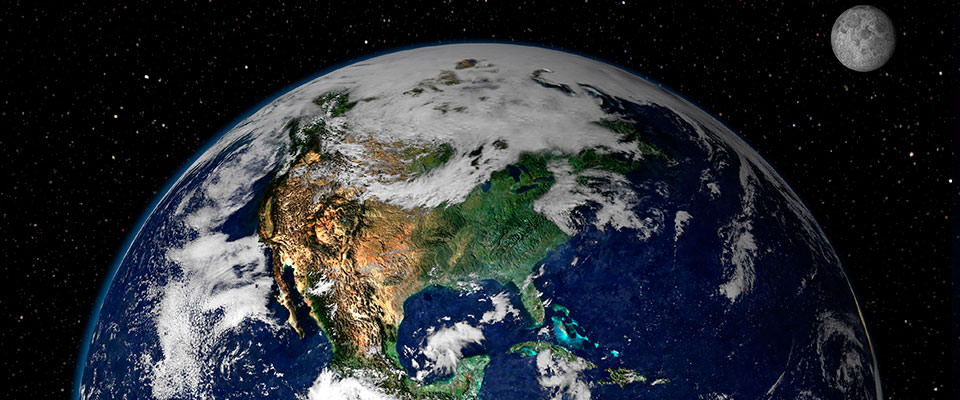
While the Earth appears to be round when viewed from the vantage point of space, it is actually closer to an ellipsoid. However, even an ellipsoid does not adequately describe the Earth’s unique and ever-changing shape.
Our planet's diameter bulges at the equator due to the centrifugal force created by the earth’s constant rotation. Mountains rising almost 30,000 feet and ocean trenches diving over 36,000 feet(compared to sea level) further distort the shape of the Earth. Sea level itself is even irregularly shaped. Slight variations in Earth’s gravity field cause permanent hills and valleys in the ocean’s surface of over 300 feet.
Additionally, the shape of the Earth is always changing. Sometimes this change is periodic, as is the case with daily tides that affect both the ocean and the crust; sometimes the change is slow and steady, as with the drift of tectonic plates or the rebound of the crust after a heavy sheet of ice has melted; and sometimes the shape of the planet changes in violent, episodic ways during events such as earthquakes, volcanic eruptions, or meteor strikes.
The National Geodetic Survey measures and monitors our ever-changing planet. Geodesy is the science of measuring and monitoring the size and shape of the Earth, including its gravity field, and determining the location of points on the Earth’s surface.