What is a Black Hole?
When a particularly large star nears the end of its life, it often becomes a black hole.
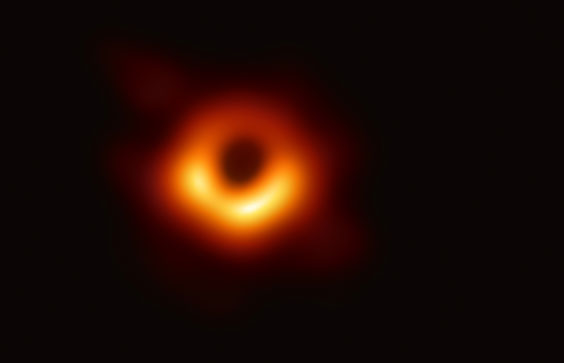
Physicists and astronomers have been theorizing and studying black holes for over 200 years. These scientists can help us better understand the stellar evolution of black holes, which in turn can help us understand the dynamics and mechanics of our universe. On April 10, 2019, a network of radio telescopes called the Event Horizon Telescope (EHT) captured and delivered our first image of a black hole! This significant event opens exciting new paths and fields to explore in the study of black holes.
Black Holes were once massive stars. Stars emit heat and light because of nuclear reactions that take place in their cores. Hydrogen atoms are converted into helium atoms, and the energy that results from the reaction causes the star to shine. The energy also helps the star keep its spherical shape. While gravity works to collapse a star onto itself, the nuclear energy counteracts the gravitational force and maintains the shape of the star.
After a lifetime spent fusing elemental components into helium and heavier atoms (all the way up to iron), the star will eventually run low on fuel. This means that fewer nuclear reactions take place in the star and there is too little energy to fight against gravity. When this happens, smaller stars like the Sun turn into white dwarves – incredibly dense stars that concentrate all of the star’s mass into a volume about the size of the Earth. This type of stellar evolution can take place over billions of years.
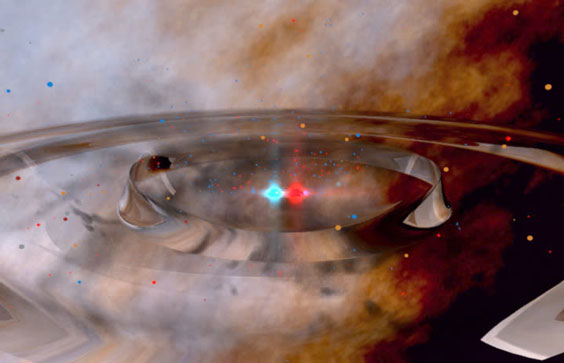
Our Sun is not big enough to become a black hole, even after a few billion years. Much larger stars that range from being four to a billion times more massive than the Sun can turn into black holes at the end of their lives. Bigger stars “burn” their hydrogen fuel much more quickly, leading to stellar lifespans of only tens of millions of years.
These larger stars have so much material in them that when they burn out, their intense gravity will collapse them into black holes. The strong gravity just keeps pulling and pulling, compressing matter into a smaller and smaller volume. At some point, the gravity field compresses the stellar remnant into a “black hole.” The name comes from the fact that even light cannot escape the pull of this intense gravity field if it passes within the distance from the black hole known as the “event horizon.”
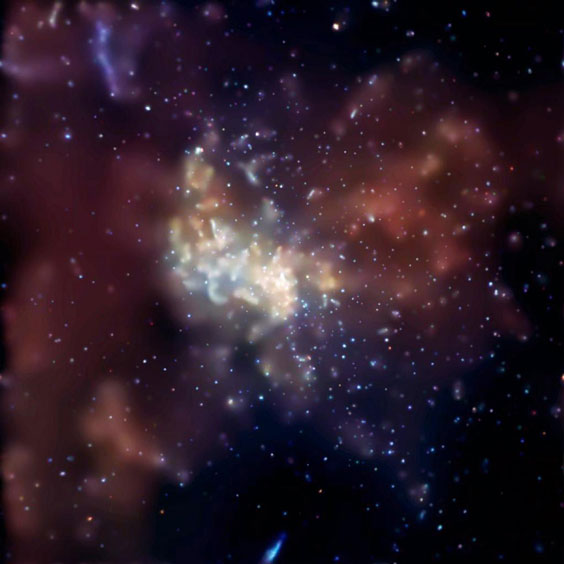
Black holes can be observed and detected in several ways. They exert a strong gravitational effect on their surroundings, and we can measure the motions of objects that orbit them, like other stars. Also, the black hole’s gravity is so strong that light that passes near their “event horizon” can get refracted, as though by a lens, altering the positions or appearance of stars and galaxies farther away from Earth than the black hole.
Black holes are often surrounded by other material, such as dust or other stars. The black hole’s intense gravity can pull apart this material, generating intense radio, x-ray, and gamma radiation, and some of this occurs above the event horizon, where it can escape and be detected and measured.
In addition, observations have recently demonstrated the occurrence of “gravitational radiation,” first predicted by Einstein, occurring when black holes pass near one another or collide, essentially pushing a wave of stretched and compressed space-time through the universe.
For many years, black holes could be detected, and their effects measured, but they were not directly observed. But in 2019 a black hole and its shadow were captured in an image for the first time. This historic feat involved a network of eight ground-based radio telescopes around the globe, operating together as if they were one telescope the size of our entire planet. This network is known as the Event Horizon Telescope.
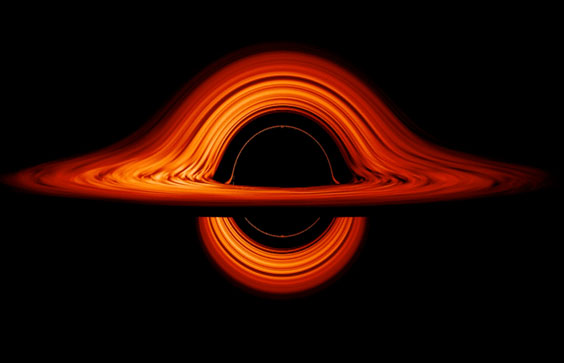
Despite everything that has been discovered about black holes, scientists still have many exciting and unanswered questions – what are conditions like inside the event horizon, especially near the “singularity” at the black hole’s center? In this region, the high density of material creates conditions unlike anywhere else in the known universe. Scientists have also theorized that black holes may “evaporate” over time, slowly dissipating and ultimately vanishing, but this phenomenon has never been observed directly. In addition, scientists are studying whether information can be destroyed by entering a black hole, or if there are mechanisms by which the information can be “recycled” and retained in the visible universe. These questions, and many more, will keep observers and scientists occupied for decades to come.