Turtles
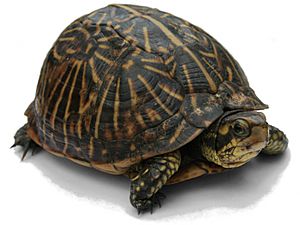
Turtles are a type of reptile that belong to the group called Testudines. They are special because they have a hard shell made of bone or cartilage. This shell grows from their ribs and acts like a strong shield to protect them.
This group, Testudines, includes both turtles alive today and those that are now extinct. The oldest known turtle fossil was found in China and is about 220 million years old. This means turtles are one of the oldest reptile groups still around. They are even older than lizards, snakes, and crocodiles!
Scientists have found that turtles are related to a group of reptiles called archosauromorphs. This group also includes dinosaurs. Turtles have been very successful and live almost all over the world. However, many of the turtle species alive today are in danger of becoming extinct.
Turtle, Tortoise, or Terrapin: What's the Difference?
The word "turtle" is often used for all members of the Testudines group. But you might also hear them called "terrapins," "tortoises," or "sea turtles." How these names are used depends on where you live.
- In British English, "turtles" live in the sea. "Terrapins" live in fresh or slightly salty water (called brackish water). "Tortoises" live on land.
- In American English, "turtle" is a general word for all species. "Tortoise" is used for most land-dwelling species. Sea turtles are usually called "sea turtles." The name "terrapin" is mostly used for one specific type of turtle, the diamondback terrapin, which lives in brackish water.
- In Australian English, "turtle" is used for both sea and freshwater species. "Tortoise" is used for land species.
To avoid confusion, some people who study these animals use the word "chelonian" as a general term. However, Chelonia is also the name of a specific type of turtle, which can sometimes be confusing.
Ecology and Life Cycle
Even though many turtles spend most of their lives underwater, all turtles and tortoises breathe air. They must come to the surface regularly to fill their lungs. Some turtles spend their entire lives on dry land.
Some Australian freshwater turtles can breathe underwater! They have special areas inside their bodies, called cloacal cavities, with many finger-like parts. These parts have a lot of blood and help the turtles take in oxygen from the water. It's a bit like how fish use gills to breathe.
Like other reptiles, turtles lay eggs. Their eggs are a bit soft and leathery. The eggs of the largest turtles are round, while others are longer. Sea turtles lay their eggs on dry, sandy beaches. Turtles can take many years to grow old enough to have babies. They often lay eggs every few years, not every year.
For some turtle species, the temperature of the nest decides if an egg becomes a male or a female. Warmer temperatures usually lead to females, and cooler temperatures lead to males. Many eggs are laid in holes dug in mud or sand. The mother turtle covers them and leaves them to hatch on their own. When the baby turtles hatch, they dig their way out and head towards the water. Turtle mothers do not care for their young.
Long-Lived Animals
Scientists have recently found something amazing about turtles. Unlike most other animals, a turtle's organs do not get old or work less well over time. The liver, lungs, and kidneys of a very old turtle look almost the same as those of a young turtle. This discovery has made scientists want to study turtle genetics to find out what makes them live so long.
Anatomy
Neck Movement
Turtles are divided into two main groups based on how they pull their necks into their shells.
- The Cryptodira (meaning "hidden neck") can pull their necks straight back and tuck them under their spine.
- The Pleurodira (meaning "side neck") are found only in freshwater in the Southern Hemisphere. They bend their necks to the side to hide them.
This means that the ability to pull their heads into their shells developed twice in different turtle groups!
Feeding Habits
Turtles have a hard beak instead of teeth. They use their jaws to cut and chew food. The upper and lower parts of their jaws are covered by hard, horny ridges.
- Turtles that eat meat (carnivores) usually have very sharp ridges to slice through their prey.
- Turtles that eat plants (herbivores) have ridges with jagged edges to help them cut tough plants.
Turtles use their tongues to swallow food. However, unlike most reptiles, they cannot stick out their tongues to catch food.
Shell Structure
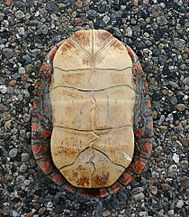
A turtle's shell has two main parts:
- The upper shell, which covers its back, is called the carapace.
- The lower shell, which covers its belly, is called the plastron.
These two parts are connected on the turtle's sides by bony structures called bridges.
The inside layer of a turtle's shell is made of about 60 bones. These bones include parts of the turtle's backbone and ribs. This means a turtle cannot crawl out of its shell! Most turtles have an outer layer of hard scales called scutes on their shell. These scutes are part of the turtle's skin. They are made of a strong protein called keratin, which is also found in the scales of other reptiles. These scutes overlap the seams between the shell bones, making the shell even stronger. Some turtles, like the leatherback sea turtle and soft-shelled turtles, do not have horny scutes. Their shells are covered with leathery skin instead.
Largest Living Turtles
The largest turtle alive today is the great leatherback sea turtle. Its shell can be up to 200 cm (80 inches) long, and it can weigh over 900 kg (2,000 lb). Freshwater turtles are usually smaller. However, some Asian softshell turtles (Pelochelys cantorii) have been reported to be as long as 200 cm (80 inches). This is much bigger than the well-known alligator snapping turtle, which is the largest turtle in North America. The alligator snapping turtle can have a shell length of up to 80 cm (31½ inches) and weigh about 60 kg (170 lb).
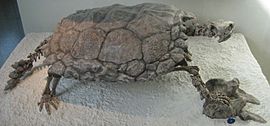
The largest fossil turtle ever found was Archelon. It was more than twice the length of the leatherback, reaching up to 4.5 meters!
Evolution of Turtles
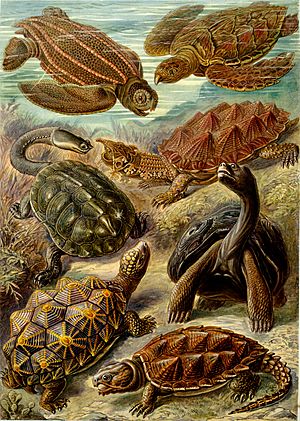
The first known turtle-like fossils appeared about 220 million years ago, during the Upper Triassic period. Their shells slowly developed from bony parts of their backbones and ribs. These bones expanded and grew together to form a complete shell. This shell offered protection at every stage of its development, even when it wasn't fully formed. This strong adaptation helped turtles survive many changes in the environment and several major extinction events.
Fossils of a freshwater turtle called Odontochelys semitestacea (meaning "half-shelled turtle with teeth") have been found in southwest China. This turtle from the later Triassic period had a complete bottom shell (plastron) but an incomplete top shell (carapace). This is similar to how a baby turtle's shell develops. By the Upper Jurassic period, turtles had spread widely, and their fossil history becomes clearer.