Trees
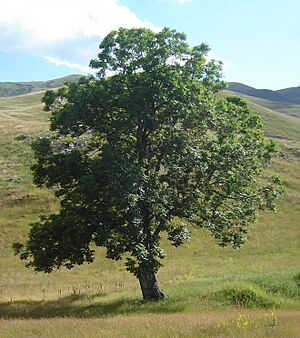
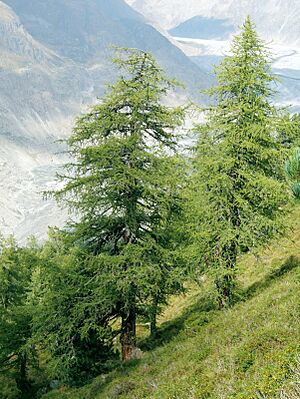
A tree is a large plant that lives for many years. It usually has a single, tall stem called a trunk. This trunk supports many branches and leaves. Some people define trees strictly, only including woody plants that grow very tall. Others include taller palms, tree ferns, bananas, and bamboo in their definition.
Trees are not all from the same plant family. Instead, many different types of plants have independently developed trunks and branches. This helps them grow tall to reach sunlight. Most trees are angiosperms, also known as hardwoods. Many others are gymnosperms, or softwoods. Trees can live for a very long time, with some reaching thousands of years old. The first trees appeared about 400 million years ago. Today, there are an estimated three trillion mature trees worldwide.
A typical tree has many branches held high above the ground by its trunk. The trunk contains woody tissue for strength. It also has vascular tissue to move water and nutrients throughout the tree. Most trunks are covered by bark, which acts as a protective layer. Underground, the roots spread out widely. They anchor the tree and absorb water and nutrients from the soil. Above ground, branches divide into smaller shoots. These shoots usually have leaves. Leaves capture light energy and turn it into sugars through photosynthesis. This process provides food for the tree's growth.
Trees usually make new trees using seeds. Flowering plants keep their seeds inside fruits. Conifers carry their seeds in cones. Tree ferns, however, produce spores instead of seeds.
Trees are very important for our planet. They help reduce soil erosion and control the climate. They take carbon dioxide from the air and store a lot of carbon in their wood. Trees and forests provide homes for many animals and plants. Tropical rainforests are some of the most diverse places on Earth. Trees offer shade and shelter, wood for building, fuel for cooking and heating, and fruit for food. Sadly, forests are shrinking in many parts of the world. This happens as trees are cut down to make more land for farming. Because trees live so long and are so useful, people have always respected them. Many cultures have sacred groves, and trees appear in many mythologies.
What Makes a Plant a Tree?

The word "tree" is common, but there isn't one exact definition. In a general sense, a tree is any plant with a tall stem or trunk. This trunk holds up the leaves and branches high above the ground. Trees are also often defined by their height. Smaller plants, usually between 0.5 to 10 meters (1.6 to 33 feet) tall, are called shrubs. So, the minimum height for a tree is not always clear. Even large plants like papaya and bananas can be called trees in this broad sense.
A more specific definition says a tree has a woody trunk that grows thicker each year. This is called secondary growth. It means the trunk grows outwards, not just upwards from the tip. Under this definition, plants like palms, bananas, and papayas are not considered true trees. This is true even if they are tall. Some monocots, like the Joshua tree, bamboos, and palms, don't have true secondary growth. They don't make wood with growth rings. But they can make "pseudo-wood" by strengthening their cells. Dracaena trees, also monocots, do have secondary growth. However, it's different from the growth in other woody trees.
Sometimes, trees are defined by how we use them. For example, plants that provide lumber (wood for building) are often called trees.
How Trees Grow and Live
The way trees grow tall is an evolutionary adaptation. By growing taller, trees can get more sunlight than other plants. Trees are usually tall and live for a long time. Some can live for thousands of years. Several trees are among the oldest living things on Earth. Trees have special structures like thicker stems. These stems have strong cells that help them grow taller and spread their leaves out. They are different from shrubs, which are usually smaller and have many stems. But there's no strict rule to tell a tree from a shrub. Trees can even be smaller in harsh places like mountains. The tree shape has developed separately in different plant groups. This is a great example of parallel evolution. There are an estimated 60,000 to 100,000 tree species worldwide. This is about 25% of all living plant species. Most of these grow in tropical areas. Many of these regions have not been fully explored by botanists. This means we don't know everything about tree diversity.
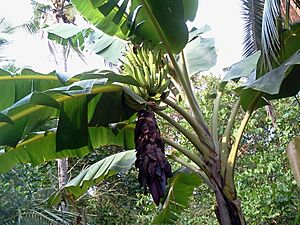
Most tree species are angiosperms, also called hardwoods. Many others are gymnosperms, or softwood trees. These include conifers, cycads, ginkgophytes, and gnetales. Gymnosperms have seeds that are not inside fruits. Instead, they are in open structures like pine cones. Many have tough, waxy leaves, like pine needles. Most angiosperm trees are eudicots. Their seeds have two cotyledons, or seed leaves. Some trees are also found among older flowering plants called basal angiosperms. These include Amborella, Magnolia, nutmeg, and avocado. Trees like bamboo, palms, and bananas are monocots.
Wood gives strength to the trunk of most trees. This helps the plant grow larger. The tree's vascular system moves water, nutrients, and other chemicals around the plant. Without it, trees couldn't grow so big. Trees need to pull water high up the stem from the roots. This happens through the xylem by capillary action. Water constantly evaporates from the leaves in a process called transpiration. If there isn't enough water, the leaves will die. The three main parts of a tree are the root, stem, and leaves. They are all connected by the vascular system. In trees that develop wood, the vascular cambium helps the vascular tissue expand. This creates woody growth. Because this growth breaks the outer skin of the stem, woody plants also have a cork cambium. This forms among the phloem. The cork cambium makes thick cork cells to protect the plant's surface and reduce water loss. Both wood and cork production are forms of secondary growth.
Trees are either evergreen or deciduous. Evergreens keep their leaves green all year. Deciduous trees shed their leaves at the end of the growing season. Then they have a resting period without leaves. Most conifers are evergreens. But larches (Larix and Pseudolarix) are deciduous. They drop their needles every autumn. Some cypress species (Glyptostrobus, Metasequoia, and Taxodium) shed small leafy shoots each year. This is called cladoptosis. The crown is the wide top part of a tree, including its branches and leaves. The highest layer in a forest, made by the crowns of trees, is called the canopy. A sapling is a young tree.
Many tall palms are herbaceous monocots. They don't have secondary growth and never produce wood. In many tall palms, only the top bud on the main stem grows. So, they have unbranched trunks with large leaves arranged in a spiral. Some tree ferns, in the order Cyatheales, have tall, straight trunks. They can grow up to 20 meters (66 feet). But these trunks are not made of wood. They are made of rhizomes that grow upwards. These are covered by many adventitious roots.