Tornadoes
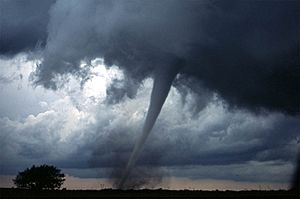
A tornado is a powerful tube of spinning air that touches the ground. The wind inside a tornado spins incredibly fast, making these storms very dangerous. They are especially risky for people in cars or mobile homes. About 60 people die from tornadoes each year.
The word tornado comes from the Spanish word tornado, which means 'to turn' or 'to have turned'. This word itself comes from the Latin word tonare, meaning 'to thunder'.
Tornadoes can destroy many things. They can tear houses apart and often leave people without a home. Even though they are smaller than hurricanes, tornadoes are much stronger. Almost three-quarters of the world's tornadoes happen in the United States. However, they can form almost anywhere.
Tornadoes cause a lot of damage to anything in their path. Scientists use the Enhanced Fujita scale to rank tornadoes, from EF0 (least damage) to EF5 (most damage).
Tornadoes can happen in nearly every part of the world. In the United States, every state has experienced a tornado. The central part of the United States is even called 'Tornado Alley' because so many tornadoes happen there. A tornado's winds can spin faster than 300 miles per hour (480 km/h)!
Most tornadoes have wind speeds less than 110 miles per hour (180 km/h). They are usually about 250 feet (80 m) wide and travel only a few miles before they disappear. Other spinning air events in nature include dust devils and fire whirls.
Weather experts issue a "tornado watch" when conditions are right for a tornado to form. A "tornado warning" means a tornado has actually been seen or detected on weather radar. A "tornado emergency" is a very serious warning. It means a powerful tornado is about to hit a crowded area, or one has been spotted and is expected to cause deaths.
What Do Tornadoes Look Like?
Size and Shape of Tornadoes
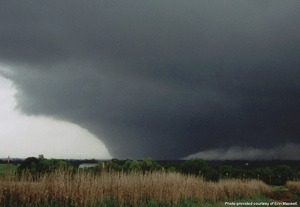
Most tornadoes look like a narrow funnel cloud. They are usually a few hundred meters (yards) wide. Sometimes, a tornado can be hidden completely by rain or dust. These hidden tornadoes are very dangerous because even experienced weather experts might not see them.
Small, weaker tornadoes might only look like a small swirl of dust on the ground. If the winds at the surface are stronger than 40 mph (64 km/h), it's considered a tornado. Some tornadoes have a nearly straight, cylindrical shape and are called "stovepipe" tornadoes. Very large tornadoes can look like huge wedges stuck into the ground. These are known as "wedge tornadoes." A wedge tornado can be so wide that it looks like a block of dark clouds. It can be hard to tell the difference between a low cloud and a wedge tornado from far away. Many of the strongest tornadoes are wedges.
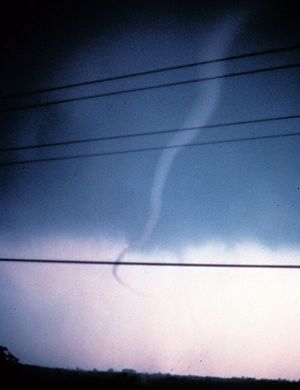
When tornadoes start to disappear, they can look like narrow tubes or ropes. They often curl or twist into strange shapes. This is called "roping out." As they rope out, their funnel gets longer, which makes the winds inside weaker. Sometimes, a tornado can have several smaller spinning columns of air inside it. These are called multiple-vortex tornadoes.
In the United States, tornadoes are about 500 feet (150 m) wide on average. But their sizes can vary a lot. Weak or disappearing tornadoes can be very narrow, sometimes just a few feet (meters) across. One tornado was only 7 feet (2 m) long! On the other hand, some wedge tornadoes can be a mile (1.6 km) wide or more. The widest tornado ever recorded was in El Reno, Oklahoma, in 2013. It was about 2.6 miles (4.2 km) wide!
How Far Do Tornadoes Travel?
In the United States, the average tornado travels about 5 miles (8 km) on the ground. However, some tornadoes travel much shorter or much longer distances. One tornado was only 7 feet (2 m) long. The longest-traveling tornado ever was the Tri-State Tornado in 1925. It stayed on the ground for 219 miles (352 km) across parts of Missouri, Illinois, and Indiana! Many tornadoes that seem to travel 100 miles (160 km) or more are actually a series of tornadoes that formed one after another.
What Colors Are Tornadoes?
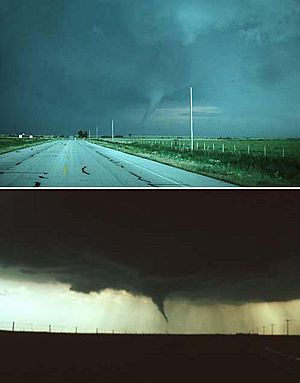
Tornadoes can be many different colors, depending on where they form. Tornadoes in dry areas might be almost invisible, only showing swirling dust at their base. Funnels that pick up little debris can be gray or white. Over water, they can turn white or even blue. Slow-moving tornadoes that pick up a lot of dirt and debris are usually darker. They take on the color of the dirt. Tornadoes in the Great Plains can look red because of the reddish soil. Tornadoes in mountains can travel over snow, making them look white.
How the sun hits the tornado also changes its color. A tornado with the sun behind it (back-lit) looks very dark. The same tornado, with the sun behind you, might look gray or bright white. Tornadoes that happen near sunset can be yellow, orange, or pink.
Dust, heavy rain, hail, and the darkness of night can make tornadoes hard to see. Tornadoes in these conditions are extra dangerous. Often, the only warning is from weather radar or the sound of the approaching tornado. Most strong tornadoes form under the storm's rain-free area, so they are usually visible. Also, most tornadoes happen in the late afternoon when the sun is bright.
Some people who have been inside a tornado say it has a clear, calm center, like the eye of a hurricane. They say lightning lights up the inside.
How Do Tornadoes Spin?
Tornadoes usually spin counterclockwise in the northern hemisphere (like a clock going backward). In the southern hemisphere, they spin clockwise.
What Sounds Do Tornadoes Make?
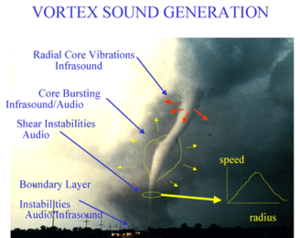
People have described tornado sounds in many ways. Some say it sounds like a freight train, rushing water, or a jet engine. Many tornadoes cannot be heard from far away. The sound and how far it travels depend on the air conditions and the land.
Since many tornadoes can only be heard when they are very close, sound is not a reliable way to warn people about a tornado.
How Do Tornadoes Form?
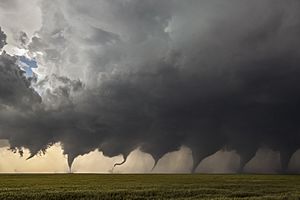
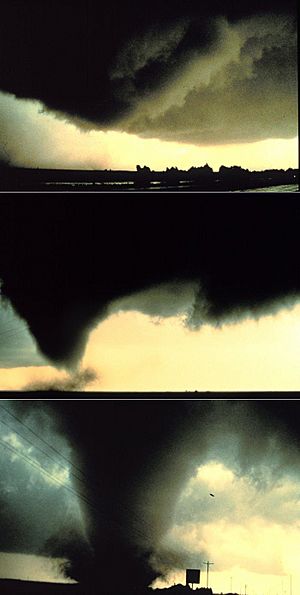
Most tornadoes form from a type of thunderstorm called a supercell. Supercells have a spinning area of air a few miles up in the atmosphere, called a mesocyclone. This spinning area is usually 1 to 6 miles (1.6 to 9.7 km) wide. Most strong tornadoes (EF3 to EF5) come from supercells. Besides tornadoes, supercells can bring very heavy rain, lots of lightning, strong wind gusts, and hail.