The Great Wall of China
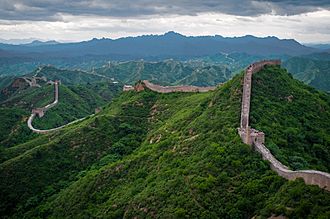
The Great Wall of China is a giant series of walls and forts in China. It was built over many centuries to protect ancient Chinese states from nomadic groups from the north. The first walls were built as early as the 7th century BC. Over time, different emperors connected and expanded these walls. The most famous and well-preserved sections were built by the Ming dynasty (1368–1644).
Stretching for thousands of kilometers, the Great Wall is not just one long wall. It is a complex defense system with watchtowers, barracks for soldiers, and signal stations. These were used to spot enemies and send messages using smoke or fire. The wall also served as a form of border control, managing trade along the famous Silk Road.
In total, all the different parts of the wall stretch for 21,196.18 km (13,170.70 mi). It is a UNESCO World Heritage Site and was named one of the New 7 Wonders of the World in 2007. Today, the Great Wall is considered one of the most amazing building projects in all of history.
What's in a Name?
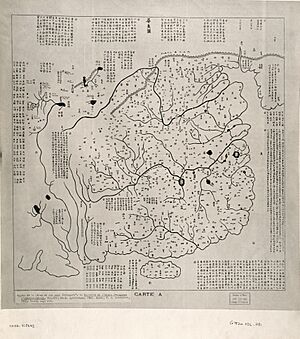
The Great Wall of China has had several names throughout history.
In Chinese, it is most commonly called Chángchéng (长城), which simply means "Long Wall."
A longer, more poetic name is Wànlǐ Chángchéng (万里长城). This translates to "Ten-Thousand Mile Long Wall." In ancient China, the number "ten-thousand" was often used to mean a number so large it was hard to count, like "immeasurable." So, the name really means the "immeasurably long wall."
In English, people used to call it "the Chinese wall." By the 1800s, the name "the Great Wall of China" became the common name we use today.
History of the Great Wall
The First Walls
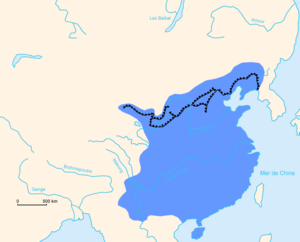
Long before China was a single country, people there already knew how to build strong walls. Between the 8th and 5th centuries BC, China was divided into several rival states. Many of these states built walls on their borders to protect themselves from each other and from nomadic tribes. These early walls were mostly made from packed earth and gravel.
In 221 BC, the state of Qin conquered its rivals and united China. The first emperor, Qin Shi Huang, wanted to protect his new empire from the Xiongnu people in the north. He ordered that the old walls on the northern border be connected and strengthened. This became the first "Great Wall." Builders used whatever materials they could find nearby, like stone from mountains or earth from the plains.
Later dynasties, like the Han, also repaired and added to the wall to defend against northern invaders.
The Mighty Ming Wall
The most famous sections of the Great Wall were built during the Ming dynasty (1368–1644). After facing threats from Mongol tribes, the Ming emperors decided to build a stronger and more advanced wall.
Instead of just using packed earth, Ming builders used bricks and stone. This made the wall much stronger and more durable. They built thousands of watchtowers along the wall. The sections near the capital, Beijing, were made especially strong. A famous general named Qi Jiguang helped to build and reinforce over 1,200 watchtowers.
Near the end of the Ming dynasty, the wall helped defend China from invasions by the Manchu people. For a time, the Manchus could not get past the heavily guarded Shanhai Pass. However, in 1644, a Ming general opened the gates, allowing the Manchus to cross. They went on to establish the Qing dynasty, which ruled China for over 250 years.
Under Qing rule, China's borders expanded, and the Great Wall was no longer needed for defense. Construction on the wall stopped.
Where Does the Wall Go?
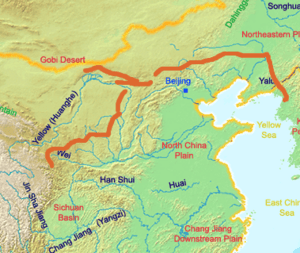
The Great Wall is not a single, continuous line. It is a network of walls, trenches, and forts that stretches across northern China. It runs from Liaodong in the east to Lop Lake in the west.
In 2012, a detailed survey found that all the sections of the wall, from different dynasties, add up to a total length of 21,196.18 km (13,170.70 mi). The wall built by the Ming dynasty alone is about 8,850 km (5,500 mi) long.
Famous Sections of the Wall
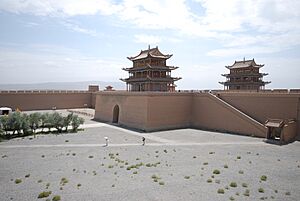
Some parts of the Great Wall are very famous and are often visited by tourists.
- Jiayu Pass: Located in Gansu province, this was the western end of the Ming Great Wall. It was a key fort in the desert.
- Badaling: This is the most famous section and was the first to be opened to tourists. It is close to Beijing and is very well-preserved.
- Mutianyu: Known for its beautiful scenery and well-restored watchtowers, this section winds along steep mountains.
- Jinshanling: This section is famous for its steep climbs and amazing views. It has many original features and is popular with hikers.
- Shanhai Pass: This is where the Great Wall meets the Bohai Gulf. The part of the wall that goes into the sea is called the "Old Dragon Head."
How Was the Wall Built?
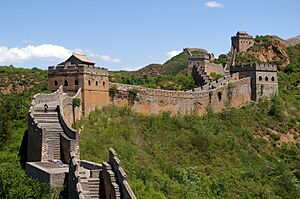
The construction of the Great Wall changed over time.
- Early Materials: The first walls were mostly made of rammed earth (dirt packed down very tightly), stones, and wood.
- Ming Dynasty Materials: During the Ming dynasty, builders used bricks, tiles, lime, and stone. Bricks were easier to carry and faster to build with than packed earth.
- Sticky Rice Mortar: To hold the bricks together, workers used a special mortar made from sticky rice soup mixed with slaked lime. This made the wall very strong. Despite some myths, no bones were ever used in the mortar.
The wall was designed for defense.
- Watchtowers and Signals: Towers were built on high points so guards could see far away. If they spotted an enemy, they would light fires or send up smoke signals to warn other soldiers.
- Defensive Features: The top of the wall has battlements, which are low walls with gaps for archers to shoot through.
- Barracks and Stables: Buildings for soldiers to live in, along with stables for their horses, were built along the inner side of the wall.
The Great Wall Today
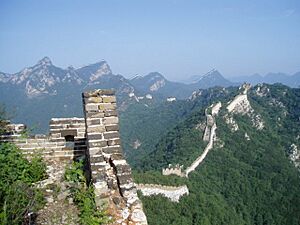
While some parts of the Great Wall near big cities are well-kept for tourists, many other parts are in disrepair.
- Damage Over Time: Some sections have crumbled away due to wind and rain. In some desert areas, sandstorms have buried parts of the wall.
- Human Impact: In the past, people took stones from the wall to build their houses and roads. Some parts have also been damaged by graffiti or destroyed to make way for new construction.
- Preservation Efforts: The Chinese government is working to protect the wall, but its great length makes this a huge challenge. In 2023, a section of the wall was badly damaged by construction workers who used an excavator to create a shortcut, showing that the wall is still at risk.