The Colosseum
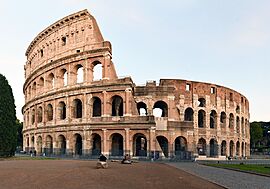
The Colosseum is a huge, oval-shaped building in the center of Rome, Italy. It is the largest ancient amphitheatre ever built. Even today, it is the biggest standing amphitheatre in the world.
Construction of the Colosseum started around 72 AD under Emperor Vespasian. It was finished in 80 AD by his son, Titus. Later, Titus's brother Domitian made more changes. These three emperors were part of the Flavian dynasty. Because of this, the Colosseum was also known as the Flavian Amphitheatre.
The Colosseum was built using strong materials like travertine limestone, tuff (a type of volcanic rock), and concrete. It could hold between 50,000 and 80,000 people. People came to watch gladiatorial fights and other public shows. These shows included animal hunts, punishments, re-enactments of famous battles, and plays based on Roman mythology. For a short time, even mock sea battles were held there.
The building stopped being used for entertainment in the early Middle Ages. Over time, it was used for many different things. It became homes, workshops, a fortress, and even a Christian shrine.
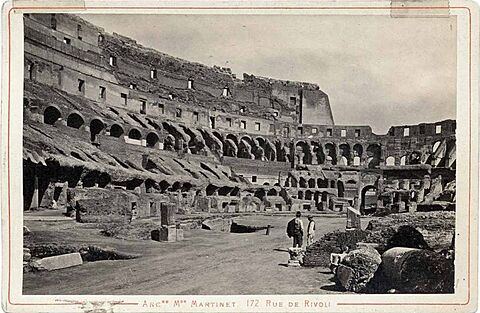
Even though earthquakes and stone robbers damaged it, the Colosseum is still a famous symbol of Imperial Rome. It is one of the New 7 Wonders of the World. Today, it is one of Rome's most popular tourist attractions. It also has ties to the Catholic Church. Every Good Friday, the Pope leads a special procession called the "Way of the Cross" near the Colosseum. You can even see the Colosseum on the Italian version of the 5 euro cent coin.
What is the Colosseum's Name?
Originally, the building was simply called an "amphitheatre" in Latin. The name Flavian Amphitheatre is often used today. This name honors the Flavian dynasty emperors who built it. But the building is much better known as the Colosseum.
How the Name "Colosseum" Came About
The name Colosseum likely comes from a giant statue of Emperor Nero. This huge bronze statue showed Nero as a sun god. Emperor Hadrian later moved it next to the amphitheatre. The word colosseum means "gigantic" or "colossal" in Latin. By the year 1000, people started calling the amphitheatre "Colosseum" because of this nearby giant statue.
An old saying from the 8th century, linked to a writer named Bede, talks about the statue. It says: "As long as the Colossus stands, so shall Rome. When the Colossus falls, Rome shall fall. When Rome falls, so falls the world." People often mistakenly think this saying refers to the Colosseum building itself. But at that time, "Colossus" meant the statue, not the amphitheatre.
Over the centuries, the spelling of the name changed. In the 12th century, it was called the "Amphitheatre of the Colossus." Later, in the 14th and 15th centuries, similar names appeared in different languages. By the 1600s, the name Colosseum was commonly used in English.
The Colosseum's History
Building the Colosseum
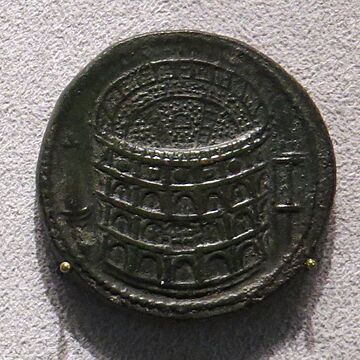
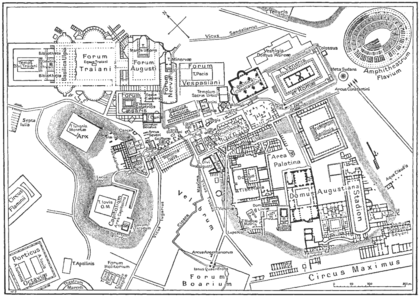
The Colosseum was built in a flat valley between several hills in Rome. This area was once a lake and part of Emperor Nero's huge palace, the Domus Aurea. After Nero's death, Emperor Vespasian decided to build the Colosseum here. This was a popular move, as it gave back land Nero had taken for himself. Unlike many other amphitheatres, the Colosseum was built right in the city center. This showed its importance to Rome.
The money for building the Colosseum came from treasures taken after the First Jewish–Roman War in 70 AD. An old inscription says Emperor Vespasian used his share of the war treasures to build it. Many people, including slaves and prisoners of war, likely worked on the construction. Skilled Roman builders, engineers, and artists also helped. The Colosseum was made from wood, limestone, tuff, tiles, cement, and mortar.
Construction began around 70–72 AD. By the time Vespasian died in 79 AD, the Colosseum was mostly built. His son, Titus, finished the top level in 80 AD. The first games were held in 80 or 81 AD. Records say that over 9,000 wild animals were killed during these opening games. Emperor Domitian, Vespasian's younger son, later added an underground area called the hypogeum. This area had tunnels for animals and performers. He also added more seating at the very top.
Changes Over Time
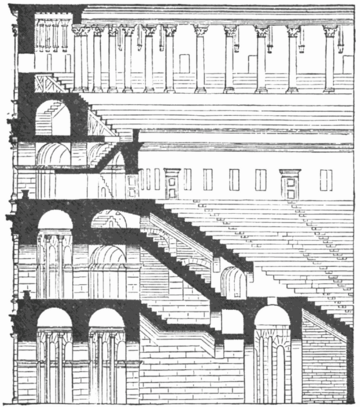
In 217 AD, a big fire, possibly caused by lightning, badly damaged the Colosseum. It took many years to fully repair. More repairs happened in 250, 252, and 320 AD. Gladiator fights were banned in 399 and again in 404 AD. The last mention of gladiator fights is around 435 AD. Animal hunts continued until at least 523 AD.
During the Middle Ages, the Colosseum was used differently. A small chapel was built inside it. The arena became a cemetery. The arched spaces under the seats were turned into homes and workshops. Around 1200, a powerful family, the Frangipani family, used it as a castle. In the 14th century, Rome's population dropped, and the Colosseum became a place for bandits.
A major earthquake in 1349 caused a large part of the outer wall to collapse. Much of the fallen stone was reused to build other structures in Rome. People also took stones from the inside, and marble was burned to make quicklime. Metal clamps holding the stones together were removed, leaving holes you can still see today.
The Colosseum in Modern Times
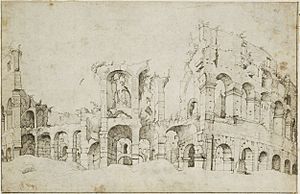
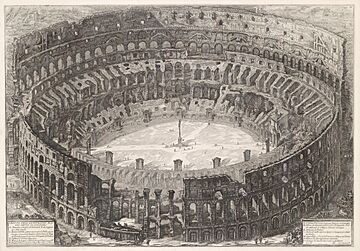
In the 16th and 17th centuries, Church leaders tried to find new uses for the Colosseum. Pope Sixtus V (1585–1590) wanted to turn it into a wool factory. This idea did not happen. In 1671, a cardinal allowed bullfights, but public protests stopped it.
In 1749, Pope Benedict XIV declared the Colosseum a sacred place. He believed early Christians had been killed there. He stopped people from taking stones from it and made it a holy site. He also added Stations of the Cross inside. However, there is no clear historical proof that many Christians were martyred specifically in the Colosseum.
Later popes worked to fix and restore the Colosseum. They removed plants that were damaging the walls. The outer walls were strengthened in the early 1800s. The inside was repaired in the 1830s and 1930s. The underground area was fully uncovered in the 1930s.
Today, the Colosseum is one of Rome's most visited places. Millions of tourists come each year. A big restoration project happened between 1993 and 2000. Another major restoration, funded by a shoe company, began in 2013 and finished in 2016. This project cleaned and repaired the outer walls. Funds have also been set aside to replace the arena floor. This new floor will allow for cultural events. Since November 2017, the top two levels have been open for guided tours.
The Colosseum has also become a symbol against the death penalty. Since 2000, its night lights change from white to gold when a death sentence is changed or abolished somewhere in the world.