The Bermuda Triangle
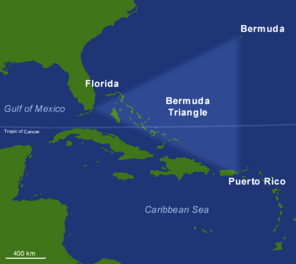
The Bermuda Triangle is a famous area in the North Atlantic Ocean. It is also known as the Devil's Triangle. This region is roughly marked by Florida, Bermuda, and Puerto Rico. For many years, people have told stories about ships and planes disappearing there. These stories often suggest strange or mysterious reasons for the disappearances. However, experts like the U.S. government and scientific organizations have looked into these events. They found no proof of anything unusual. Instead, they believe most incidents are due to natural weather, human mistakes, or misunderstandings.
How the Mystery Began
The idea of the Bermuda Triangle as a mysterious place began to grow in the mid-1900s. Before that, the nearby Sargasso Sea already had a reputation for ships getting lost.
The first time someone wrote about strange disappearances in the Bermuda area was in 1950. Edward Van Winkle Jones wrote an article for the Miami Herald. It talked about unusual events in that part of the ocean.
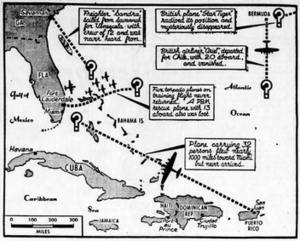
Two years later, in 1952, Fate magazine published an article. George X. Sand wrote "Sea Mystery at Our Back Door." This article was the first to describe the triangular area we know today. Sand wrote about several planes and ships that had gone missing since World War II. These included a cargo ship called Sandra and a group of five US Navy planes, Flight 19, in 1945. He also mentioned passenger planes like Star Tiger (1948) and Star Ariel (1949).
In 1962, The American Legion Magazine revisited the story of Flight 19. Author Allan W. Eckert wrote that the flight leader sounded confused. He reportedly said, "We cannot be sure of any direction... everything is wrong... strange... the ocean doesn't look as it should."
Then, in 1964, Vincent Gaddis wrote "The Deadly Bermuda Triangle" for Argosy magazine. He suggested that Flight 19 and other disappearances were part of a strange pattern. He claimed these events dated back to at least 1840. Gaddis later turned his article into a book called Invisible Horizons.
Other writers, like Charles Berlitz, also wrote books about the Bermuda Triangle. They often added supernatural ideas to explain the events.
Defining the Triangle Area
George X. Sand's article described the area as a "watery triangle." Its points were roughly Florida, Bermuda, and Puerto Rico. Vincent Gaddis later specified the points as Miami, San Juan, and Bermuda. However, not everyone agreed on the exact boundaries. The total size of the "triangle" could change a lot depending on who was describing it. Some even stretched it as far as the Irish coast! This means that whether an accident happened "inside" the triangle often depends on which writer you read.
Exploring Ideas About the Bermuda Triangle
People who believe the Bermuda Triangle is a real mystery have come up with many ideas. They try to explain why so many things supposedly disappear there.
Supernatural Ideas
Some writers have suggested magical or unexplained forces are at work. One idea blames technology left over from the mythical lost city of Atlantis. Sometimes, people connect this to the Bimini Road. This is a rock formation off the island of Bimini in the Bahamas. Some believe it's a road or wall from Atlantis, but scientists say it's a natural formation.
Other theories suggest a parallel universe exists in the area. This could cause a time or space warp that pulls things away. Some people even think UFOs are responsible for the disappearances. Charles Berlitz, a writer about strange events, listed many such theories. These ideas suggest unknown forces cause the losses in the Triangle.
Natural Explanations
Scientists and experts look for natural reasons behind the disappearances.
Compass Problems
Many stories mention compasses acting strangely in the Triangle. Some people thought there might be unusual magnetic spots there. However, no such spots have been found. Compasses naturally point to the magnetic north pole, not the true north pole. This difference is called magnetic variation. Navigators have known about this for hundreds of years. The magnetic north pole moves over time. So, a compass will show slightly different directions in different places. This natural change might seem mysterious to someone who doesn't know about it.
The Powerful Gulf Stream
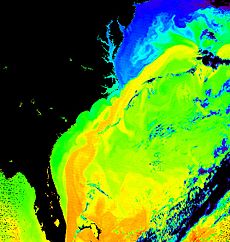
The Gulf Stream is like a huge, fast-moving river within the ocean. It starts in the Gulf of Mexico and flows north into the North Atlantic. This current can move very quickly, up to 2 meters per second. If a small plane lands on the water or a boat has engine trouble, the Gulf Stream can carry it far away. This makes finding the wreckage much harder.
Human Mistakes
Often, the simplest explanation for an accident is human error. This means someone made a mistake. For example, a businessman named Harvey Conover lost his yacht, Revonoc, in 1958. He sailed into a big storm south of Florida, which was a risky decision. Sometimes, people make bad choices or don't check their equipment properly.
Underwater Gas Pockets
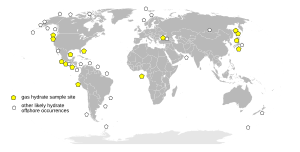
Another idea involves large pockets of methane gas under the sea. These are called methane hydrates. Scientists have done experiments showing that gas bubbles can make water less dense. If enough gas bubbles rise from the seafloor, a ship could lose its buoyancy and sink very quickly. This could happen without any warning.
The United States Geological Survey (USGS) has found many of these gas hydrate stores worldwide. However, the USGS says there's no evidence of large gas releases in the Bermuda Triangle for the last 15,000 years. So, while possible, it's not a recent explanation for disappearances.
Famous Incidents in the Bermuda Triangle Stories
Many specific events are often mentioned when people talk about the Bermuda Triangle. Here are some of the most well-known stories.
HMS Atalanta
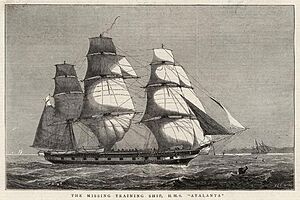
The training ship HMS Atalanta disappeared in 1880. She was sailing from the Royal Naval Dockyard, Bermuda to Falmouth, England with many inexperienced trainees. A powerful storm crossed her path a couple of weeks after she left. It's believed she sank in that storm. Her disappearance gained worldwide attention. Decades later, some linked her loss to the mysterious triangle. However, research by author David Francis Raine in 1997 strongly disagreed with this idea.
USS Cyclops
The USS Cyclops was a large ship carrying manganese ore. It went missing in 1918 with 306 people on board. This was the largest non-combat loss of life in US Navy history. The ship disappeared without a trace after leaving the island of Barbados. There's no single proven theory for its loss. Some ideas include storms, the ship tipping over, or even enemy action during World War I. Two similar ships, the Proteus and Nereus, also disappeared later during World War II. They were carrying heavy metal ore, too. Experts believe structural failure from being overloaded with dense cargo was the most likely cause for all three sinkings.
The Carroll A. Deering
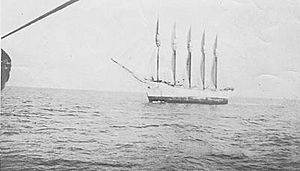
The Carroll A. Deering was a five-masted sailing ship. In 1921, it was found stuck on a sandbank near Cape Hatteras, North Carolina. The ship was completely empty and abandoned. The Federal Bureau of Investigation (FBI) looked into the mystery. They considered many ideas, like pirates or other groups. But they ruled out all these theories. The reason for the ship's abandonment remains a mystery.