Telephone
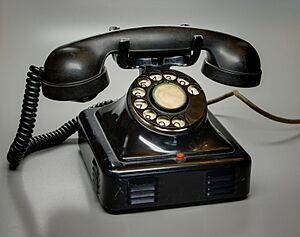
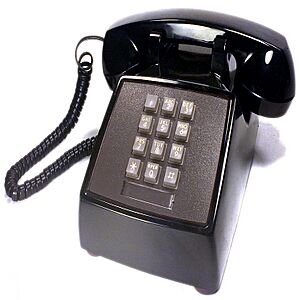
A telephone, often called a phone, is a device that lets two or more people talk to each other from far away. It changes your voice into electronic signals. These signals travel through wires or other channels to another phone. That phone then turns the signals back into sound so the other person can hear you. The word "telephone" comes from Greek words meaning "distant voice."
In 1876, Alexander Graham Bell received the first U.S. patent for a device that could clearly send human voices. Many others helped improve this invention. Soon, telephones became very important in homes, businesses, and governments around the world.
What is a Telephone?
A telephone is a communication tool that helps people talk over long distances. It takes sound, like your voice, and changes it into electrical signals. These signals then travel to another phone. That phone changes the signals back into sound for the person listening. This way, you can have a conversation even if you are miles apart.
How Does a Telephone Work?
Every telephone has two main parts: a microphone and an earphone. The microphone, also called a transmitter, is where you speak. It turns your voice's sound waves into electrical signals. The earphone, or receiver, is where you listen. It changes the electrical signals back into sound. These parts are usually together in a handset that you hold to your ear and mouth. Telephones allow people to talk and listen at the same time.
Most phones also have a way to tell you when someone is calling. This might be a ringing sound or a light. To make a call, you usually dial a telephone number using a keypad. This number tells the phone system where to send your call.
Who Invented the Telephone?
The idea of sending voices over wires was explored by many inventors. People like Antonio Meucci, Johann Philipp Reis, Alexander Graham Bell, and Elisha Gray all worked on similar devices.
Alexander Graham Bell was the first to get a patent for the electric telephone in the United States in March 1876. His invention used a special kind of electric current that could clearly reproduce sounds. This was a big step forward. Shortly after Bell's patent, Tivadar Puskás suggested the idea of a telephone switch. This allowed many phones to connect through a central point, creating telephone networks.
Connecting Calls: From Operators to Networks
The very first telephones were connected directly, one to another. This meant you needed a separate wire for each person you wanted to call. This was not practical for many people. Soon, central switchboards were created. Operators at these switchboards would manually connect your call to the person you wanted to reach.
Over time, these switchboards were linked together. This formed a huge, worldwide network called the public switched telephone network. Later, radio systems allowed people to use phones in cars and on ships. In 1973, the first handheld mobile phones were introduced. These early mobile phones used analog signals. Later, digital networks made mobile phones even better and more affordable.
Old Telephones: From Candlesticks to Rotary Dials
Early telephones looked very different from today's phones. Some used a special microphone that was very loud. These phones often needed a local battery to work. Technicians had to visit homes regularly to check these batteries.
At first, phones used a single wire, like old telegraphs. This could cause problems like hearing other conversations or buzzing sounds. Soon, two-wire systems were used, which worked much better.
To get an operator's attention, people would sometimes whistle into the phone! Later, phones got bells to announce incoming calls. Early automatic phone systems even used seven wires for different functions.
In the 1890s, a new style of phone appeared, often called a "candlestick" phone. It had a tall stand for the microphone. The receiver hung on a hook, which also acted as a switch. This made it easier to know if the phone was "on hook" (hung up) or "off the hook" (in use).
By the early 1900s, the familiar style of phone with a combined receiver and transmitter (a handset) in a single unit became popular. In the 1930s, rotary dial phones became common. You would spin a dial for each number. This allowed people to dial calls themselves without an operator. After World War II, phone networks grew quickly. In 1963, push-button telephones were introduced by AT&T. These phones used tones instead of clicks to dial numbers.
Special Phones: Sound-Powered Communication
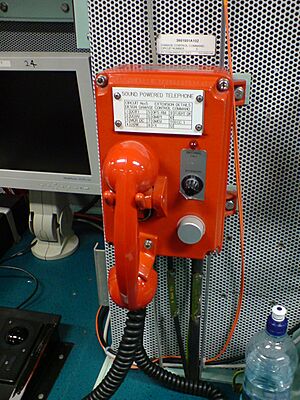
A sound-powered telephone is a special type of phone. It works using only the energy from your voice. It does not need batteries or an outside power source.
How Sound-Powered Telephones Work
When you speak into a sound-powered phone, your voice's sound waves create a small electrical signal. This signal travels through wires to the other phone. There, it is changed back into sound for the listener. To get someone's attention, these phones often have a hand-cranked generator. This generator makes a current that rings a buzzer on the other end.
Where Are Sound-Powered Telephones Used?
These phones are very useful in places where power might fail. They are often found in airports, on ships, in mines, and in military communications. Because they use very low voltage, they are also safe to use in places where there's a risk of explosions, like chemical plants. On naval ships, they have extra wiring to make sure they keep working even if parts of the ship are damaged.
The Digital Revolution: Internet Calls (VoIP)
The invention of the transistor in 1947 changed telephone technology a lot. Over many years, phones moved from analog to digital systems. This made phone calls clearer, cheaper, and allowed for more calls at once.
In the 1980s, ISDN brought digital phone services to homes and businesses. This included data, voice, and even video calls.
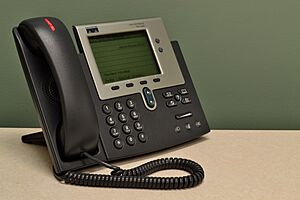
Later, the internet made it possible to send voices as digital data. This led to Voice over Internet Protocol (VoIP), or internet telephony. VoIP lets you make phone calls using your internet connection. This technology has become very popular. By 2005, many people in Japan and South Korea were already using digital phone services.
Today, VoIP is a major way people communicate. It uses fast internet connections and special equipment. You can use a special IP phone, an adapter for a regular phone, or even an app on your computer or smartphone. Modern VoIP also works with mobile networks like Voice over LTE (VoLTE) and Voice over 5G (Vo5G). This means you can make calls over your mobile data network. Unlike old analog phones, digital phones need their own power supply. Also, internet-based services need special ways to tell emergency services your location if you call for help.
Cordless Phones: Freedom to Move
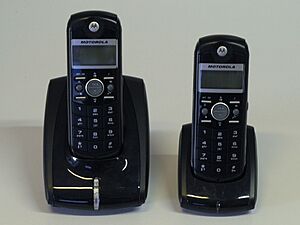
A cordless telephone lets you move around while talking. It has a base station that plugs into a phone line or uses internet calling (VoIP). The portable handset talks to the base station using radio signals. This means you can walk around your house or yard while on the phone.