Soccer
Association football, often just called football, is a super popular team sport. Two teams play against each other, trying to score goals. It's known as "football" in most parts of the world, like the United Kingdom. But in countries like the United States and Canada, people usually call it "soccer."
The rules we use today were first set in England in 1863 by a group called the Football Association. Each team has 11 players on the field. One player is the goalkeeper, who protects the goal. The other ten are "outfield players." The game involves kicking a ball into the opponent's goal. A match lasts 90 minutes, split into two 45-minute halves. There's a 15-minute break in the middle called half-time. Sometimes, extra time is added for delays like injuries.
The Story of Football: A Brief History
Early Ball Games Around the World
Ball-kicking games have been played in many cultures for a very long time. One of the earliest known games is cuju from China. It was first recorded during the Han dynasty (206 BCE – 220 CE). Players had to kick the ball without it touching the ground. They aimed to kick it through a high goal.
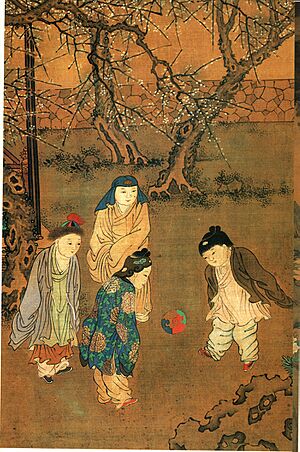
Other old games include kemari in Japan and episkyros in ancient Greece. The Romans also played a game called harpastum. These early games often involved both hands and feet. They were sometimes quite rough.
How Modern Football Began
In the Middle Ages, a game called calcio storico fiorentino was played in Florence, Italy. It was similar to modern football. However, these medieval games often involved more handling of the ball than kicking.
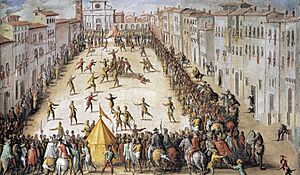
The modern rules of football came from efforts in England in the mid-1800s. Different schools played different versions of football. In 1848, the Cambridge rules were created to standardize the game.
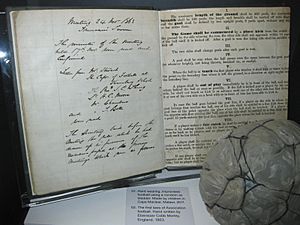
In 1863, the Football Association (FA) was formed in London. They published the first complete set of rules, called the Laws of the Game. These rules banned running with the ball in hand and kicking opponents. Some clubs disagreed with these rules and formed the Rugby Football Union later.
The world's oldest football competition is the FA Cup. It started in England in 1872. The first official international match was also in 1872, between Scotland and England. England also created the world's first football league in 1888.
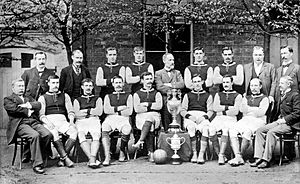
The International Football Association Board (IFAB) was formed in 1886. It includes representatives from the four British football associations. FIFA was created in Paris in 1904. FIFA agreed to follow the Laws of the Game set by the IFAB. FIFA joined the IFAB in 1913.
Football Today: A Global Sport
For most of the 20th century, Europe and South America were the strongest regions in football. The FIFA World Cup, which began in 1930, became the main event. It showed off the best players and national teams.
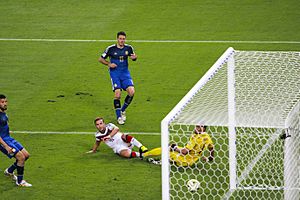
Today, South America still produces many top players. However, European clubs often sign the best players from around the world. Football has also grown a lot in Africa, Asia, and North America.
Football is played professionally everywhere. Millions of fans go to stadiums to watch games. Billions more watch on TV or online. Many people also play football just for fun. A 2001 FIFA survey found that over 240 million people play football regularly.
Football can create strong feelings and plays a big part in communities. For example, the Ivory Coast national football team helped bring peace during a civil war in 2006. They played a match in a rebel area, bringing both sides together peacefully. Sometimes, rivalries in football can become very intense, as seen in some historical events.
Girls and Women in Football
Early Challenges for Women's Football
Women have played football and similar games for a long time. Ancient Chinese art from the Han dynasty shows women playing cuju. There are also reports of women's football matches in Scotland in the 1790s.
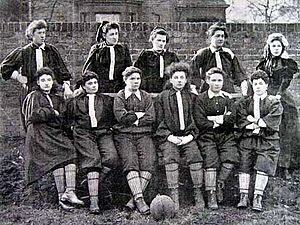
The first recorded women's football game in England was in 1895. An activist named Nettie Honeyball started the British Ladies' Football Club in 1894. She believed women playing football was part of women's rights. However, British football groups did not support women's football. Some thought it was not suitable for women.
Women's football became very popular during the First World War. Many women worked in factories and started playing. The Dick, Kerr Ladies F.C. was a very successful team. They played international matches in 1920. Women's matches often raised money for charity.
Despite drawing huge crowds, women's football in England faced a setback in 1921. The Football Association banned women from playing on their fields. They said football was "unsuitable for females." Many believed this ban was due to jealousy over the large crowds and money women's games attracted. Other countries also banned women's football for many years.
The Rise of Women's Football
Even with the bans, women in Britain kept playing football. Restrictions began to ease in the late 1960s and 1970s. The Women's Football Association was formed in England in 1969. In 1971, UEFA officially recognized women's football. The Football Association also lifted its ban in England that same year.

Women's football still faces challenges, but it has grown worldwide. Major competitions now exist at both national and international levels. The FIFA Women's World Cup started in 1991 in China. It featured 12 teams. By the 2019 tournament, it had 24 teams. Over 1.12 billion people watched it. The 2023 FIFA Women's World Cup had 32 teams and aimed for 2 billion viewers. Women's football has also been an Olympic sport since 1996.
North America is a strong region in women's football. The United States has won many World Cups and Olympic tournaments. Europe and Asia are also very successful.
How to Play Football: The Basics
Football follows the Laws of the Game. It uses a round ball, about 68 to 70 centimeters (27–28 inches) around. Two teams of eleven players try to score goals. A goal is scored when the ball goes between the posts and under the crossbar. The team with more goals wins. If scores are equal, it's a draw. Each team has a captain. Their main job is to represent the team at coin tosses.
Players, except goalkeepers, cannot touch the ball with their hands or arms during play. However, they use both hands for a throw-in. Players usually kick the ball, but they can use their head (a "header"), chest, or thighs. Players can move anywhere on the field. They cannot pass to a teammate who is in an offside position.
Players try to create chances to score. They do this by dribbling the ball, passing to teammates, and shooting at the goal. Opponents try to get the ball back by intercepting passes or tackling. Physical contact between players is limited by the rules. Football is a continuous game. Play stops only when the ball leaves the field or the referee blows the whistle for a rule break.