Seeds
A seed is a tiny package from a plant that can grow into a brand-new plant! It's like a special container that protects a baby plant and gives it food until it's ready to sprout. Every seed has three main parts:
- A tiny embryo (the baby plant).
- A supply of nutrients (food) for the embryo.
- A protective seed coat.
There are so many different kinds of seeds! Some plants make tons of tiny seeds, while others make just a few big ones. Seeds are often hard and very small, but some, like the coconut, are huge! When seeds are first formed, they are usually dormant, which means they are resting inside their coat. When a seed is ready to grow, it needs water, air, and warmth. It does not need sunlight to start growing into a seedling.
Seeds carry the food that helps the new plant begin to grow. This food is stored in a part called the endosperm or in special leaves called cotyledons. Many seeds are important food for animals and people. Think of rice, wheat, and maize (corn) – these are all seeds that we eat! Seeds are often found inside fruits.
How Seeds Are Made
Seeds from flowering plants (called angiosperms) grow inside a structure called a fruit. This fruit can be hard or soft and fleshy, and it protects the seeds as they develop. For example, an apple is a fruit that protects its seeds inside.
Other plants, like conifers (gymnosperms), don't have fruits. Their seeds start growing "naked" on the scales of cones. As the seeds grow, the cone scales usually cover them up for protection.
The number of seeds plants produce can change a lot each year. Things like weather, insects, and diseases can affect how many seeds a plant makes. Sometimes there are lots of seeds, and sometimes there are only a few.
Seed Development and Life Cycle
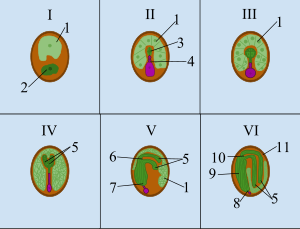
II Proembryo
III Globular IV Heart
V Torpedo
VI Mature Embryo Key: 1. Endosperm 2. Zygote 3. Embryo 4. Suspensor 5. Cotyledons 6. Shoot Apical Meristem 7. Root Apical Meristem 8. Radicle 9. Hypocotyl 10. Epicotyl 11. Seed Coat
In flowering plants, seeds have three parts that come from different genetic sources:
- The embryo, which is the baby plant.
- The endosperm, which is the food supply.
- The seed coat, which comes from the mother plant's tissue.
Seed development starts after a process called double fertilization. This is when two male cells join with different parts of the plant's egg cell. One joining creates the embryo, and the other creates the endosperm. The endosperm grows quickly to provide food for the young plant until its roots can grow after germination.
Ovule
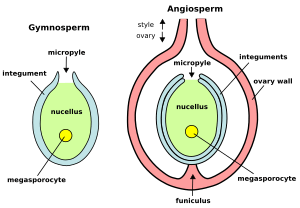
After fertilization, the ovules inside the plant's ovary develop into seeds. The ovule has several parts:
- The funicle (or seed stalk) connects the ovule to the plant's ovary wall.
- The nucellus is the main part of the ovule where the baby plant develops.
- The micropyle is a small opening where the pollen tube usually enters during fertilization.
- The chalaza is the base of the ovule.
The shape of the ovules often affects the final shape of the seeds.
Embryo

The embryo is the most important part of the seed because it's the actual baby plant. It has several key parts:
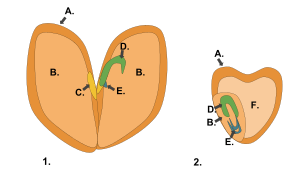
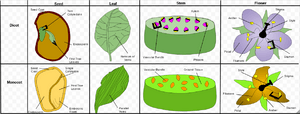
- The cotyledons are the seed leaves. Some plants, called monocots, have one cotyledon. Most other plants, called dicots, have two. These cotyledons can also store food for the embryo.
- The epicotyl is the part of the stem above the cotyledons.
- The plumule is the very tip of the epicotyl. It looks feathery and will grow into the plant's shoot (stem and leaves) when the seed sprouts.
- The hypocotyl is the part of the stem below the cotyledons. It connects the epicotyl to the root.
- The radicle is the very tip of the hypocotyl. It will grow into the plant's first root.
Seed Shape and Look

Seeds come in many different shapes and sizes. Some common shapes include:
- Bean-shaped (like a kidney bean).
- Square or Oblong (longer than wide).
- Triangular (three-sided).
- Elliptic or Ovate (rounded, like an egg).
- Discoid (like a disc or plate).
- Globose (spherical) or subglobose (almost spherical).
Most seeds are brown or black, but some can be other colors. Their surfaces can be smooth and shiny or rough. Some seeds even have special parts or textures on their coats.
Seed Structure
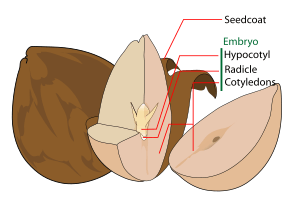
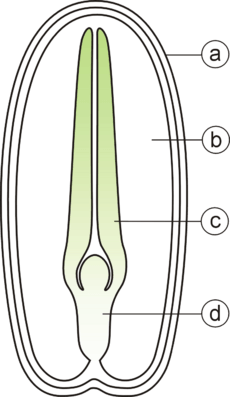
A typical seed has two main parts:
- An embryo (the baby plant).
- A seed coat (the protective outer layer).
Many seeds also have an endosperm, which is a supply of food for the embryo. This is especially true for monocots and some dicots.
Embryo
Inside the seed coat, there's the embryo, which is the young plant ready to grow. The embryo has one seed leaf (cotyledon) in monocots, two in most dicots, and sometimes more in gymnosperms.
Nutrient Storage
Seeds usually have a store of food for the seedling that will grow from the embryo. This food helps the young plant get a strong start before it can make its own food through photosynthesis.
Size and Number of Seeds

Seeds vary greatly in size. Orchid seeds are incredibly tiny, like dust, with about a million seeds in just one gram!
Plants that make smaller seeds can produce many more of them from each flower. Plants with larger seeds put more energy into each seed, so they usually make fewer. Small seeds ripen faster and can spread more quickly. Many annual plants (plants that live for one year) make lots of small seeds to make sure at least a few find a good place to grow.
Perennial plants (plants that live for many years) and woody plants often have larger seeds. These seeds have more food stored, which helps the seedling grow bigger and stronger right after it sprouts.
What Seeds Do
Seeds have several important jobs for the plants that make them:
- They feed the embryo.
- They help the plant spread to new places (this is called dispersal).
- They allow the plant to rest during bad conditions (this is called dormancy).
Seeds are also how most plants reproduce. They are usually the result of sexual reproduction, which mixes up genetic material and helps plants adapt to their environment.
Embryo Nourishment
Seeds protect and feed the baby plant inside. They give a seedling a much better start than a sporeling (a plant growing from a spore) because seeds have more food stored and a more developed embryo.