Sea Turtles
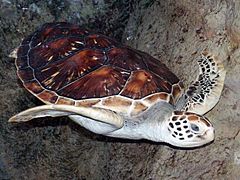
Sea turtles (Chelonioidea) are amazing creatures that live in almost all the world's oceans. They are a type of turtle that spends most of its life in the sea. You won't find them in the very cold Arctic Ocean. Some sea turtles even travel across entire oceans!
There are seven main types of sea turtles. These include the Kemp's Ridley, Flatback, Green, Olive Ridley, Loggerhead, Hawksbill, and the Leatherback. All of these, except the Leatherback, belong to the Chelonioidea family. The Leatherback sea turtle is special because it's the only member of its own family, Dermochelyidae.
The Leatherback sea turtle is the biggest of them all. It can grow up to 2 meters (6-7 feet) long and weigh as much as 900 kilograms (2000 pounds)! Most other sea turtles are smaller, usually around 0.5 to 1 meter (2-4 feet) long. The Flatback turtle is unique because it only lives off the northern coast of Australia.
What Sea Turtles Look Like
Both male and female sea turtles are usually the same size. This means there isn't a big difference in how they look based on their gender.
Sea turtles have a special body shape that helps them swim fast. Their bodies are smooth and tapered at both ends, like a torpedo. This shape helps them move easily through the water. Unlike other turtles, sea turtles cannot pull their heads or flippers into their shells for protection. But their streamlined body helps them glide through the ocean.
Sea turtles are reptiles that breathe air. They have lungs, just like us. This means they need to come to the surface of the water regularly to take a breath.
Where Sea Turtles Live
You can find sea turtles in all oceans, except for the very cold areas near the North and South Poles. The Flatback sea turtle, as mentioned, lives only near northern Australia. The Kemp's Ridley sea turtle is found mostly in the Gulf of Mexico and along the East Coast of the United States.
Young sea turtles often spend their first few years floating in large mats of seaweed in the open ocean. These seaweed mats, like those made of Sargassum, offer them a safe place to hide, find food, and get water. Once they grow up, sea turtles move closer to the shore. Female sea turtles will then come onto sandy beaches to lay their eggs.
Sea turtles often travel very long distances to reach their special nesting beaches. Their large size helps them travel far and also protects them from big ocean predators like sharks.
Sea Turtle Life Cycle
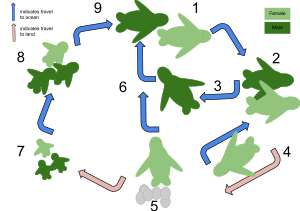
The life of a sea turtle starts on a sandy beach. After hatching, baby turtles crawl to the ocean and swim out to find food. When they are old enough, they travel to special breeding areas to find a mate. After mating, females go back to the beach to lay their own eggs, starting the cycle again. Males return to their feeding areas until it's time to mate again.
How Sea Turtles Reproduce
It takes many years for sea turtles to become old enough to have babies. Once they are mature, they might travel thousands of miles to reach their breeding spots. After mating in the ocean, the adult female sea turtles swim to land to lay their eggs.
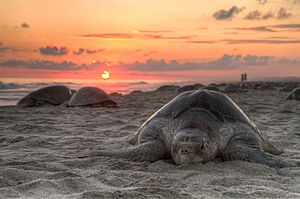
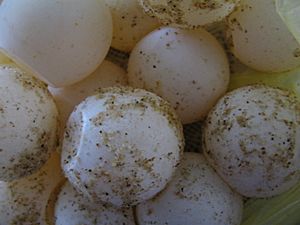
The female turtle usually comes ashore at night. She uses her back flippers to dig a round hole about 40 to 50 centimeters (16-20 inches) deep. After the nest is ready, she lays her soft-shelled eggs. A group of eggs is called a clutch. Depending on the type of turtle, a clutch can have anywhere from 50 to 350 eggs!
Once the eggs are laid, she covers the nest with sand. She smooths out the surface and even uses plants to hide it so it's hard to spot. This whole process takes about 30 to 60 minutes. Then, she returns to the ocean, leaving her eggs to hatch on their own.
A female turtle might lay 1 to 8 clutches of eggs in one nesting season. Most sea turtle species lay their eggs alone. But Ridley sea turtles are different. They come ashore in huge groups to lay their eggs. This event is called an arribada, which means "arrival." Kemp's Ridley sea turtles even do this during the day!
The temperature of the sand where the eggs are buried decides if the baby turtle will be male or female. Warmer sand usually means more female hatchlings, while cooler sand produces more males. The eggs stay in the nest for about 50 to 60 days. All the eggs in one nest usually hatch around the same time.
Baby sea turtles break out of their shells, dig their way through the sand, and then crawl to the sea. Most sea turtles hatch at night. However, Kemp's Ridley sea turtles often hatch during the day. Nests that hatch during the day are more at risk from predators and human activity on the beach. Bigger baby turtles tend to survive better because they can swim faster and escape predators more easily.
What Sea Turtles Eat
Many sea turtles are omnivores, meaning they eat both plants and animals. This includes Loggerhead, Kemp's Ridley, Olive Ridley, and Hawksbill sea turtles. They might eat crabs, seagrass, seaweed, sponges, snails, jellyfish, starfish, worms, and even small fish. However, some sea turtle species prefer specific foods.
Green sea turtles change their diet as they grow. When they are young, they eat both plants and animals. But as they get older, they become herbivores, eating only plants like seagrass and algae. Their jaws are even specially shaped to help them eat these plants.
Leatherback sea turtles mostly eat jellyfish. They play an important role in controlling jellyfish populations in the ocean.
Hawksbill sea turtles love to eat sponges. Sponges make up a huge part of their diet, sometimes 70-95% of what they eat in the Caribbean Sea.
Who Hunts Sea Turtles
Most sea turtle deaths happen when they are very young. Sea turtles lay around 100 eggs at a time, but usually only one of those baby turtles will survive to become an adult. Animals like raccoons, foxes, and seabirds might dig up nests or eat the tiny hatchlings as they try to reach the ocean. Once in the water, young turtles can be eaten by seabirds, large fish, and even other sea turtles.
Adult sea turtles have very few natural enemies. Large ocean predators like sharks and crocodiles are their biggest threat. Sometimes, land animals like jaguars have been known to attack nesting female turtles on the beach.