Rabbits
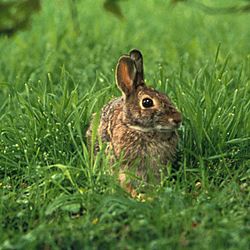
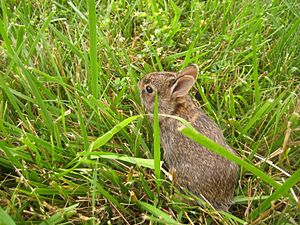
Rabbits are furry mammals. They belong to a group called Lagomorpha, which also includes hares and pikas. There are about 50 different kinds of rabbits and hares around the world. Wild rabbits live in burrows, which are tunnels they dig underground. A group of rabbits living together in a burrow is called a warren. Rabbits are well-known for their hopping and love for carrots.
A male rabbit is called a buck, and a female is called a doe. A baby rabbit is called a kit, which is short for kitten. Female rabbits are pregnant for about 31 days. They can have up to 12 or 13 babies at one time. Sometimes they have as many as 18 or as few as one. Some people keep rabbits as pets. Rabbits are also raised for their meat and fur.
Rabbits are prey animals, meaning other animals hunt them for food. They are very careful in open areas. If they sense danger, they stop moving and watch. Rabbits have a very wide field of vision, even above their heads. Their enemies include foxes, dogs, bears, raccoons, minks, weasels, and snakes. Birds of prey also hunt rabbits. Sometimes people hunt rabbits because they eat crops. When rabbits feel threatened, they quickly run to their burrows, where they are usually safe.
Rabbits have a complex social life. Like dogs, they have a social order. Rabbit ears have several uses. Their main job is to warn of predators. They may also be used for sending signals and for controlling their body temperature.
Rabbit Types and Classification
Rabbits and hares used to be grouped with Rodents until 1912. Then, they were moved into their own group called Lagomorpha. This group also includes pikas. Below are some different kinds of rabbits.
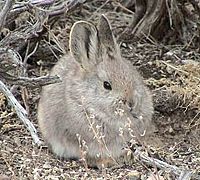
Pygmy rabbit
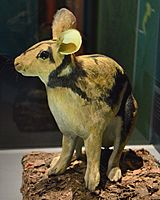
Sumatran Striped Rabbit
(Model)
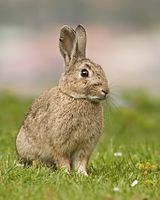
European rabbit
(Feral Tasmanian specimen)
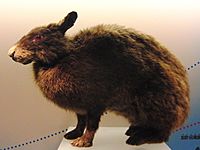
Amami rabbit
(Taxidermy specimen)
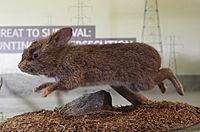
Volcano rabbit
(Taxidermy specimen)
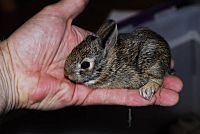
Swamp rabbit
(Juvenile)
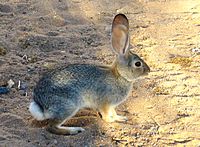
Desert cottontail
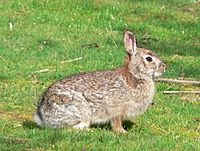
Brush rabbit
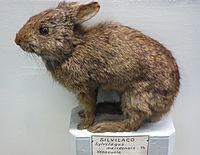
Tapeti
(Taxidermy specimen)
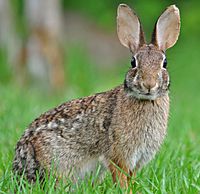
hefneri
Lower Keys
marsh rabbit
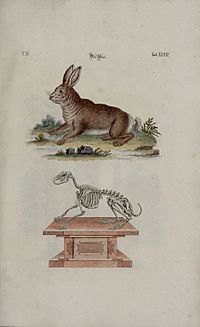
Johann Daniel Meyer (1748)
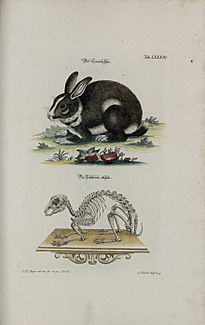
Johann Daniel Meyer (1748)
How Rabbits are Different from Hares
Hares are born with fur and can see and move around soon after birth. Rabbits, however, are born without fur and are blind. They need more care from their mothers. Hares and cottontail rabbits usually live alone in simple nests above ground. Most other rabbits live in social groups underground in burrows or warrens.
Hares are generally bigger than rabbits. They have longer ears and longer, larger back legs. Hares have not been tamed by humans. But many kinds of European rabbits are raised as farm animals and kept as pets.
Reproduction and Life Cycle
Rabbits have a short gestation period, usually around 31 days. A longer pregnancy often means a smaller litter of babies. A shorter pregnancy usually means a larger litter. A female rabbit can have between 4 and 12 babies at a time. This means she can give birth to up to 60 new kits in a year. After giving birth, the female can become pregnant again as soon as the next day.
Where Rabbits Live
Rabbits live in many places, including meadows, woods, forests, grasslands, deserts, and wetlands. They live in groups. The most famous type, the European rabbit, lives in underground burrows. A group of burrows is called a warren.
More than half of the world's rabbits live in North America. They are also found in southwestern Europe, Southeast Asia, Sumatra, some islands of Japan, and parts of Africa and South America. They are not naturally found in most of Eurasia, where many kinds of hares live instead. Rabbits came to South America more recently. Most of South America has only one type of rabbit, the tapeti. The very southern part of South America has no rabbits.
The European rabbit has been introduced to many places around the world by humans.
Environmental Challenges
When humans introduce rabbits into new wild areas, they can cause environmental problems. Because rabbits eat a lot and breed very quickly, large groups of wild rabbits can harm farms. People have tried different ways to control rabbit numbers. These include using gas, building fences, shooting, trapping, and using ferrets.
The most effective ways to control rabbits are diseases like myxomatosis and calicivirus. In Europe, where rabbits are farmed, they are protected from these diseases with a special vaccine. This vaccine was made in Spain and helps rabbit farmers. If this vaccine got into wild rabbit groups in places like Australia, it could cause a huge increase in rabbit numbers. This is because these diseases are the biggest threats to wild rabbits there. In Australia and New Zealand, rabbits are such a big problem that landowners are legally required to control them.
Rabbits for Food and Clothing
In some areas, wild rabbits and hares are hunted for their meat. Rabbit meat is a good source of protein. In the wild, people hunt them using trained falcons, ferrets, or dogs. They also use traps or rifles. A caught rabbit can be quickly killed with a sharp blow to the back of its head. The term rabbit punch comes from this practice.
Most rabbit meat eaten around the world comes from farm-raised rabbits. These are descendants of the European rabbit (Oryctolagus cuniculus). Raising rabbits for meat is called cuniculture. In 1994, countries like Malta, Italy, and Cyprus ate the most rabbit meat per person. Rabbit meat used to be common in Sydney, Australia. But its popularity dropped after the myxomatosis virus was brought in to control the many wild rabbits there.
In the United Kingdom, fresh rabbit is sold in butcher shops. Some supermarkets sell frozen rabbit meat. Rabbit meat is also a part of Moroccan cooking. In China, especially in Sichuan cuisine, rabbit meat is very popular. You can find stewed rabbit, spicy diced rabbit, and even spicy rabbit heads.
Besides meat, rabbits are used for their wool, fur, and pelts. Their waste is also used as fertilizer. Some rabbit breeds, like the famous Angora rabbit, are raised specifically for these products.
Rabbits in Stories and Culture
Rabbits are often seen as a symbol of new life and fertility. They have long been linked to spring and Easter, like the Easter Bunny. Because they are prey animals with few ways to defend themselves, rabbits often represent being vulnerable and innocent. In old stories and modern children's books, rabbits are often kind characters. They can easily connect with young people, like the Velveteen Rabbit or Thumper in Bambi.
Rabbits are also known for being fast, quick, and tough. You can see this in marketing symbols like the Energizer Bunny and the Duracell Bunny.
Folklore and Mythology
The rabbit often appears in folklore as a trickster. This means it uses its cleverness to outsmart its enemies.