Pablo Picasso
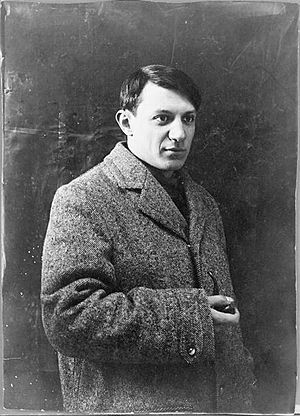
Pablo Ruiz Picasso (born October 25, 1881 – died April 8, 1973) was a famous Spanish artist. He was a painter, sculptor, printmaker, ceramicist, and theatre designer. Picasso was one of the most important artists of the 20th century. He is best known for helping to create the Cubist art movement.
Early Life and Art Talent
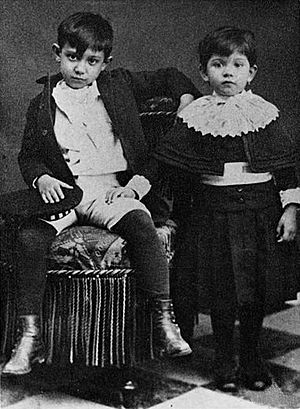
Picasso was born in Málaga, a city in southern Spain, on October 25, 1881. He was the first child of Don José Ruiz y Blasco and María Picasso y López. His family was middle-class.
Picasso's father was a painter and an art professor. He taught art at a school and was a museum curator. Picasso showed a great talent for drawing from a very young age. From age seven, his father taught him how to draw figures and paint with oils. His father believed in traditional art training. This meant copying famous artworks and drawing from plaster models.
In 1891, Picasso's family moved to A Coruña. His father became a professor at the School of Fine Arts there. One time, his father found 13-year-old Picasso painting over his unfinished sketch of a pigeon. His father felt that Picasso had already become a better artist than him.
In 1895, Picasso's seven-year-old sister, Conchita, died from diphtheria. This was a very sad event for him. After her death, the family moved to Barcelona.
Education and Artistic Growth
Picasso's father convinced art officials to let his son take an entrance exam. This was for an advanced art class. Most students took a month to complete the exam. Picasso finished it in just one week, and he was accepted at only 13 years old.
As a student, Picasso was not very disciplined. But he made important friendships that helped him later in life. His father rented a small room for him to work alone. However, his father often checked on him and judged his drawings. They argued frequently about his work.
Picasso's father and uncle decided to send him to Madrid. He went to the Real Academia de Bellas Artes de San Fernando. This was the best art school in Spain. At 16, Picasso left home. He soon stopped going to classes. He did not like the formal way they taught art.
Instead, he spent his time at the Museo del Prado. He studied paintings by famous artists like Diego Velázquez and Francisco de Goya. Picasso especially admired the works of El Greco. You can see elements like long limbs and strong colors from El Greco in Picasso's later art.
Picasso's Art Periods
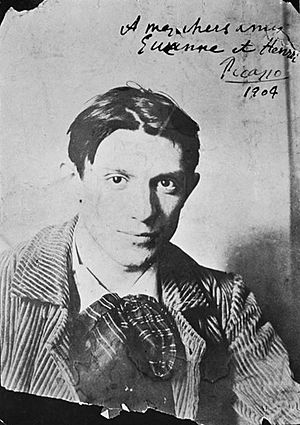
Picasso's art is often divided into different periods. Each period shows a different style or theme.
The Blue Period: 1901–1904
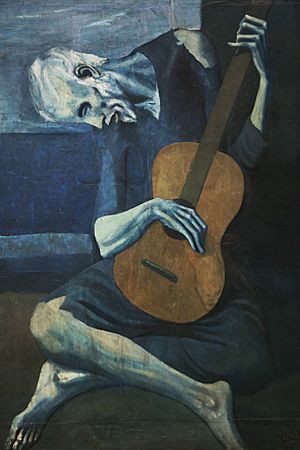
Picasso's Blue Period started around 1901. It is called this because he mostly used shades of blue and blue-green in his paintings. These artworks often showed sad or lonely people.
The Rose Period: 1904–1906
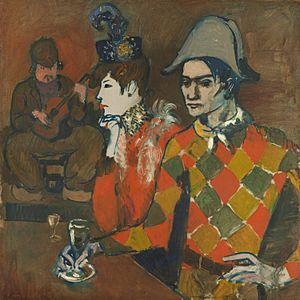
The Rose Period followed the Blue Period, from 1904 to 1906. In this time, Picasso used more orange and pink colors. Many of his paintings featured circus performers, acrobats, and harlequins.
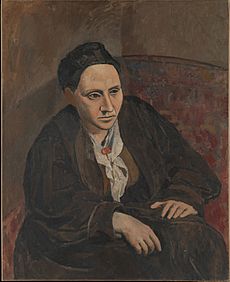
By 1905, Picasso became popular with American art collectors. These included Leo and Gertrude Stein.
African-Influenced Period: 1907–1909
Picasso's African-influenced Period began in 1907. His painting Les Demoiselles d'Avignon marks the start of this time. When he first showed this painting, many people were shocked. Picasso did not show Les Demoiselles publicly until 1916. The ideas from this period led directly to Cubism.
Analytic Cubism: 1909–1912
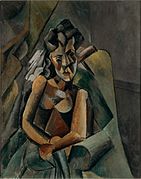
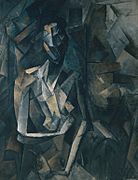
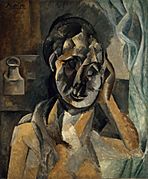
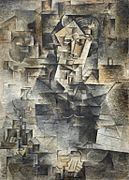
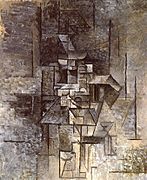
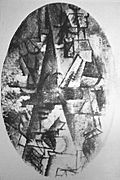
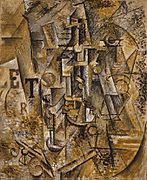
Analytic Cubism was a painting style Picasso developed with his friend Georges Braque. They used mostly brownish and neutral colors. Both artists would break objects apart and "analyze" them using different shapes. Their paintings from this time look very similar.
Synthetic Cubism: 1912–1919
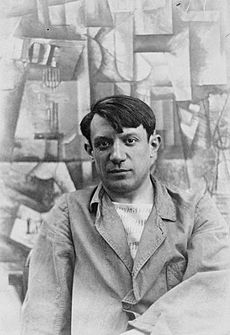
Synthetic Cubism was a new step in the Cubist style. Artists started pasting cut paper pieces into their artworks. These pieces were often wallpaper or newspaper. This was the first time collage was used in fine art.
Between 1915 and 1917, Picasso painted many geometric and simple Cubist objects. These often included a pipe, a guitar, or a glass. Sometimes, he added collage elements.
Neoclassicism and Surrealism: 1919–1929
In 1917, Picasso visited Italy for the first time. During this period, he created art in a neoclassical style. His paintings from this time often looked like the works of older masters like Raphael.
In 1925, Picasso took part in the first Surrealist art show in Paris. Between 1924 and 1926, he often painted abstract still lifes. In 1928, he began making sculptural artworks.
Before World War II
In 1936, Picasso became the director of the Prado-Museum in Madrid. During this time, the Spanish Civil War began. German bombs fell on the town of Guernica in Spain on April 26, 1937.
Picasso was deeply affected by this event. He used his feelings to paint one of his most famous works, Guernica. He finished this large painting in about two months. It was first shown in Paris in 1937.
During World War II
In 1938, Picasso's mother passed away. When World War II started in September 1939, Picasso returned to Paris. In 1941, he wrote his first play, Desire Caught by the Tail. It was first performed in 1944. Also in 1944, Picasso joined the Communist Party. He spent most of the war in Paris.
Picasso's Family Life
Picasso was married two times. He had four children with three different women:
- Paulo (born 1921 – died 1975) with Olga Khokhlova
- Maya (born 1935 – died 2022) with Marie-Thérèse Walter
- Claude (born 1947) with Françoise Gilot
- Paloma (born 1949) with Françoise Gilot
Photographer and painter Dora Maar was a close friend and companion of Picasso. They were closest in the late 1930s and early 1940s. Dora Maar took many photos while Picasso was painting Guernica.
Death
Pablo Picasso died on April 8, 1973, in Mougins, France. He was 91 years old. He passed away from lung problems and heart failure while having dinner with friends. He was buried at his Château of Vauvenargues.