Owls

Owls are amazing birds that belong to the order Strigiformes. There are over 200 different kinds of owls! Most owls live alone and hunt at night. They are known as birds of prey because they hunt other animals for food.
Owls have a special look: they stand upright, have a big, wide head, and can see with both eyes at once (this is called binocular vision). They also have great hearing, sharp talons, and feathers that help them fly silently. Not all owls are nocturnal; for example, the northern hawk-owl hunts during the day.
Owls mainly hunt small mammals, insects, and other birds. Some types of owls are even good at catching fish. You can find owls almost everywhere on Earth, except for the very cold polar ice caps and some faraway islands.
Owls are grouped into two main families: the true (or typical) owls (Strigidae) and the barn-owls (Tytonidae).
Did you know that a group of owls is called a "parliament"?
Owl Body Features


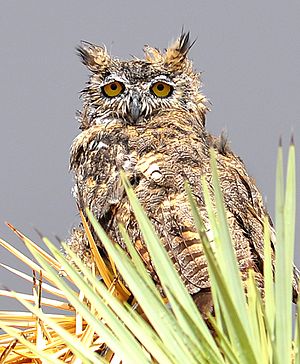
Owls have large eyes that face forward, just like humans. Their ear holes are also big. They have a hawk-like beak and a flat face. Around their eyes, you'll often see a circle of feathers called a facial disc. These feathers can be moved to help the owl hear sounds better, focusing them towards their ears.
Most birds of prey have eyes on the sides of their heads. But owls' forward-facing eyes give them excellent depth perception. This helps them hunt in low light. Even though their eyes are large, owls cannot move them in their sockets. Instead, they turn their whole head to look around. Owls are also farsighted, meaning they can't see things clearly if they are very close to their eyes. They use special hair-like feathers on their beak and feet to feel their prey. Their vision, especially in the dark, is incredibly good.
Owls can turn their heads and necks as much as 270 degrees! This is because they have 14 neck bones, while humans only have seven. Their bodies are also designed so that turning their head doesn't stop blood flow to their brain.
The smallest owl is the elf owl (Micrathene whitneyi), which weighs about 31 grams (1.1 ounces) and is about 13.5 centimeters (5.3 inches) long. The largest owls are the Eurasian eagle-owl (Bubo bubo) and Blakiston's fish owl (Bubo blakistoni). The biggest females of these species can be 71 cm (28 in) long, have a wingspan of 190 cm (75 in), and weigh 4.2 kg (9.3 lb).
Different owls make different sounds. These calls help owls find mates or tell other owls where they are. Scientists who study birds also use these calls to find and identify different owl species. The facial disc helps owls direct sounds to their ears, and in many species, these discs are placed unevenly for even better sound location.
Most owls have feathers that help them blend in with their surroundings. Some species also have special markings on their faces or heads, like face masks or ear tufts. These markings are more common in owls that live in open areas and might be used to communicate with other owls when it's dark.
Differences Between Male and Female Owls
Sexual dimorphism means there are physical differences between males and females of the same species. Female owls are usually larger than males. This size difference can vary among different owl groups.
One idea is that male owls are smaller so they can be better at finding food. Being able to get more food is helpful during breeding season. In some owl species, the female stays in the nest with the eggs, and the male brings food back. If there isn't much food, the male eats first before feeding the female. Smaller, more agile birds are an important food source for owls. Male burrowing owls, for example, have longer wings than females, even though they are smaller. This suggests that smaller bodies and long wings help them catch prey better.
Another idea is that since female owls often stay in the nest, being larger helps them go longer without food if needed. Larger females might also be better at tearing apart prey to feed their young.
A third idea suggests that larger female owls can choose their mates and might even scare away males they don't like. So, smaller male owls might have been chosen over time because they can escape from females who aren't interested.
How Owls Hunt
All owls are meat-eaters and hunt for their food. They eat insects, small rodents, and rabbits. Some owls are even specially adapted to catch fish. Owls are very skilled hunters in their environments. Since they live all over the world, their hunting skills can vary a bit, but most owls share similar traits.
Silent Flight and Special Feathers
Most owls can fly almost silently and often more slowly than other birds of prey. Since many owls hunt at night, flying without making noise gives them a big advantage. Their prey won't hear them coming! Silent flight isn't as important for owls that hunt during the day, as their prey can usually see them.
Owl feathers are generally larger than average bird feathers. They have special serrated (saw-like) edges on their flight feathers. These edges help reduce air disturbances, making their wing flaps nearly silent. The surface of their flight feathers also has a soft, velvety texture that absorbs sound. These unique features reduce sounds above 2,000 Hz, which is higher than what most of their prey can hear. This means the owl can fly silently to catch prey without being heard, and it can also hear any sounds its prey makes.
The special feathers that allow silent flight mean that barn owl feathers are not waterproof. They can't use the special oils or dust that other birds use to make their feathers waterproof. This means that in wet weather, barn owls can't hunt, which can be a big problem, especially when they have young. Barn owls are sometimes found drowned in water troughs because they land to drink or bathe but can't climb out. Owls also have many soft, downy feathers to help them stay warm since their outer feathers aren't waterproof.
Amazing Vision
An owl's eyesight is very important for hunting at night. Owls are one of the few bird groups that hunt in the dark without using echolocation (like bats do). Owls are known for their very large eyes compared to the size of their skulls. Their eyes are shaped like tubes and are fixed in their sockets. This means they can't move their eyes. Instead, owls turn their heads almost all the way around (about 270 degrees) to see their surroundings. This ability helps them see behind them without moving their body, which keeps them quiet while waiting for prey.
Owls have eyes that are placed very far forward, giving them a wide field of binocular vision. They are farsighted, so they can't focus on things that are just a few centimeters from their eyes. Their large eyes and special vision help them see much better than their prey in the dark.