Lizards
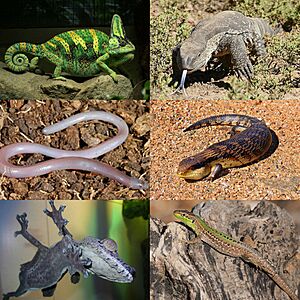
A lizard is a type of reptile that belongs to a large group called squamates. This group includes all squamates except snakes and amphisbaenians. There are over 7,000 different kinds of lizards! They live on every continent except Antarctica and on many oceanic island chains.
The term "lizard" describes a group that is not a true family in biology (it's called paraphyletic). This means some lizards are actually more closely related to snakes than they are to other lizards. Lizards come in many sizes. Some chameleons and geckos are only a few centimeters long. The biggest lizard is the Komodo dragon, which can be 3 meters (about 10 feet) long!
Most lizards have four legs and move with a strong side-to-side wiggle. Some lizards, called "legless lizards," have lost their legs over time and look like snakes. A few lizards, like the Draco from forests, can even glide through the air. Lizards often protect their territory. Males might fight other males and use bright colors to attract mates or scare off rivals. Most lizards eat meat. Many smaller species are sit-and-wait predators that eat insects. The Komodo dragon can eat large mammals like water buffalo.
Lizards have many ways to protect themselves from predators. These include venom, camouflage, reflex bleeding, and the amazing ability to drop and regrow their tails.
Lizard Anatomy
Size: From Tiny to Giant
Lizards come in a huge range of sizes. The smallest are only a few centimeters long. Examples include chameleons like Brookesia micra and geckos like Sphaerodactylus ariasae. The largest living lizard is the Komodo dragon. It can grow to almost 3 meters (10 feet) long. Most lizards are quite small animals.
What Makes a Lizard Unique?
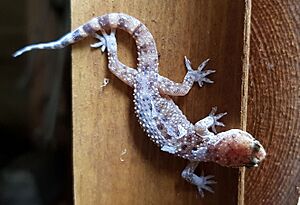
Lizards usually have round bodies, heads on short necks, four legs, and long tails. However, some species are legless. Lizards and snakes both have a special movable bone in their jaw called a quadrate bone. This helps them open their mouths very wide. This bone is different from the more rigid skulls of rhynchocephalians (like the tuatara). Some lizards, like chameleons, have prehensile tails. These tails can grip branches, helping them climb.
Like other reptiles, lizards have skin covered in overlapping scales. These scales are made of keratin, which is the same material as your fingernails. This tough skin protects them and helps them save water. This is why lizards can live in very dry deserts. Lizards shed their skin as they grow. Unlike snakes, which shed their skin in one piece, lizards shed theirs in several pieces. Their scales can also be spiky for display or protection. Some lizards even have bone plates called osteoderms under their scales.
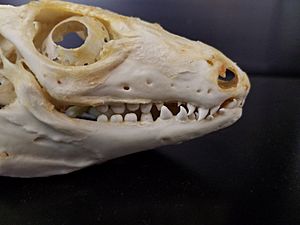
Lizards have different kinds of teeth depending on what they eat. Their diets can include meat, insects, plants, nectar, or snails. Most species have teeth that are all similar and suited to their diet. But some have different teeth, like sharp cutting teeth in the front and crushing teeth in the back. Most lizards have teeth attached to the side of their jawbone (pleurodont). However, agamids and chameleons have teeth attached to the top of their jawbone (acrodont).
A lizard's tongue can stick out of its mouth and is often long. In some lizards, like monitor lizards, the tongue is forked. They use it to sense their surroundings. They flick it out to pick up tiny particles from the air. Then they bring it back to a special organ inside their mouth that helps them "smell" or "taste" their environment. Geckos use their tongues to clean their eyes because they don't have eyelids. Chameleons have very long, sticky tongues that shoot out quickly to catch insects.
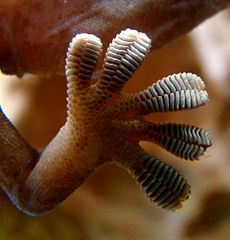
Three types of lizards—geckos, anoles, and chameleons—have special pads under their toes. These pads help them stick to surfaces. The pads have millions of tiny hair-like structures called setae. These setae create a strong grip using a special force called van der Waals force. No sticky liquid is needed! Chameleons also have toes that are split into two groups on each foot. This helps them grip branches like birds.
How Lizards Function
Movement and Locomotion
Most lizards have four legs and move by wiggling their bodies from side to side. This body bending makes it hard for them to breathe well while running fast. This limits how long they can run. This is known as Carrier's constraint. Some lizards can run on two legs. A few can even stand on their hind legs and tail when they are still.
Several small lizards, like those in the Draco group, can glide. Some can glide as far as 60 meters (about 200 feet), losing only 10 meters (about 33 feet) in height. Some species, like geckos and chameleons, can stick to vertical surfaces, including glass and ceilings. The common basilisk lizard can even run across water!
Lizard Senses
Lizards use their senses of sight, touch, olfaction (smell), and hearing just like other vertebrates. How much they rely on each sense depends on where they live. For example, skinks that live mostly underground use smell and touch a lot. Geckos rely on their sharp vision to hunt and judge distances. Monitor lizards have excellent vision, hearing, and smell.
Some lizards use their senses in unusual ways. Chameleons can move their eyes in different directions at the same time. This means one eye can look forward while the other looks backward! Lizards don't have outer ears like humans. Instead, they have a round opening where you can see their eardrum. Many lizards use their hearing to detect predators early and quickly run away.
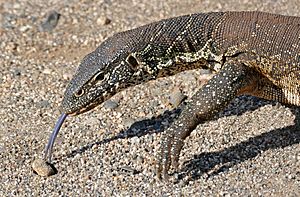
Like snakes and many mammals, all lizards have a special smelling organ called the vomeronasal organ. They use it to detect pheromones, which are chemical signals. Monitor lizards touch their tongue to this organ to "smell" their surroundings. Their tongue is only for gathering information, not for eating.
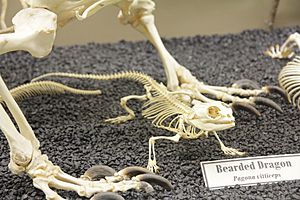
Some lizards, especially iguanas, have a light-sensing organ on top of their heads called the parietal eye. This is a very old feature in reptiles, also found in the tuatara. This "eye" can't form images, but it can sense changes in light and dark and detect movement. This helps them spot predators coming from above.
Lizard Venom
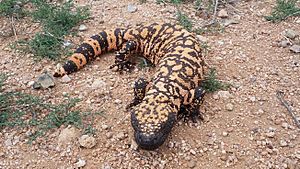
Until 2006, people thought only the Gila monster and the Mexican beaded lizard were venomous. But now we know that several types of monitor lizards, including the Komodo dragon, also produce strong venom in their mouth glands. For example, lace monitor venom can make an animal lose consciousness quickly and cause a lot of bleeding. This is because it lowers blood pressure and stops blood clotting. Lizards produce nine types of toxins that are also found in snakes. These toxins could be used to create new medicines.
Scientists have found genes linked to venom toxins in the saliva glands of many lizards. This includes species that were thought to be non-venomous, like iguanas and bearded dragons. This suggests that these venom genes might have first appeared in the common ancestor of lizards and snakes about 200 million years ago. This group is called the Toxicofera. However, many of these genes are "housekeeping genes" found in all cells. So, they might just be early versions of venom genes.