Leonardo da Vinci
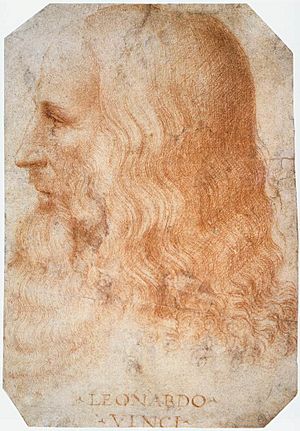
Leonardo da Vinci (born April 15, 1452 – died May 2, 1519) was an amazing Italian person from the Renaissance period. He is most famous for his paintings. But he was also a scientist, mathematician, engineer, inventor, anatomist, sculptor, architect, botanist, musician, and a writer.
Leonardo wanted to understand everything about nature. He wanted to know how everything worked. He was very good at studying, designing, and creating all sorts of interesting things.
Many people believe Leonardo was one of the greatest painters ever. Others think he was the most talented person who ever lived.
Leonardo was born in Vinci, a small town near Florence, Italy. He learned to be an artist from the sculptor and painter Verrocchio. He spent most of his life working for rich Italian noblemen. In his later years, he lived in a beautiful home given to him by the King of France.
Two of his pictures are among the most famous paintings in the world: the Mona Lisa and The Last Supper. He also made many drawings. His best-known drawing is Vitruvian Man. Leonardo often thought of new inventions. He kept notebooks filled with notes and drawings of these ideas. Most of his inventions were never built. Some of his ideas included a helicopter, a tank, a calculator, a parachute, a robot, a telephone, and solar power.
Leonardo's Life Story
Early Years (1452–1466)
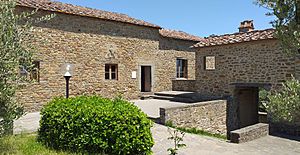
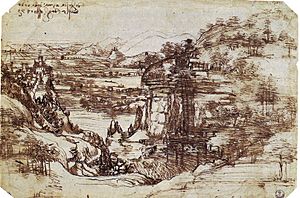
Leonardo was born on April 15, 1452. This happened in the Tuscan hill town of Vinci, in the Arno River valley. Leonardo's full name was "Leonardo di ser Piero da Vinci." This means "Leonardo, the son of Mister Piero from Vinci."
We don't know much about Leonardo's early childhood. He likely lived with his grandfather, Antonio da Vinci, by 1457. He probably spent some years with his mother in Vinci. He was close to his uncle, Francesco da Vinci. His father, Ser Piero, was a successful notary in Florence. Leonardo received a basic education in reading, writing, and math. Then he moved to Vinci to live with his father, his father's new wife Albiera, his grandparents, and his Uncle Francesco.
Leonardo started painting when he was a boy. Giorgio Vasari, a biographer (someone who writes about a person's life), wrote about Leonardo after he died. Vasari shared many stories about how clever Leonardo was. He said that Leonardo painted a round wooden shield with a picture of snakes spitting fire. Leonardo's father took this painting to Florence and sold it to an art dealer.
Learning with Verrocchio (1466–1476)
In 1466, when Leonardo was fourteen, his father took him to Florence. There, he became an apprentice to the artist Verrocchio. An apprentice learns a skill by working for a master.
Florence was a very exciting place for young artists. Many famous artists had lived there. If an artist was lucky, they would find a rich patron. A patron is someone who buys many paintings. The wealthiest family in Florence was the Medici. They had a beautiful palace and loved buying art. They also liked studying literature and philosophy. Many young artists hoped to work for the Medici family.
Verrocchio had a large and busy workshop in Florence. Leonardo learned drawing, painting, sculpting, and model making. He also learned other useful skills. These included chemistry, metallurgy (working with metals), metal working, plaster casting, leather working, mechanics, and carpentry.
Leonardo was not the only young painter at Verrocchio's workshop. Other painters trained there or visited often. Some of them later became famous, like Ghirlandaio, Perugino, and Botticelli. These artists were only a few years older than Leonardo.
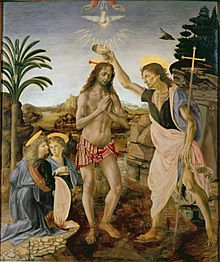
Giorgio Vasari tells a story from this time. Verrocchio was painting a large picture called The Baptism of Christ. He asked Leonardo to paint one of the angels holding Jesus' robe. Vasari said Leonardo painted the angel so beautifully that Verrocchio stopped painting forever. If you look closely at the painting, you can see that Leonardo might have painted other parts too. These include the rocks, the brown stream, and the background. Verrocchio also made a bronze statue of David around this time. Many people believe Leonardo was the model for this statue.
Around 1472, when he was twenty, Leonardo joined the Guild of St. Luke. This was a group for artists and doctors. Even after his father helped him set up his own workshop, Leonardo still liked working at Verrocchio's studio.
Working as an Artist (1476–1499)
When Vasari wrote about Leonardo, he used words like "noble," "generous," "graceful," and "beautiful." Vasari said that as an adult, Leonardo was a tall and handsome man.
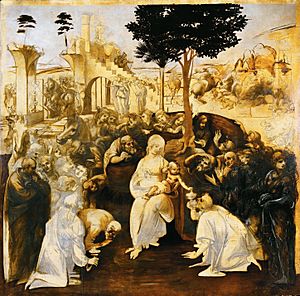
We don't know much about Leonardo's life between 1472 and 1481. He was likely busy in Florence. In 1478, he received an important job to paint an altarpiece for the Monks of San Donato a Scopeto. The painting was to be The Adoration of the Magi (The Three Wise Men). This painting was never finished. This is because Lorenzo Medici sent Leonardo to Milan as an ambassador.
Leonardo was a very talented musician. In 1482, he made a silver lyre (a musical instrument) shaped like a horse's head. At that time, there was a new ruler in Milan, in northern Italy. Duke Ludovico il Moro was making other rulers nervous. Lorenzo de Medici wanted Leonardo to give Ludovico the lyre as a gift from him. Leonardo stayed in Milan and worked for the Duke from 1482 to 1499. Part of his job was to design festivals and carnival parades. He didn't know then that he would be most remembered for his paintings.
The Gran Cavallo Statue
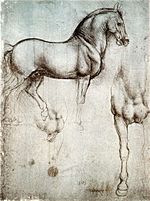
Leonardo's most important work for Duke Ludovico was to create a huge statue. It was to be of the previous ruler, Francesco Sforza, on horseback. Leonardo made a giant clay horse called the Gran Cavallo. It was meant to be cast in bronze. However, the bronze was needed to make cannons. This was because the French army was invading Milan. So, the statue was never finished.
The Virgin of the Rocks Painting
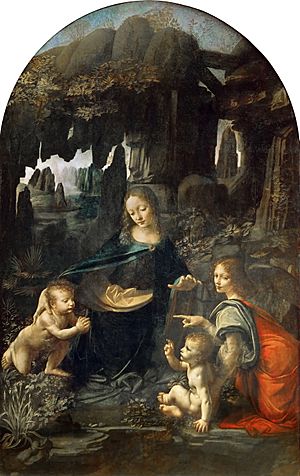
While working for Duke Ludovico, Leonardo received two important painting jobs. One was to create an oil painting for a large altarpiece. This was for the Confraternity of the Immaculate Conception. Leonardo painted this picture twice. He left one with the monks in Milan. He took the other painting to France, where it is now in the Louvre Museum. Both paintings are called The Virgin of the Rocks. They show the Virgin Mary and the child Jesus in a rocky, mysterious landscape. Mary and Jesus are meeting with John the Baptist. There is a story (not in the Bible, but a Christian tradition) about baby John and baby Jesus meeting on the way to Egypt. In this scene, John is praying, and baby Jesus raises his hand to bless John. The paintings have a strange light with soft, deep shadows. In the background, there is a lake and mountains in the mist. No painting like this had ever been done before.