LEGO
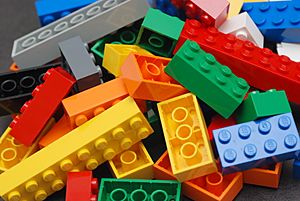
Lego is a super popular line of plastic building toys made by the Lego Group. This company is based in Billund, Denmark. Lego sets include colorful plastic bricks that snap together. They also come with gears, small figures called minifigures, and many other cool parts.
You can connect Lego pieces in tons of ways to build almost anything! Think vehicles, buildings, or even working robots. Once you build something, you can take it apart and use the pieces to create something totally new.
The Lego Group started making these interlocking toy bricks in 1949. Today, Lego bricks are made in places like Denmark, Hungary, Mexico, and China. The designs on the bricks and the packaging are done in the first three countries, plus the Czech Republic. Every year, about 36 billion Lego bricks are made. That's about 1,140 pieces every second! Lego is one of Europe's biggest companies and the largest toy maker in the world by sales. By July 2015, over 600 billion Lego parts had been produced.
Lego has a huge community of fans who love building amazing things. There are even building competitions! The Lego brand has also inspired many movies, video games, and ten Legoland amusement parks.
The Story of Lego
The Lego Group started in 1932. It was the workshop of Ole Kirk Christiansen (1891–1958), a carpenter from Billund, Denmark. He began by making wooden toys. In 1934, his company got the name "Lego." This name comes from the Danish phrase leg godt, which means "play well."
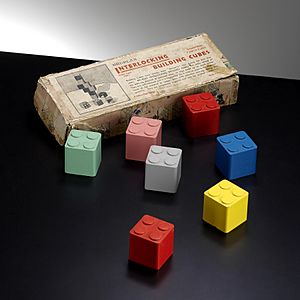
In 1947, Lego started making plastic toys. By 1949, the company was producing an early version of the interlocking bricks we know today. They called them "Automatic Binding Bricks." These bricks were inspired by the Kiddicraft Self-Locking Bricks. Those were invented by Hilary Page in 1939. Lego got a sample of the Kiddicraft bricks from a machine supplier. The first plastic bricks were made from cellulose acetate. They were an improvement on the wooden blocks people used to stack.
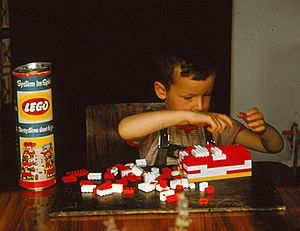
Lego's motto, "only the best is good enough," was created in 1936. Christiansen made this motto to remind his employees to always focus on quality. He believed in this strongly. By 1951, plastic toys made up half of the company's products. Some people thought plastic toys would never replace wooden ones. But Lego toys became very popular, partly because of Ole Kirk's high standards.
In 1954, Christiansen's son, Godtfred, became a leader at the Lego Group. He had an idea for a "toy system" after talking with a buyer. Godtfred saw that Lego bricks could be used for super creative play. But the bricks still had some issues. They didn't always lock together perfectly, and they weren't as flexible as they could be.
In 1958, the modern Lego brick design was created. Five years later, a stronger plastic called ABS replaced the old material. The patent for the modern Lego brick was filed in Denmark on January 28, 1958.
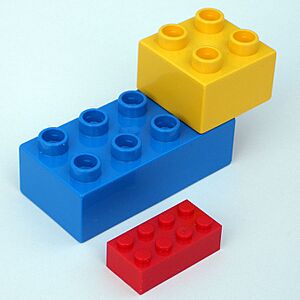
The Duplo product line came out in 1969. These blocks are twice as big as standard Lego bricks. They are made for younger children. In 1978, Lego made the first minifigures. These small figures are now a key part of most Lego sets.
In 1997, a big wave hit a cargo ship off the coast of Cornwall, England. More than five million Lego pieces were swept into the sea. These pieces have been washing up on beaches for decades, getting attention from news and social media.
In May 2011, the Space Shuttle Endeavour took 13 Lego kits to the International Space Station. Astronauts built models there to see how they would work in microgravity (zero gravity). This was part of the Lego Bricks in Space program. In May 2013, the largest Lego model ever built was shown in New York City. It was a life-size Star Wars X-wing fighter made of over 5 million bricks! Other record-breaking builds include a 34-meter (111-foot) tower and a 4-kilometer (2.5-mile) railway.
In February 2015, Lego was named the "world's most powerful brand." It even passed Ferrari!
Lego has always been a toy for kids. But now, many adults are also big fans. In 2020, Lego started making sets for ages 18+. These are often more expensive and harder to build. They are based on real-world or fictional things, like the Concorde airplane or Rivendell from The Lord of the Rings. These sets became popular during the COVID-19 pandemic. Many adults bought them to build during lockdowns. Movies like The Lego Movie and the TV show Lego Masters also made Lego popular with adults. By 2024, almost 15% of the sets sold in the U.S. were for adult builders.
In May 2025, Lego announced plans to move its London headquarters. It will move from Farringdon to 76 South Bank in 2027.
How Lego is Designed
Lego pieces are part of a universal system. This means that even though designs have changed over the years, all pieces still fit together. Lego bricks from 1958 can still connect with ones made today. Sets for young children also work with sets for teenagers. Did you know that six 2x4 Lego bricks can be combined in over 915 million ways?
Every Lego piece must be made very precisely. When two pieces connect, they need to fit tightly but also be easy to take apart. The machines that make Lego bricks are super accurate, with tiny differences of only 10 micrometres.
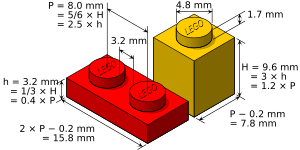
Most of the new Lego products are designed at the company's headquarters in Billund. About 120 designers work there. Lego also has smaller design offices in the UK, Spain, Germany, and Japan. These offices create products for their local markets. It takes about twelve months to develop a new product.
Designers first look at what's popular and what kids want. Some even visit toy shops or talk to children directly. Then, they design and develop the product. As of September 2008, design teams use special 3D modeling software to create drawings. They then make test models using a special machine. These models are shown to the team, and parents and children test them. Designs might change based on what people say. Virtual models of finished Lego products are also made. These are used for instructions, marketing, and packaging.
Lego Digital Designer was a special Lego software for computers. It let users create their own digital Lego designs. You could even order your custom designs as physical models, but this service ended in 2012. Now, Lego's website suggests using BrickLink Studio for digital building.
How Lego is Made
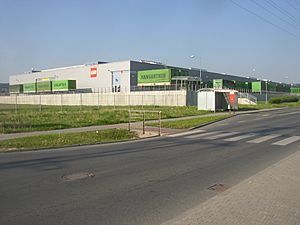
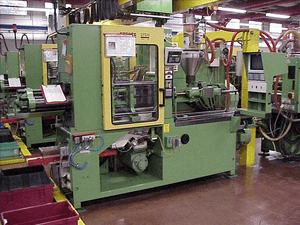
Since 1963, Lego pieces have been made from ABS plastic. As of September 2008, Lego engineers use special software to design the parts. This software helps them make sure the parts are perfect. Test molds are sometimes made before mass production starts.