Kenya
Kenya, officially known as the Republic of Kenya (Jamhuri ya Kenya in Swahili), is a country located in East Africa. It is home to over 47.6 million people, making it the 28th most populated country in the world. It is also the 7th most populated country in Africa.
Nairobi is Kenya's capital and largest city. Mombasa is the oldest and second-largest city, located on the coast. It was Kenya's first capital until 1907. Kisumu is the third-largest city and an important port on Lake Victoria. This lake is a hub for transport, fishing, farming, trade, and tourism.
Kenya is the third-largest economy in sub-Saharan Africa, after Nigeria and South Africa. It shares borders with South Sudan to the northwest, Ethiopia to the north, Somalia to the east, Uganda to the west, and Tanzania to the south. The Indian Ocean lies to its southeast. Kenya has a wide variety of landscapes, from cold, snow-capped mountains like Mount Kenya to vast forests, wildlife areas, and fertile farms. It also has warmer regions in the west and dry, desert areas like the Chalbi Desert.
The first people in Kenya were hunter-gatherers. Later, groups speaking Cushitic languages settled in the lowlands between 3,200 and 1,300 BC. Around 500 BC, Nilotic-speaking people who raised animals began moving into Kenya from what is now South Sudan. Bantu people settled along the coast and inland between 250 BC and 500 AD.
Europeans first arrived in Kenya around 1500 AD with the Portuguese Empire. The British Empire began to take control in the 19th century. Modern Kenya started as a British protectorate in 1895 and became the Kenya Colony in 1920. Many disagreements between the British and the colony led to the Mau Mau revolution in 1952. Kenya gained its independence in 1963 and became a republic in 1964. It is still a member of the Commonwealth of Nations. Kenya's current constitution was put in place in 2010.
A Look at Kenya's Early History
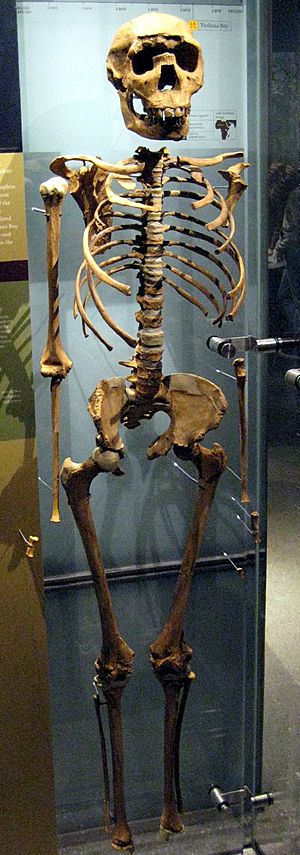
Fossils found in Kenya show that early human-like creatures lived there over 20 million years ago. Discoveries near Lake Turkana suggest that early humans, like Homo habilis and Homo erectus, lived in Kenya long ago. These species are thought to be direct ancestors of modern humans.
In 1984, a 1.6-million-year-old fossil called the Turkana boy was found near Lake Turkana. This fossil belonged to Homo erectus. Other important ancient sites in Kenya include Namoratunga, which studied ancient stars, and the walled settlement of ThimLich Ohinga.
The first people in Kenya were groups who hunted animals and gathered plants for food. Later, people who raised animals and farmed, called agropastoralists, came from the Horn of Africa. Around 500 BC, people who raised animals, like the Samburu and Maasai, started moving into Kenya from Southern Sudan.
By 1000 AD, Bantu-speaking farmers had moved into the region. They brought new ways of farming and iron working. Along the Kenyan coast, communities of ironworkers, farmers, hunters, and fishers traded with other countries. These communities formed early city-states known as Azania.
The Kenyan Coast has welcomed many traders and explorers over the centuries. Malindi has been an important Swahili settlement since the 14th century. In 1414, the Chinese explorer Zheng He visited the coast. The Portuguese explorer Vasco da Gama was welcomed in Malindi in 1498.
Kenya Under British Rule (1888–1962)
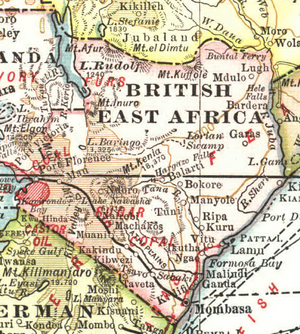
Kenya's time as a colony began when Germany set up a protectorate over the Sultan of Zanzibar's coastal lands in 1885. Then, the Imperial British East Africa Company arrived in 1888. Germany later gave its coastal areas to Britain in 1890. After this, the Kenya–Uganda railway was built through the country.
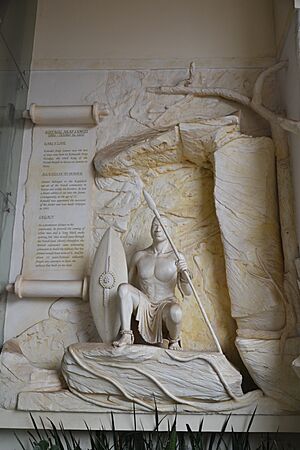
Some local groups, like the Nandi led by Koitalel Arap Samoei, resisted the railway's construction for ten years. However, the British finished the railway. The Nandi were the first group to be moved to a special reserve to stop them from bothering the railway builders.
Many Indian people came to Kenya during the railway's construction. They provided most of the skilled workers needed. Many of them and their families stayed in Kenya, forming communities like the Ismaili Muslim and Sikh groups.
During World War I, a German military leader named Paul von Lettow-Vorbeck fought against the British in East Africa. He used guerrilla warfare tactics, living off the land and capturing British supplies. He remained undefeated until after the war ended in 1918. The British brought troops from India and used many African porters to carry supplies. This experience helped many Africans become more interested in politics.
In 1920, the East Africa Protectorate became a colony and was renamed Kenya, after its highest mountain. British and other European farmers settled in the central highlands. They grew coffee and tea and became very wealthy. By the 1930s, about 30,000 white settlers lived there and had a strong political voice.
The central highlands were already home to over a million Kikuyu people. To protect their own interests, the settlers banned the Kikuyu from growing coffee. They also introduced a hut tax and gave less land to landless farmers in exchange for their work. This caused many people to move to cities. By the 1950s, there were 80,000 white settlers in Kenya.
During World War II, Kenya provided many workers and farm products for the United Kingdom. There was also fighting in Kenya between Allied forces and Italian troops in 1940–41.
In 1952, Princess Elizabeth was visiting Kenya when her father, King George VI, passed away. She immediately returned home to become Elizabeth II. It is said that she went up a tree in Africa as a princess and came down a queen.
The Mau Mau Uprising
From October 1952 to December 1959, Kenya was in a state of emergency. This was because of the Mau Mau rebellion against British rule. The Mau Mau, also known as the Kenya Land and Freedom Army, were mainly members of the Kikuyu group.
The British governor asked for British and African troops, including the King's African Rifles. The British began operations to stop the rebellion. In May 1953, General Sir George Erskine took charge of the armed forces with support from Winston Churchill.
The capture of Warũhiũ Itote, also known as General China, in January 1954 helped the British understand the Mau Mau's leadership better. A big operation called Operation Anvil started in April 1954. It put Nairobi under military control. People in Nairobi were checked, and Mau Mau supporters were sent to detention camps. By the end of the emergency, 4,686 Mau Mau fighters had been killed.
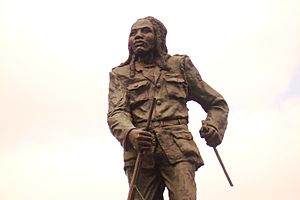
The capture of Dedan Kimathi in October 1956 marked the end of the Mau Mau's military fight. During this time, the government made big changes to land ownership. The Swynnerton Plan was used to reward those loyal to the British and punish Mau Mau supporters.
Kenya Gains Independence
The first direct elections for native Kenyans to the Legislative Council happened in 1957. The Kenya African National Union (KANU), led by Jomo Kenyatta, formed a government. Kenya became an independent country on December 12, 1963.