Joan of Arc
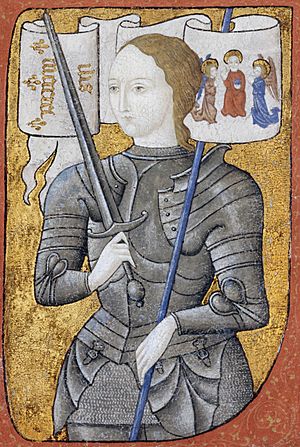
Joan of Arc (born around 1412 – died May 30, 1431) is a famous French hero and a patron saint of France. She is remembered for her bravery during the Hundred Years' War, a long conflict between France and England. Joan believed she had a special mission from God to help the French king, Charles VII of France, and save her country from English control.
At just 17 years old, Joan became a military leader. She helped the French army achieve a major victory at the city of Orléans in 1429. This success boosted the spirits of the French people and led to Charles VII being crowned king. Joan's actions were a turning point in the war.
Later, Joan was captured by enemies and put on trial. She was accused of serious offenses, including wearing men's clothes and claiming her visions were from God. She was found guilty and tragically died on May 30, 1431, when she was about 19 years old.
Years later, in 1456, her trial was reviewed. The court decided that the first trial was unfair and wrong. Joan of Arc is now seen as a symbol of courage, faith, and French national pride. She was made a saint by the Catholic Church in 1920.
Joan's Name
Joan of Arc's name was spelled in many different ways long ago. Before the 1500s, there wasn't one correct way to write it. Her last name was often "Darc," but you might see "Tarc" or "Dart" too. It's possible Joan never even heard herself called "Jeanne d'Arc." The first time her name was written this way was in 1455, many years after she died.
Joan didn't learn to read or write when she was a child. So, she would tell others what to write in her letters. She might have learned to sign her name later, as some letters have her signature. In her letters, Joan called herself "Jeanne la Pucelle," which means "Joan the Maiden." This name highlighted her purity. Later, people also called her the "Maid of Orleans."
Joan's Early Life and France's War
Where and When Joan Was Born
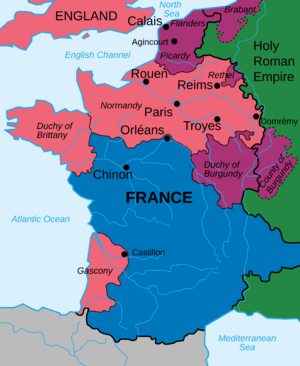
Joan of Arc was born around 1412 in a small French village called Domrémy. Her parents were Jacques d'Arc and Isabelle Romée. Joan had three brothers and one sister. Her father was a farmer and also helped the village by collecting taxes.
France During the Hundred Years' War
Joan grew up during a very long conflict called the Hundred Years' War. This war was between England and France and had started way back in 1337. England wanted to control parts of France and claimed the French throne. Most of the fighting happened in France, which caused a lot of damage and made life hard for people.
France was also divided by its own internal problems. The French king, Charles VI, was often sick and couldn't rule properly. Different powerful French families, like the Armagnacs and the Burgundians, fought for control. The future French king, Charles VII, was known as the Dauphin (the heir to the throne) and was supported by the Armagnacs.
England's King Henry V of England took advantage of these divisions. He invaded France and allied with the Burgundians. This made things even worse for France. After both Henry V and Charles VI died in 1422, the English claimed their young king, Henry VI of England, should also be the king of France. But Charles VII, the French Dauphin, also claimed the throne. This meant France had two people claiming to be king, and a big part of the country was under English or Burgundian control.
Joan's Visions and First Steps
Growing Up in Domrémy
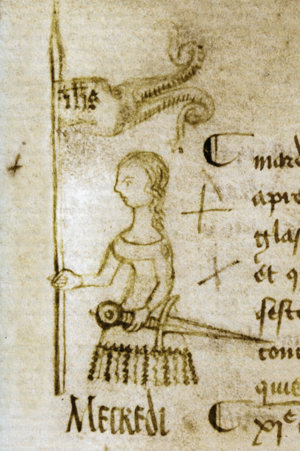
As a young girl, Joan helped her family with farm chores. She spun wool, worked in the fields, and took care of animals. Her mother taught her about religion. Joan's village was loyal to the French king, even though it was surrounded by areas that supported the Burgundians. In 1425, her village was attacked, and cattle were stolen. This made the villagers feel strongly that the English needed to leave France for peace to return.
Hearing Voices and Receiving a Mission
Around 1425, when Joan was about 13, she said she started having visions. She believed Saint Michael, along with other angels and saints like Saint Margaret and Saint Catherine, appeared to her. These voices told her she had a special mission from God. They said she must help the Dauphin Charles become the true king of France and drive the English out.
Joan believed these voices guided her throughout her life. She also made a promise to remain pure. There was an old prophecy that said France would be saved by a virgin. Many people thought Joan might be this promised maiden.
Seeking Help for France
In 1428, Joan asked her uncle to take her to Vaucouleurs. There, she asked the local commander, Robert de Baudricourt, for soldiers to escort her to the Dauphin Charles. Baudricourt refused at first. But after her village was attacked again, Joan returned to Vaucouleurs in 1429. This time, she gained support from some soldiers and convinced Baudricourt to let her go to Charles.
Joan traveled with six soldiers. Before leaving, she put on men's clothes. This was practical for traveling and fighting, and it also helped her stay safe. She continued to wear men's clothes for the rest of her life.
The Importance of Orléans
At this time, the English army was surrounding the city of Orléans. This city was very important because it was the last major obstacle before the English could attack the rest of Charles's territory. Joan's visions told her it was time to leave Domrémy and help the Dauphin save France, starting with Orléans.
Meeting the Dauphin
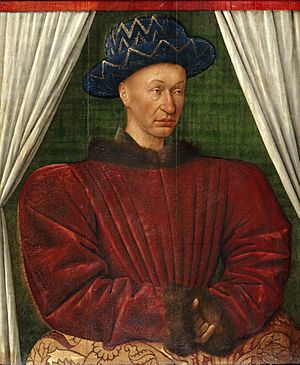
Joan met Charles VII for the first time at his court in Chinon in early 1429. She was about 17, and he was 26. Joan told him that she was sent to lift the siege of Orléans and to lead him to Reims for his coronation. She also reassured him that he was the rightful king of France.
Charles and his advisors wanted to be sure Joan was truly sent by God. They sent her to Poitiers to be questioned by religious scholars. These scholars decided that Joan was a good and faithful Catholic. They agreed that sending her to Orléans would be a good way to test if her mission was divine. Joan was also examined by women to confirm her purity, which was important for the prophecy of the virgin savior.
After these tests, Charles felt confident in Joan. He gave her armor and she designed her own banner. She also had a special sword brought to her from a church. From this time, she often called herself "Joan the Maiden," highlighting her purity and mission.
Before Joan arrived, the French army was losing hope. But Joan's strong belief and personality began to inspire them. She turned the war into a religious cause, convincing many that God was on France's side. Before heading to Orléans, Joan sent a letter to the English, warning them that she was sent by God to drive them out of France.