Ferdinand Magellan
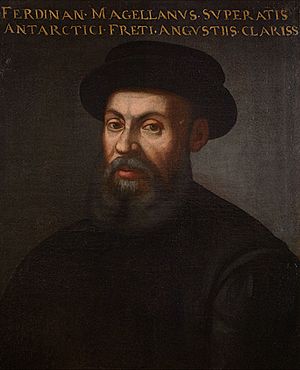
Ferdinand Magellan (born around 1480 – died April 27, 1521) was a brave Portuguese explorer. He is famous for leading the first trip around the world by sea. Even though he died during the journey, his crew finished the voyage.
Magellan was the first European to sail across the Pacific Ocean. He even named it Mar Pacifico, which means "peaceful sea" in Portuguese. This name fit because the waters seemed calm after the stormy Atlantic. His journey also helped prove that the Earth is round.
The narrow waterway at the tip of South America, the Strait of Magellan, is named after him. He was the first European to sail through it. Magellan was killed in the Philippines during a battle with local people.
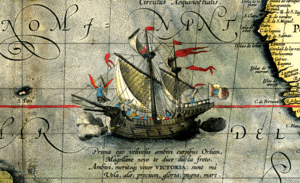
King Charles V of Spain gave Magellan five ships for his big trip. Only one ship, the Victoria, made it all the way around the world.
Magellan's Early Life and Training
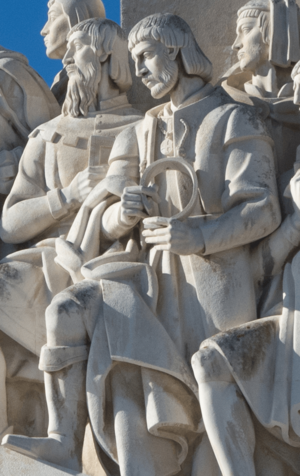
Ferdinand Magellan was born in 1480 in Portugal. His family was part of the Portuguese nobility. When he was ten, both his parents died. After this, he became a page for the queen in the royal court.
Living in the royal court helped Magellan learn many important skills. He studied cartography (map-making), navigation, and astronomy. These skills were very useful for his future travels.
In 1505, when he was 25, Magellan joined the Portuguese navy. He traveled to many places while working for Portugal. These places included India, the Spice Islands, East Africa, and Morocco. In 1513, he was hurt in Morocco, which made him limp for the rest of his life.
Later, Magellan lost his job with the King of Portugal. So, he went to work for the King of Spain instead. He was married to Beatriz Barbosa and had two sons, Rodrigo and Carlos.
The Quest for the Spice Islands
Long ago, European countries wanted to find a sea route to the Spice Islands (also called the Indies). These islands, now known as the Maluku Islands in Indonesia, were rich in valuable spices like cloves and nutmeg. Christopher Columbus had tried to reach them by sailing west, but he found a new continent instead: the Americas.
When Magellan came to the Spanish court, he had a new plan. He believed he could find a western route to the Spice Islands that would give Spain direct access to these riches. This plan excited King Charles V.
Magellan's Epic Voyage
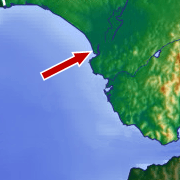
On August 10, 1519, Magellan's five ships left Seville, Spain. They sailed down the Guadalquivir River to Sanlúcar de Barrameda. They stayed there for over five weeks. On September 20, Magellan finally set sail from Sanlúcar de Barrameda with about 270 men.
After stopping at the Canary Islands, they headed towards Brazil. On November 27, they crossed the equator. By December 6, they saw the coast of South America.
Brazil was Portuguese land, so Magellan avoided it. On December 13, they stopped near what is now Rio de Janeiro to get more supplies. They continued sailing south along the east coast of South America. They were looking for a strait, a narrow passage of water, that Magellan believed would lead to the Spice Islands. On January 10, 1520, the fleet reached the Río de la Plata.
On March 30, the crew set up a camp they called Puerto San Julian. A few days later, on April 2, some of the ship captains tried to take control. But the crew stayed loyal to Magellan, and the mutiny failed. Some of the captains were punished.
The journey continued. One ship, the Santiago, was sent to explore but was wrecked in a storm. Luckily, all its crew survived. Two of them walked back to tell Magellan what happened and help rescue their friends. After this, Magellan decided to wait a few more weeks before moving on.
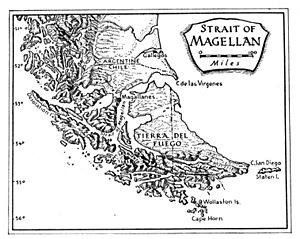
On October 21, at 52°S latitude, the fleet found Cape Virgenes. They thought they had found the passage because the water remained salty even as they sailed inland. Four ships began the difficult trip through the 373-mile (600 km) passage. Magellan named it the Estrecho (Canal) de Todos los Santos ("All Saints' Channel") because they sailed through it on November 1, All Saints' Day. Today, it is known as the Strait of Magellan.
Magellan sent two ships, the Concepción and San Antonio, to explore the strait. The San Antonio secretly left and sailed back to Spain on November 20. This left Magellan with three ships: Concepción, Trinidad, and Victoria.
Magellan was the first European to reach Tierra del Fuego, an area just east of the Pacific side of the strait.
On November 28, the three ships entered the South Pacific. Magellan named these waters the Mar Pacifico (Pacific Ocean) because they looked so calm and peaceful.
Sailing northwest, the crew reached the equator on February 13, 1521. On March 6, they arrived at the Marianas and Guam. Magellan first called Guam the "Island of Sails" because of the many sailboats they saw. Later, they renamed it "Ladrones Island" (Island of Thieves) because some of Trinidad's small boats were stolen there.
Magellan's Death
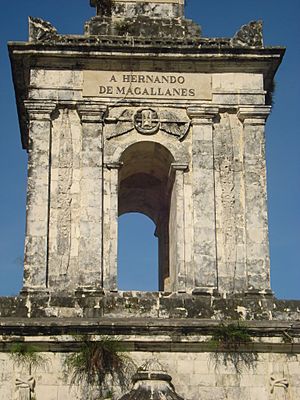
On March 16, Magellan reached the island of Homonhon in the Philippines. Only about 150 crew members were left. He was the first European to reach the Philippines.
Magellan could talk with the local people because his Malay interpreter, Enrique, understood their language. Enrique was Magellan's servant. Magellan and his crew exchanged gifts with Rajah Kolambu of Limasawa. Rajah Kolambu then guided them to Cebu on April 7.
Rajah Humabon of Cebu became friends with Magellan. He and his queen, Juana, even became Christians. Afterward, Humabon and another leader, Datu Zula, convinced Magellan to help them fight their enemy, Lapu-Lapu, on Mactan Island.
Magellan wanted Lapu-Lapu to become Christian too. On the morning of April 17, 1521, Magellan sailed to Mactan with his men. During the Battle of Mactan against Lapu-Lapu's forces, Magellan was killed.
Magellan's will said that Enrique, his interpreter, should be set free after his death. However, the remaining ship leaders refused to free Enrique. Enrique managed to escape on May 1.
The First Trip Around the World
After Magellan's death, many men had died in the Philippines. There were not enough sailors left for the three remaining ships.
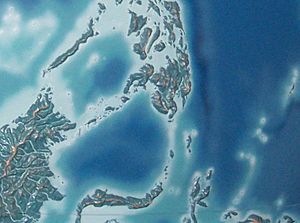
On May 2, they decided to abandon the Concepción and burned it. This was to make sure no one could use the ship against them. They were left with two ships, Trinidad and Victoria. They sailed west to Palawan. On June 21, they left Palawan. Moro pilots, who knew the shallow seas, guided them to Brunei, Borneo.
The ships stayed off the coast of Brunei for 35 days. There, they saw the amazing wealth of Rajah Siripada's court. They saw gold, two pearls as big as hens' eggs, and many other wonders. Brunei also had tame elephants and 62 cannons, which was much more than Magellan's ships had. They also saw things like porcelain and eyeglasses, which were rare or new in Europe.