Egypt
Egypt (Arabic: مصر Miṣr), officially known as the Arab Republic of Egypt, is a country that connects North Africa and Western Asia. It includes the Sinai Peninsula in Asia and a large part of northeastern Africa.
Egypt is a powerful country in North Africa, the Middle East, and the Islamic world. It is also an important country worldwide. Egypt helped start the United Nations, the Non-Aligned Movement, the Arab League, the African Union, and the Organisation of Islamic Cooperation. It is also a member of BRICS.
History of Egypt
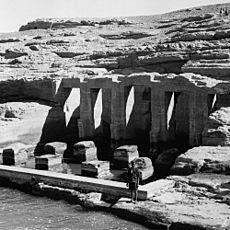
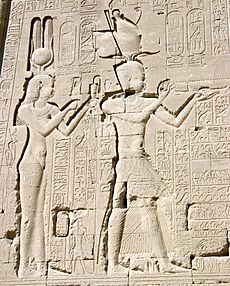
Egypt has one of the longest histories of any country. Its story goes back thousands of years along the Nile Delta. It is seen as a "cradle of civilization" because it was one of the first places where people started writing, farming, building cities, having organized religions, and central governments. Egypt's long and rich culture is a big part of who Egyptians are today. This is because Egypt is located in a unique spot, connecting the Mediterranean Sea, the Middle East, and North Africa. Egypt was also an early and important center for Christianity. Later, in the seventh century, it became mostly Islamic.
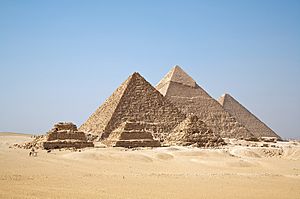
Modern Egypt became an independent country in 1922. Before that, it was a monarchy (ruled by a king or queen) under the British Empire. After the 1952 revolution, Egypt became a republic. In 1958, it joined with Syria to form the United Arab Republic, but this union ended in 1961.
In the second half of the 1900s, Egypt faced some challenges. It had several conflicts with Israel and experienced political changes. In 1978, Egypt signed a peace agreement, recognizing Israel. After the 2011 Egyptian revolution in 2011, which led to the removal of President Hosni Mubarak, the country went through a period of political change.
What's in a Name?
The ancient Egyptians called their country
(𓆎 𓅓 𓏏𓊖) km.t. This name means "black land." It probably referred to the rich, dark soil left behind by the Nile River's floods. This was different from the deshret, or "red land," which was the desert. Another ancient name for Egypt was ⟨tꜣ-mry⟩ meaning "land of the riverbank."
How Egypt is Governed
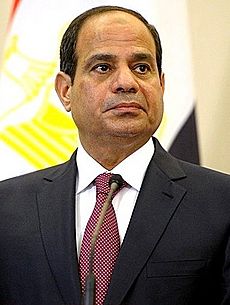
Egypt is a semi-presidential republic. This means it has both a president and a prime minister.
The House of Representatives is where laws are made. Its members are chosen by the people and serve for five years.
Egypt has a very old tradition of having a parliament. The first people's assembly was set up in 1866.
Laws of the Land
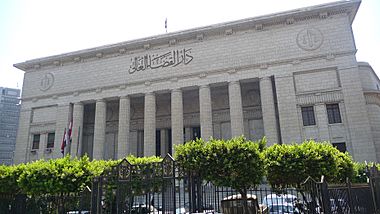
Egypt's legal system is based on Islamic law and civil law, which is similar to the Napoleonic Code. There is also a Supreme Court that reviews laws.
Where is Egypt?
Egypt is bordered by the Mediterranean Sea to the north. To the northeast, it shares borders with the Gaza Strip of Palestine and Israel. The Red Sea is to the east, Sudan to the south, and Libya to the west. The Gulf of Aqaba in the northeast separates Egypt from Jordan and Saudi Arabia.
Geography of Egypt
Egypt is located mostly between 22° and 32°N latitude and 25° and 35°E longitude. It covers about 1,010,450 square kilometers, making it the 30th largest country in the world. Most of Egypt's climate is very dry. This means that almost all of the population lives along the narrow Nile Valley and its delta. About 99% of Egyptians live on only about 5.5% of the total land area.
Egypt shares borders with Libya to the west, Sudan to the south, and the Gaza Strip and Israel to the east. It is a transcontinental nation, meaning it is in both Africa and Asia. It has a land bridge called the Isthmus of Suez. This land bridge is crossed by the Suez Canal, a waterway that connects the Mediterranean Sea with the Indian Ocean through the Red Sea.
Apart from the Nile Valley, most of Egypt's land is desert. There are a few oases scattered around. Winds create many sand dunes that can be over 30 meters high. Egypt includes parts of the Sahara desert and the Libyan Desert.
The Sinai Peninsula is home to Egypt's highest mountain, Mount Catherine, which is 2,642 meters tall. The Red Sea Riviera, on the east side of the peninsula, is famous for its beautiful coral reefs and sea life.
Egypt's Climate
Most of Egypt's rain falls during the winter. South of Cairo, there is very little rain, only about 2 to 5 millimeters per year. Sometimes it doesn't rain for many years. Along a small strip of the northern coast, rainfall can be as high as 410 millimeters, mostly from October to March. Snow falls on the mountains in Sinai and in some northern coastal cities. It rarely snows in Alexandria. A very small amount of snow fell on Cairo in December 2013, which was the first time in many decades. Frost can also happen in central Sinai and central Egypt.
Egypt has a very hot, sunny, and dry climate. Average high temperatures are warm in the north but very hot in the rest of the country during summer. Cooler winds from the Mediterranean Sea blow over the northern coast. This helps keep temperatures more moderate there, especially in summer. The Khamaseen is a hot, dry wind that comes from the vast deserts in the south. It blows in the spring or early summer. It brings scorching sand and dust. It can make daytime temperatures go over 40°C and sometimes even over 50°C inland. The air can become very dry.
Before the Aswan Dam was built, the Nile River flooded every year. This flooding made Egypt's soil rich and fertile, helping farmers have good harvests year after year.
Rising sea levels due to global warming could be a problem for Egypt's crowded coastal areas. This could affect the country's economy, farming, and industries. Some experts believe that if sea levels rise a lot, millions of Egyptians might have to move from their homes by the end of the 21st century.
Amazing Wildlife
Egypt cares about its wildlife and has a plan to protect its many different species.
Scientists have recorded many types of living things in Egypt. For example, there are:
- Algae (1,483 types)
- Animals (about 15,000 types, with over 10,000 being insects)
- Fungi (over 627 types)
- Bacteria (319 types)
- Plants (2,426 types)
- Protozoans (371 types)
For some groups, like lichen-forming fungi and tiny worms called nematodes, the exact number of species is still unknown. For larger, well-studied groups like amphibians, birds, fish, mammals, and reptiles, the numbers are more certain. However, for many other groups, the number of recorded species is likely to grow as more discoveries are made in Egypt. For example, over 2,200 types of fungi have been found, and the real number is probably much higher. Also, 284 native and naturalized types of grasses have been found in Egypt.