Cats
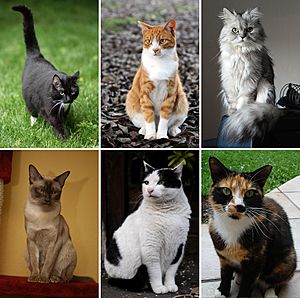
Cats, also known as domestic cats (Felis catus), are small, meat-eating mammals. They belong to the family called Felidae. Many people keep domestic cats as pets in their homes. These are often called house cats.
Cats have been tamed by humans for almost 10,000 years. Some domestic cats live on farms to help catch rodents. These are called farm cats. Cats that live away from humans are called Feral cats. Cats are one of the most popular pets in the world. People keep them for hunting rodents and for companionship. There are about 60 different breeds of domestic cats. Some have short hair, some have long hair, and some have no hair at all! Cats that are not specific breeds are often called 'domestic shorthair' (DSH) or 'domestic longhair' (DLH).
A baby cat is called a kitten. People sometimes call cats kitty or pussycat. A female cat that can have kittens is called a queen. A male cat that can father kittens is called a tom.
The word cat can also mean other felines. Felines are usually known as either big cats or small cats. The big, wild cats are famous: lions, tigers, leopards, jaguars, pumas, and cheetahs. There are also small, wild cats in most parts of the world. Examples include the lynx in northern Europe and the bobcat in North America. Wild cats, no matter their size, are not tame and can be very dangerous.
Cat History
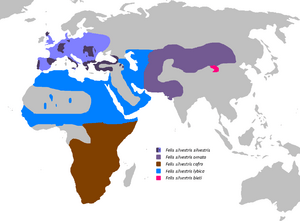
Long ago, especially in Egypt, people kept domestic cats. They were useful because they hunted and ate mice and rats. The oldest proof of cats kept as pets comes from the Mediterranean island of Cyprus. This was around 7500 BC.
Ancient Egyptians even thought cats were gods. They often mummified them. This was so the cats could be with their owners "forever."
Cat Body Parts
Cats have a body structure similar to other members of the Felis group. Their lower back and chest bones are extra flexible. This is why a cat's spine can bend so much. Unlike human arms, a cat's front legs are connected to the shoulder by bones that float freely. This lets cats squeeze their bodies through any space their head can fit through.
A cat's skull is special among mammals. It has large eye sockets and a strong, unique jaw.
Compared to other felines, domestic cats have canine teeth that are close together. This helps them eat their small rodents prey.
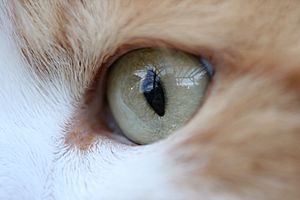
Cats have amazing night vision. They can see things very well in low light, much better than humans. This is partly because their eyes have a special layer called a tapetum lucidum. This layer reflects light back into the eye. It makes their eyes more sensitive to dim light. Cats also have a great sense of smell and very sharp hearing.

To help them move around and feel things, cats have many movable whiskers. These are called vibrissae. They are mostly on their faces. These whiskers tell the cat about the spaces they travel through. They also help them find objects in the dark. Whiskers can sense air currents and anything they touch. Whiskers also make cats blink. This protects their eyes from harm, just like human eyelashes do.
Cats walk very carefully. Unlike most mammals, cats use a "pacing" walk. They move the two legs on one side of their body first. Then they move the legs on the other side. When a cat walks faster into a trot, its walking style changes. It becomes a "diagonal" walk, like most other mammals. This means the front leg on one side and the back leg on the opposite side move at the same time. Cats, like dogs, walk directly on their toes. The bones of their feet make up the lower part of their leg.
Most cats have five claws on their front paws. They have four claws on their back paws. Their claws can be extended or pulled back in. When a cat is relaxed, its claws are hidden by the skin and fur around its paw pads. Cats can extend their claws for hunting, self-defense, climbing, kneading, or for better grip on soft ground.
On the inside of their front paws, there is something that looks like a sixth "finger." This special part on the inside of the wrist is called the carpal pad. Other cats and dogs also have this carpal pad.
Cat Behavior
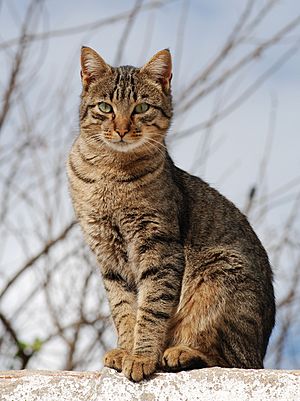
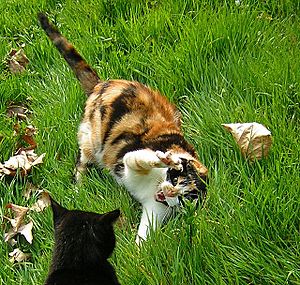
Cats are active carnivores. This means that in the wild, they hunt live prey. Cats are super fast, but only for short distances. Their main prey is small mammals, like mice. They will also sneak up on, and sometimes catch and eat, birds. Cats eat many different kinds of prey. This includes insects like flies and grasshoppers. Their main way of hunting is to stalk and pounce. The basic cat fur color, tabby (like the cat in the top photo), helps them hide well in grass and woodland. This is a kind of camouflage. The cat creeps towards its chosen victim. It keeps its body low to the ground so it's hard to see. It waits until it's close enough for a quick dash or pounce. Cats, especially kittens, practice these natural behaviors when they play with each other or with small toys.
Cats can even fish! They use a quick flip of a front paw. If they are successful, they flip the fish out of the water. It lands over the cat's shoulders onto the grass. Research from the Netherlands showed this is a natural behavior. Cats do it without being taught.
Cats are quiet and well-behaved animals. This makes them popular pets. Young kittens love to play. They can easily entertain themselves with toys from a store or made at home. House cats have even learned to open lever-style doorknobs and use toilet handles. You can train cats, but there's a limit. They can be as smart as dogs, but they don't live in packs.
Cats are quite independent animals. They can take care of themselves. They don't need or want as much attention as dogs do.
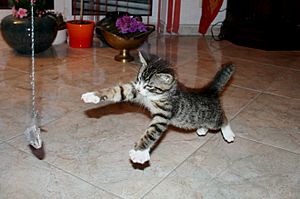
Kittens play all the time. This is how they learn. They will play their favorite games, like 'hide and pounce,' with almost anyone or anything. Soft balls on strings are a common toy. A scratching post is also very popular.
How Cats Communicate
Cats use many different sounds to talk. These include meowing, purring, trilling, hissing, growling, squeaking, chirping, clicking, and grunting.
Their body posture also helps them communicate. The way a cat holds its ears and tail tells other cats what it wants to say. The whole shape of its body changes when a cat is relaxed compared to when it is alert.
These ways of communicating are very important. They are used between a mother cat and her kittens. They are also used between male and female cats. And they are used between cats and other animals, like dogs. A mother cat protecting her kittens will fight even the biggest dog. She gives a good warning with a scary show. She hisses loudly, shows her claws, arches her back, and makes her fur stand on end. If that doesn't work, she attacks the dog's face with her claws. People say that no dog ever tries to attack a second time.