Bridge
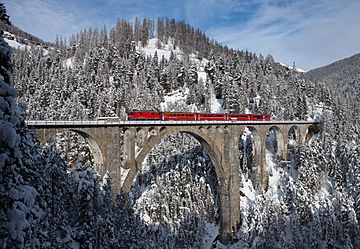
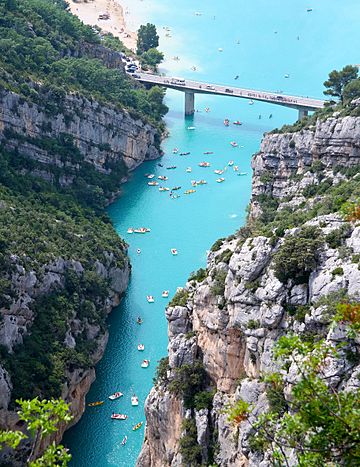
A bridge is a special structure built to cross an open space or a gap. Bridges are super helpful for getting over rivers, valleys, or busy roads. People have used bridges for a very long time, not just for cars and trains, but also for walking. Some bridges, called highway overpasses, help traffic flow smoothly by letting roads cross over each other without needing traffic lights.
Bridges are also used by the military. These military bridges are designed to be easily moved. This makes them more complex than regular bridges, but they can be quickly set up where soldiers need them.
History of Bridges
The very first "bridges" might have been simple stepping stones across a stream. Early humans also used log bridges, which were just trees that fell or were placed across water. These were some of the simplest ways to cross.
About 6,000 years ago, people in England built wooden walkways across marshy areas, like the Sweet Track.
One of the oldest wooden bridges still known is the Holzbrücke Rapperswil-Hurden in Switzerland. It crosses Lake Zürich. Parts of it date back to 1523 BC! The Romans later built a wide wooden bridge there. A new wooden footbridge, opened in 2001, is now the longest wooden bridge in Switzerland.
The Arkadiko Bridge in Greece is super old, from the 13th century BC. It's one of the oldest arch bridges still standing and being used today! It was part of a road system for chariots.
The ancient Romans were amazing bridge builders. They built strong arch bridges and aqueducts (bridges that carry water). Some of their bridges, like the Alcántara Bridge in Spain, are still standing! The Romans used a special type of cement called pozzolana, which made their bridges very strong.
In India, ancient texts mention building dams and bridges. By the 4th century, people in India were using strong bridges made of woven bamboo and iron chains.
In China, the oldest stone bridge still around is the Zhaozhou Bridge, built between 595 and 605 AD. It's special because it's the world's oldest stone arch bridge with open spandrels (the spaces above the arch).
The Inca people in South America built rope bridges. These were a simple type of suspension bridge used in the Andes mountains before Europeans arrived.
A big step forward in bridge building happened in 1779 with the Iron Bridge in England. It was the first time cast iron was used to make the arches of a bridge. Later, during the Industrial Revolution, engineers started using wrought iron and then steel to build much larger and stronger bridges.
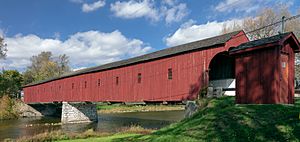
In Canada and the United States, many wooden covered bridges were built in the 1700s and 1800s. These bridges were covered to protect the wood from weather. Hundreds of them are still standing today!
In 1929, the Maurzyce Bridge in Poland became the world's first welded road bridge. This was a new way to join metal parts together.
Types of Bridges
Bridges can be sorted in different ways, like by their structure, what they carry, if they move, or what they are made of.
Structure Types
Bridges are built to handle forces like pulling (tension), pushing (compression), bending, twisting (torsion), and sliding (shear). Here are some main types:
Fixed or Movable Bridges
Most bridges are fixed bridges, meaning they don't move. They stay in one place unless they are taken down. Some bridges, like Bailey bridges, are temporary bridges. They can be put together quickly, taken apart, and moved to a new spot. These are often used in emergencies or by the military.
Movable bridges are special because they can move to let boats or other tall traffic pass underneath. They are usually powered by electricity.
Double-decked Bridges
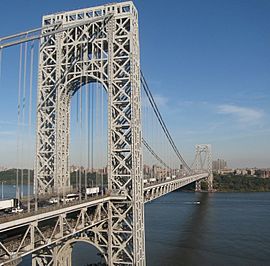
Double-decked bridges have two levels. The George Washington Bridge in the US is a famous example, carrying cars on two different levels. It's the world's busiest bridge! Some double-decked bridges carry different types of traffic on each level. For example, the Tsing Ma Bridge in Hong Kong has six lanes for cars on its upper deck and two lanes for cars plus train tracks on its lower deck. The High Level Bridge in England, built in 1849, was an early double-decked bridge with a railway on top and a road below.
Viaducts
A viaduct is like a very long bridge made up of many smaller bridges connected together. They are often used to cross wide valleys or many obstacles. The Lake Pontchartrain Causeway and the Millau Viaduct are famous examples of long viaducts.
Multi-way Bridge
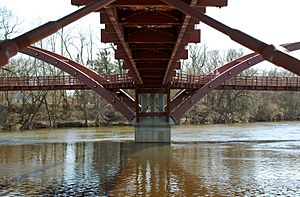
A multi-way bridge is very rare. It has three or more separate parts that meet near the center. When you look at them from above, they might look like a "T" or a "Y" shape. Examples include The Tridge in Michigan and the Zanesville Y-Bridge in Ohio.
Bridge Types by Use
A bridge can be named by what it carries. A road bridge carries cars, while a railway bridge carries trains. An aqueduct is a bridge that carries water, like for a canal. A road-rail bridge carries both cars and trains.
Some bridges have extra features. The tower of the Nový Most Bridge in Slovakia has a restaurant! Some bridge towers also hold antennas for broadcasting.
To help animals, conservationists build wildlife overpasses. These "animal bridges" let animals safely cross busy roads, reducing accidents and helping wildlife move freely. France built the first animal bridges in the 1950s.
Bridge Types by Material
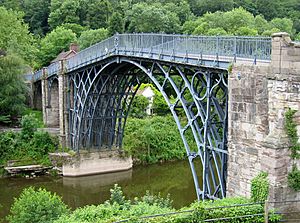
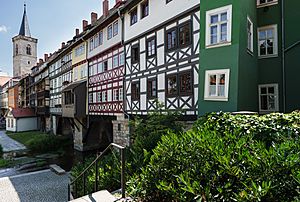
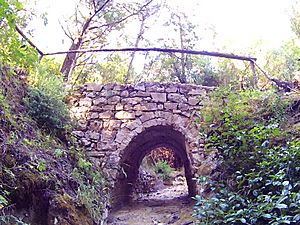
Bridges are also named by the materials they are made from. For a long time, bridges were built using wood, stone, and brick. Today, modern bridges are often made from concrete, steel, or even special strong plastics called fiber reinforced polymers (FRP). Sometimes, different materials are combined. Some amazing "living bridges" are even made from the roots of living trees, like in India!
| Bridge type | Materials used |
|---|---|
| Cantilever | Smaller bridges might use simple beams. Large cantilever bridges for cars or trains use strong structural steel frames or concrete box girders. |
| Suspension | The main cables are usually made of steel cables , often coated with zinc to prevent rust. Most of the bridge structure is also steel, but some parts might use steel- reinforced concrete . |
| Arch | Stone , brick , and other materials that are very strong when pushed (in compression) are used for arch bridges. |
| Beam | Beam bridges often use prestressed concrete, which is concrete strengthened with steel bars (rebar). This makes the bridge strong against both pushing and pulling forces. |
| Truss | The triangular parts of truss bridges are made from straight bars, usually of steel . |
Military Bridge
A Tank Bridge Transporter (TBT) is a special military vehicle that can carry and deploy a bridge. It can move across rough terrain just like a tank. It can set up and drop off bridges on its own, allowing tanks and other vehicles to cross obstacles quickly.