Australia
Australia, officially the Commonwealth of Australia, is a large country that includes the mainland of the Australian continent, the island of Tasmania, and many smaller islands. It is the largest country in Oceania and the world's sixth-largest country by land area. Australia is known for being the oldest, flattest, and driest inhabited continent, with soils that are not very fertile.
Australia is a megadiverse country, meaning it has a huge variety of plants and animals. Its large size means it has many different landscapes and climates. You can find deserts in the middle, tropical rainforests in the north-east, tropical savannas in the north, and mountain ranges in the south-east.
The first people to live in Australia were Aboriginal Australians. Their ancestors arrived from Southeast Asia about 65,000 years ago, during the last ice age. They traveled by sea and settled the continent, forming about 250 different language groups. They have some of the longest-running artistic and religious traditions in the world.
Australia's written history began when Europeans started exploring. The Dutch explorer Willem Janszoon was the first known European to reach Australia in 1606. In 1770, the British explorer James Cook mapped the east coast and claimed it for Great Britain. The First Fleet of British ships arrived in Sydney in 1788 to start a new colony called New South Wales.
More Europeans arrived over the next decades. By the end of the gold rush in the 1850s, most of the continent had been explored by European settlers. Five more self-governing British colonies were set up. Over the 1800s, democratic parliaments were slowly created. This led to the federation of the six colonies and the start of the Commonwealth of Australia on January 1, 1901. This was the beginning of Australia gaining more independence from the United Kingdom, which was completed with the Australia Act 1986.
Australia is a federal parliamentary constitutional monarchy. It has six states and ten territories. Almost 29 million people live in Australia, and most live in cities along the eastern coast. Canberra is the capital city. Sydney is the largest city and a major financial hub. Other large cities include Melbourne, Brisbane, Perth, and Adelaide. Australia is a very diverse and multicultural country, with many people having parents born overseas.
Australia has lots of natural resources and strong international trade. Its economy earns money from services, mining exports, banking, manufacturing, agriculture, and international education. Australia is ranked very high in the world for its quality of life, health, education, and freedoms.
Australia has a highly developed economy and one of the highest incomes per person globally. It is a regional power and has the world's thirteenth-highest military spending. Australia is part of many international groups like the United Nations, the G20, and the Commonwealth of Nations. It is also a close ally of the United States.
About the Name Australia
The name Australia comes from the Latin words "Terra Australis", which means "southern land". This name was used for a made-up continent in the Southern Hemisphere a long time ago. Some mapmakers in the 1500s used the word Australia on their maps, but not for the land we know today. When Europeans started exploring and mapping Australia in the 1600s, they naturally used the name Terra Australis for these new lands.
Before the early 1800s, Australia was mostly known as New Holland. This name was first given by the Dutch explorer Abel Tasman in 1644. The explorer Matthew Flinders helped make the name Australia popular. He said it sounded "more agreeable to the ear." The name Australia was first officially used in April 1817 by Governor Lachlan Macquarie. In 1824, the British Admiralty agreed that the continent should officially be called Australia.
People often call Australia "Oz" or "the Land Down Under." Other nicknames include "the Great Southern Land" and "the Sunburnt Country." The last two come from Dorothea Mackellar's 1908 poem "My Country".
Australia's Story
First Peoples
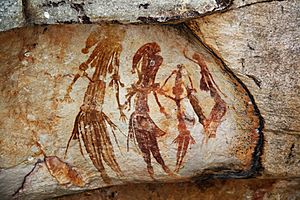
Indigenous Australians include two main groups: the Aboriginal peoples from the mainland (and nearby islands like Tasmania), and the Torres Strait Islanders, who are a different group from Melanesia. People are thought to have first lived on the Australian continent 50,000 to 65,000 years ago. They came by land bridges and short sea trips from what is now Southeast Asia.
The Madjedbebe rock shelter in Arnhem Land is the oldest place showing humans in Australia. The oldest human remains found are the Lake Mungo remains, which are about 41,000 years old. Aboriginal Australian culture is one of the oldest continuous cultures on Earth. When Europeans first arrived, Aboriginal Australians were skilled hunter-gatherers with many different ways of life and about 250 different language groups. They have an oral culture, meaning they pass down stories by speaking. Their spiritual beliefs are based on respecting the land and the Dreamtime.
The Torres Strait Islander people settled their islands about 4000 years ago. They are different from mainland Aboriginal peoples in their culture and languages. They were seafarers who got their food from farming and the ocean.
European Arrival and Settlement
The northern coasts of Australia were sometimes visited by Makassan fishermen from what is now Indonesia for trade. The first time Europeans officially saw the Australian mainland was by the Dutch. The ship Duyfken, led by Dutch navigator Willem Janszoon, was the first to map the Australian coast and meet Aboriginal people in 1606. Later that year, Spanish explorer Luís Vaz de Torres sailed through the Torres Strait Islands. The Dutch mapped the western and northern coastlines and named the continent "New Holland" in the 1600s.
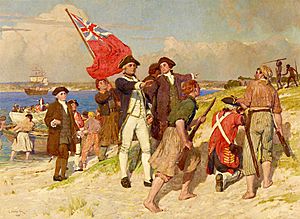
In 1770, Captain James Cook sailed along and mapped the east coast. He named it "New South Wales" and claimed it for Great Britain. After losing its American colonies, the British Government sent the First Fleet of ships, led by Captain Arthur Phillip. Their goal was to start a new colony in New South Wales. They set up a camp and raised the Union Flag at Sydney Cove on January 26, 1788. This date later became Australia's national day.
Many early settlers were people who had been sent to Australia as punishment for crimes. They often worked as laborers for free settlers. The number of Indigenous people decreased for 150 years after European settlement, mainly due to diseases. Many also died in conflicts with settlers.
Growing Colonies
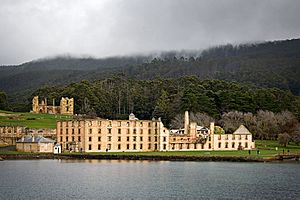
The British continued to explore other parts of the continent in the early 1800s. In 1803, a settlement was started in Van Diemen's Land (now Tasmania). In 1813, explorers crossed the Blue Mountains west of Sydney, opening up the inland areas for European settlement. The British claimed the whole Australian continent in 1827.
As the population grew, new colonies were created from New South Wales: Tasmania in 1825, South Australia in 1836, Victoria in 1851, and Queensland in 1859. South Australia was a "free province" and never a penal colony. Western Australia also started as "free" but later accepted people sent there as punishment.