Apollo 11
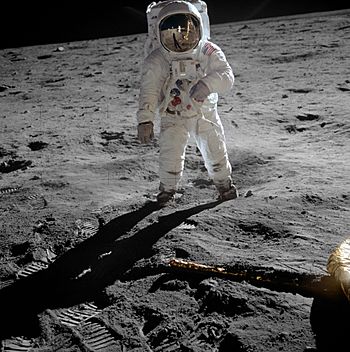
Apollo 11 was a very important space mission. It was the first time humans landed on the Moon. NASA, the American space agency, launched this mission.
The mission began on July 16, 1969. Three astronauts were on board: Neil Armstrong, Buzz Aldrin, and Michael Collins. On July 20, 1969, Armstrong and Aldrin became the first people to walk on the Moon. Michael Collins stayed in orbit around the Moon in the command module.
This flight was a big part of the Space Race. It completed a goal set by President John F. Kennedy in 1961. He wanted to "land a man on the moon, and return him safely to the Earth" before the 1960s ended.
Getting Ready for Apollo 11
Mission Patch Design
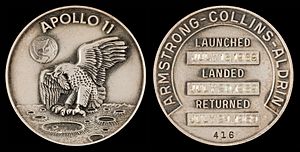
The mission emblem for Apollo 11 was designed by Michael Collins. He wanted it to show a "peaceful lunar landing by the United States." He chose the bald eagle, America's national bird, as the main symbol.
A simulator instructor suggested adding an olive branch in the eagle's beak. This would show that their mission was peaceful. Collins then added the Moon in the background with Earth far away. The astronauts decided the eagle and Moon would be in their natural colors. They chose a blue and gold border.
Neil Armstrong was worried that people who didn't speak English might not understand "eleven." So, they used "Apollo 11" instead. They also decided not to put their names on the patch. They wanted it to represent everyone who helped make the Moon landing happen.
An artist at the Manned Spacecraft Center (MSC) drew the design. But NASA officials rejected it at first. Bob Gilruth, the MSC director, thought the eagle's claws looked "too warlike." After some talk, the olive branch was moved to the eagle's claws. This patch design was later used on the back of the Eisenhower dollar coin in 1971. It was also used on the smaller Susan B. Anthony dollar in 1979.
Spacecraft Names
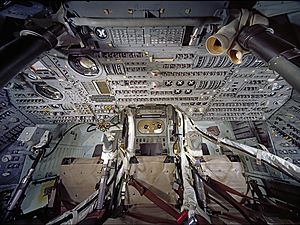
The Lunar Module was named Eagle. This name came from the eagle on the mission patch. The command module was named Columbia. This name was inspired by a giant cannon in Jules Verne's 1865 book From the Earth to the Moon. That cannon also launched a spacecraft from Florida. The name Columbia also refers to a historic name for the United States. Michael Collins later said Columbia was named after Christopher Columbus.
Special Items Carried
The astronauts had small bags called personal preference kits (PPKs). These bags held personal items they wanted to take into space. Five PPKs were carried on Apollo 11. Three were on Columbia (one for each astronaut), and two were on Eagle.
Neil Armstrong's PPK for the Lunar Module held some very special items. It had a piece of wood from the Wright brothers' 1903 Wright Flyer airplane. It also had a piece of fabric from its wing. Plus, it carried a diamond-studded astronaut pin. This pin was meant for Deke Slayton from the widows of the Apollo 1 crew. Armstrong took it with him on Apollo 11.
The Journey to the Moon
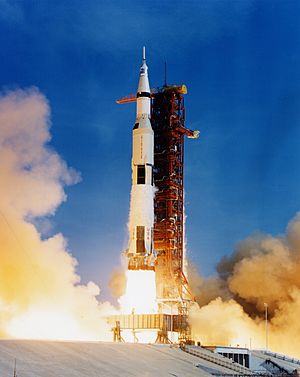
Apollo 11 was launched by a huge Saturn V rocket. It lifted off from Kennedy Space Center in Florida on July 16, 1969, at 1:32 PM UTC. This was the fifth mission in NASA's Apollo program that carried people.
The Apollo spacecraft had three main parts:
- A command module (CM) where the three astronauts lived. This was the only part that returned to Earth.
- A service module (SM) that helped the command module. It provided power, oxygen, water, and helped with movement.
- A lunar module (LM) with two parts. One part was for landing on the Moon, and the other part was for taking the astronauts back into lunar orbit.
After the Saturn V rocket sent them towards the Moon, the astronauts separated their spacecraft. They traveled for three days until they reached the Moon's orbit. Armstrong and Aldrin then moved into the Eagle. They landed in an area called the Sea of Tranquility on July 20.
During the landing, the computer had some problems. Armstrong had to fly the Eagle himself to land it safely. They landed with only 25 seconds of fuel left!
The astronauts used Eagle's top part to lift off from the Moon. They rejoined Collins in the command module. They left Eagle behind before heading back to Earth. They returned to Earth and landed in the Pacific Ocean on July 24. The whole mission lasted more than eight days.
Exploring the Moon
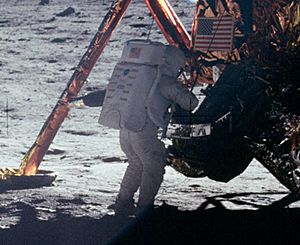
Neil Armstrong and Buzz Aldrin began getting ready to walk on the Moon at 11:43 PM UTC. This took longer than expected, about three and a half hours instead of two. During training on Earth, everything was neatly organized. But on the Moon, the cabin was full of checklists, food, and tools.
Six hours and thirty-nine minutes after landing, Armstrong and Aldrin were ready to go outside. The Eagle was depressurized, meaning the air was let out.
The Eagle's hatch opened at 2:39:33 AM. Armstrong had some trouble getting through the hatch with his portable life support system (PLSS) backpack. Astronauts' heart rates were very high during this part. At 2:51 AM, Armstrong began his climb down to the Moon's surface.
Apollo 11 used a special TV system that was not like regular broadcast TV. So, the signal was shown on a special monitor. A regular TV camera then filmed this monitor. This made the picture quality lower. The signal was first received in the United States. But it was clearer at a station in Australia. Later, a bigger radio telescope in Australia took over the feed.
Even with some problems, black and white images of the first Moonwalk were seen by at least 600 million people on Earth. Copies of this video are still available. However, the original recordings from the Moon were likely erased by NASA.
Armstrong described the Moon dust as "very fine-grained" and "almost like a powder." At 2:56:15 AM, six and a half hours after landing, Armstrong stepped off Eagle's landing pad. He famously said: "That's one small step for [a] man, one giant leap for mankind."
About seven minutes after stepping onto the Moon, Armstrong collected a small soil sample. He put it in a bag on a stick and tucked it into his pocket. This was to make sure they brought back some Moon soil. This was in case they had to leave quickly. Twelve minutes later, he set up the TV camera on a tripod. He took a wide view of the area.
Aldrin joined Armstrong on the surface. He described the view simply: "Magnificent desolation."
Armstrong said moving in the Moon's gravity was easy. The Moon's gravity is one-sixth of Earth's. Aldrin tried different ways to move, including kangaroo hops. The PLSS backpack made them lean backward a bit. But neither astronaut had trouble keeping balance. Loping (a long, easy stride) became the best way to move. The astronauts said they had to plan their steps ahead. The fine soil was quite slippery. Aldrin noticed that moving from sunlight into Eagle's shadow did not change the temperature inside his suit. But his helmet felt warmer in sunlight.