American Football
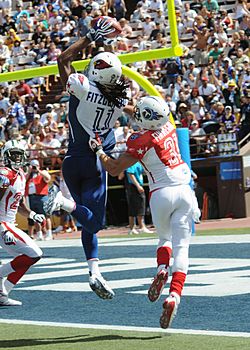
American football, often just called football in the United States and Canada, is an exciting team sport. Two teams of eleven players compete on a rectangular field with goalposts at each end. The team with the ball, called the offense, tries to move it down the field. They can do this by running with the oval-shaped ball or throwing it. The other team, the defense, tries to stop them and get the ball back.
The offense must gain at least ten yards in four tries, called downs. If they succeed, they get another four downs to keep going. If they fail, the other team gets the ball. Teams score points by getting the ball into the opponent's end zone for a touchdown or by kicking it through the goalposts for a field goal. The team with the most points at the end of the game wins. If the score is tied, the game goes into overtime.
American football started in the United States. It grew out of soccer and rugby. The very first game was played on November 6, 1869. Two college teams, Rutgers and Princeton, played with rules similar to soccer. Over time, rules changed to be more like rugby. A man named Walter Camp, known as the "Father of American Football," helped create many of the rules we know today. These included the snap, the line of scrimmage, and the idea of downs. American football is very similar to Canadian football. Both are types of gridiron football.
This sport is super popular in the United States. Professional and college football are the most watched. Many kids play high school and youth football too. The National Football League (NFL) has huge crowds at its games. Its championship game, the Super Bowl, is one of the most-watched sports events worldwide. While not as popular globally as soccer or basketball, American football is growing in places like Canada, Europe, Brazil, and Japan. A version of the game called flag football will be played at the 2028 Summer Olympics.
What's in a Name? Understanding "Football"
In the United States and Canada, people simply call American football "football." This name became official in 1876 when the rules changed from soccer-style to rugby-style. Even though it could have been called "rugby," the name "football" stuck. In other English-speaking countries, like the United Kingdom or Australia, where other types of football (like soccer) are popular, people use "gridiron" or "American football" to avoid confusion.
The Story of American Football
How the Game Began
American football grew from rugby and soccer. Rugby is a sport where two teams try to control a ball. They can kick it through goalposts or run it into the opponent's goal area to score.
The first American football game was on November 6, 1869. It was played between Rutgers and Princeton. Each team had 25 players. They used a round ball that could only be kicked or batted, not carried. Rutgers won that game 6–4. Over the next few years, different colleges played with their own rules.
In 1873, some colleges tried to create standard rules. But Harvard liked a rugby-style game where players could run with the ball. Harvard played against McGill University using both American and Canadian (rugby) rules. The Harvard players preferred the Canadian style. This included having only 11 players, running with the ball, tackling, and using an oval-shaped ball.
Walter Camp and Key Rule Changes
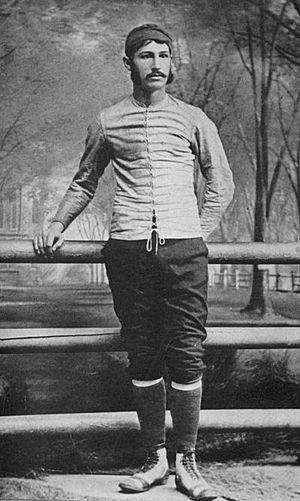
After seeing a rugby-style game, Princeton also adopted similar rules. Soon, Princeton, Harvard, Yale, and Columbia formed a group to play using rugby rules. Walter Camp, a Yale player, made big changes in 1880. He reduced teams from 15 to 11 players. He also introduced the snap, where the ball is passed from the ground to start a play. Before this, games started with a messy "scrum" like in rugby.
The snap led to a problem: teams could hold the ball forever to prevent opponents from scoring. To fix this, Camp proposed a new rule in 1882. Teams would get three downs (tries) to move the ball 5 yards. If they failed, the other team got the ball. This rule made American football very different from rugby. The field also got lines every 5 yards, making it look like a "gridiron." Other changes included reducing the field size and adjusting how points were scored.
Making the Game Safer
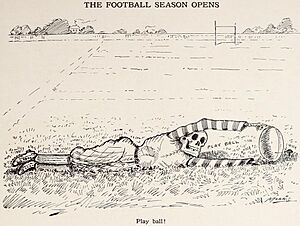
Early football was very rough. Dangerous plays, like the "flying wedge," caused many serious injuries and even deaths. In 1905, President Theodore Roosevelt threatened to ban the game if it wasn't made safer. In response, colleges met and formed the Intercollegiate Athletic Association of the United States. This group later became the National Collegiate Athletic Association (NCAA), which still governs college sports today.
To make the game safer and more exciting, new rules were added. The forward pass became legal in 1906, allowing players to throw the ball forward. The field was shortened, and the end zones were created. Teams were also given four downs instead of three to gain 10 yards. Penalties were introduced for dangerous plays, like roughing the passer.
Professional Football Begins
The first recorded instance of a player being paid to play American football was on November 12, 1892. Pudge Heffelfinger was paid $500 to play in a game. Over time, paying players became more common. In 1920, the National Football League (NFL) was formed. Its goal was to organize professional teams and create fair rules for players. By 1922, the NFL was the top professional football league in America.
Professional football grew in popularity, especially after the 1958 NFL Championship game. This game, known as the "Greatest Game Ever Played," was watched by millions on TV. By the mid-1960s, football was the most popular sport in the United States. The Super Bowl, the NFL's championship game, started in 1966. It became a huge event, bringing together the best teams from the NFL and the rival American Football League (AFL). The two leagues eventually merged in 1970.
College Football Today
College football has also changed over the years. The NCAA divided its top football teams into different levels. Today, the highest level is called the Football Bowl Subdivision (FBS). These teams often play in special postseason bowl games. Another level, the Football Championship Subdivision (FCS), has a playoff system to decide its champion.
In recent years, rules have changed to allow college players to earn money. They can now get paid for using their names, images, and likenesses (NIL). This was a big change for college sports.
Players and Their Roles
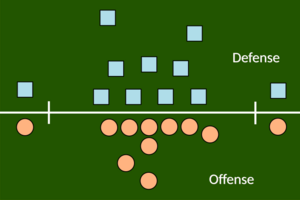
An American football game has two teams, each with 11 players on the field at a time. Teams can swap players between plays. This means teams often have special groups for offense, defense, and special teams. Players wear numbers from 0 to 99. While most football players are men, women can and do play in high school and college games.