Can Offshore Wind Energy and Whales Get Along?
Abstract
Would you believe that whales and wind turbines are connected? Capturing energy from wind over the ocean is already popular across Europe, and more and more wind turbines (like giant windmills) are being built along the coasts of the United States. While the ability to create energy from renewable sources like wind has many advantages over traditional energy sources, building these turbines creates loud noises, which might bother or affect marine animals. This noisy process is especially worrying for baleen whales, who are amazing listeners and use sound to communicate. Currently, scientists are working to understand how to build offshore wind farms in ways that protect whales while still producing a lot of energy. In this article, you will learn how wind turbines in the ocean connect to your home, how wind energy and whales are connected, and why this research matters.
How Ocean Breezes Power Your TV
While the United States has successfully produced renewable energy from land-based wind farms, offshore wind is still relatively new. Offshore wind farms are similar to land-based wind farms, except that the wind turbines are located in the ocean in areas of strong breezes to spin the blades instead of on land (Figure 1A).
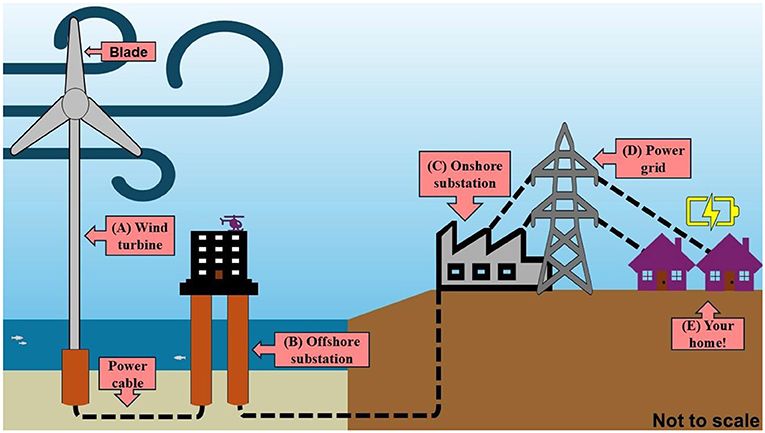
- Figure 1 - (A) The blades of offshore wind turbines in the ocean spin due to the strong ocean breeze.
- (B) This generates electricity that travels through underwater power cables to an offshore substation. (C) The electricity then travels to an onshore substation, where it is changed into the kind of electricity your house can use. (D, E) Finally, it travels through the power grid and into your home.
When the blades turn, the wind turbine converts that movement into electricity. This electricity then travels through underwater cables to an offshore substation where the electricity is gathered and prepared to be sent to land (Figure 1B). From there, the electricity travels through even more cables until it reaches an onshore substation, where the electricity is changed into the kind of electricity your household electronics can use (Figure 1C). Finally, it is sent through the power grid and into your house (Figures 1D, E), ready to power your lights, TV, video games, and more.
How Are Baleen Whales And Wind Turbines Connected?
Whether they are being built, running, or eventually being taken apart, offshore wind farms can be a concern for baleen whales, though scientists are most concerned about the construction process. To keep each turbine in place, giant poles, called piles, that hold the wind turbine upright must be installed into the seafloor. The most common method to install these piles is through pile driving, which is similar to using a hammer to hit a nail into a piece of wood—but instead of a nail, construction workers have an enormous steel tube, and instead of wood, they have the seafloor (Figures 2A, B). This step is incredibly important when building offshore wind farms because, if not done correctly, the wind turbine could float away or fall over when hit by waves or a strong breeze.
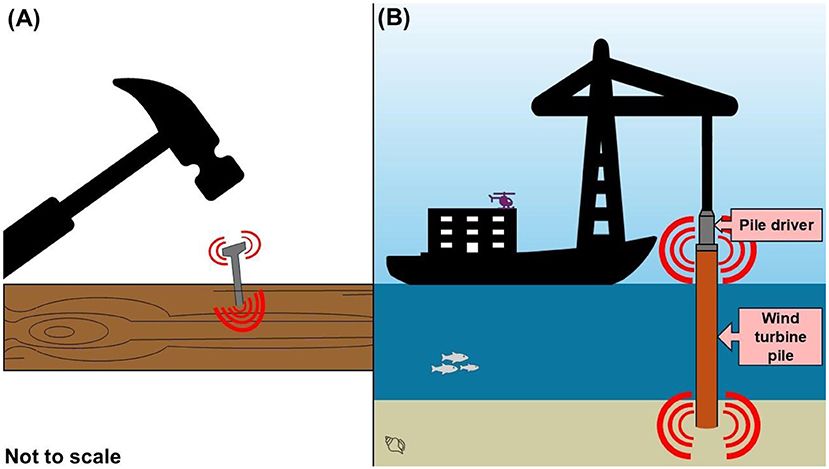
- Figure 2 - (A) Pile driving is like hammering a giant nail underwater.
- (B) The “hammer”, called the pile driver, hits the “nail” a.k.a the wind turbine pile, driving it into the sea floor. Just like hammering a nail, hitting a pile creates loud sounds.
Each offshore wind farm is made up of many turbines so pile driving can take months. During this time, the loud hammering sounds travel through the surrounding ocean well beyond the construction site. This noise is potentially dangerous because it falls within the hearing and communication range of baleen whales. Pile-driving noise is also low in pitch and can therefore travel very far underwater [1].
Imagine listening to hammering for hours a day, every day, for months on end. That might be really annoying or stressful. In fact, for a wind farm off the coast of Denmark, scientists found that during the 5 months it took to drive all the piles, harbor porpoises located about 17.8 km (about 11 miles) away from the construction site would leave the area after just 1 h of pile driving [2]. If baleen whales do the same thing, it could be a problem, as they might be forced out of important feeding or migration areas, or their behavior might change.
However, staying near the loud pile driving might not be safe either. If the baleen whales stay, their communication sounds could become masked by the construction noise, meaning that the sounds the whales use to “talk” to one another may be covered or at least harder to hear by other whales [1]. This interruption could then force the whales to call louder, call at a different pitch, or call at a different time of day, which could make the whales use a lot more energy than they normally would. Plus, if the pile driving is exceptionally loud, the whales could suffer temporary or even permanent damage to their ears and hearing.
On top of all this, if the whales stay in an area with loud pile driving, their stress levels could increase. Over an extended period of time, increased stress could have a variety of health impacts, including making the whales more likely to get sick or less likely to reproduce.
Although research on pile driving and baleen whale stress is limited, a study that checked whale poop for chemicals that indicate stress found that baleen whales surrounded by loud passing boats had high amounts of stress chemicals in their poop [3]. This suggests that other loud sounds, like pile driving, could also cause the whales to become stressed. Finally, pile driving is of concern to baleen whales because it may change the behavior of their prey or cause prey to leave the area [1]. This could force the whales to move to follow their prey to avoid going hungry, potentially leading to the same issues discussed above.
Ensuring Baleen Whale Safety
To learn how pile driving affects baleen whales, some scientists are using underwater passive acoustic monitoring devices. These devices can include recording tags, which are small recording devices originally used on elephant seals. These use a suction cup, glue, or thin needle to stick to the animal. Once attached to the animal, they record all the sounds near it, as well as the animal’s movement, until eventually falling off after a few weeks (or earlier, if the animal knocks it off). Other commonly used underwater sound recording devices are placed on the ocean floor and collected after about 6 months (Figure 3). While on the seafloor, these devices record every sound in the area and do not disturb the animals in any way. Once these devices are recovered, scientists bring the data back to the lab and upload it to their computers, where they listen to learn when the whales were in the area.
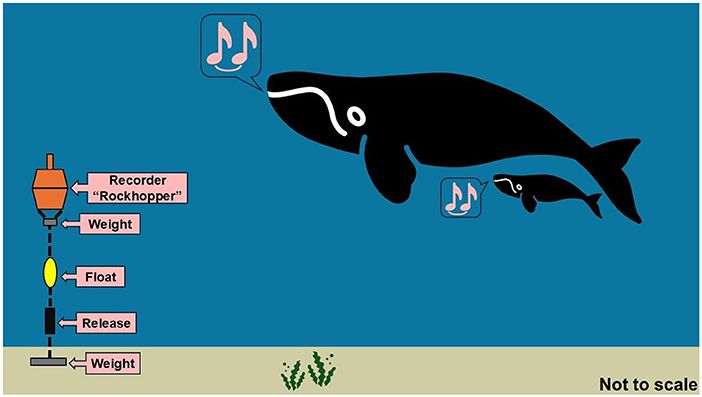
- Figure 3 - A passive acoustic monitoring device that listens to and records all sounds in its environment.
- The example shown here is the “Rockhopper”, created by the Cornell K. Lisa Yang Center for Conservation Bioacoustics, recording passing whales.
Most of what scientists already know about pile driving noise and marine life comes from Europe, where offshore wind farms have been used for much longer than in the United States. However, past research focused on other species, such as harbor porpoises and harbor seals, which produce sounds at different pitches, have different hearing ranges, and have different movement patterns than baleen whales [1].
Because there is still a lot we do not know and since baleen whales are protected by law in the United States (specifically by the Marine Mammal Protection Act [https://www.marinemammalcenter.org/marine-mammal-protection-act] and the Endangered Species Act [https://kids.nationalgeographic.com/history/article/endangered-species-act]), this research is extremely important. It helps balance baleen whale safety, human energy needs, and the fight against global climate change. For example, it allows scientists to tell construction companies if an area is a safe place to build and, if it is, to recommend the best times that pile driving should occur (when the whales are least likely to be in the area).
What About Global Climate Change?
While the main goal of this article is to talk about the importance of studying the relationship between offshore wind construction, particularly pile driving, and whales, it is important to understand why humans and baleen whales benefit from offshore wind in the first place. All forms of energy production have some negative impacts on the Earth. More traditional sources like coal and natural gas use up a lot of land therefore taking space away from animals and humans and can destroy the landscape. More importantly, traditional energy sources release greenhouse gases (such as carbon dioxide, methane, or nitrous oxide). These gases are dangerous because they trap heat in the atmosphere, making the Earth warmer. This warming can melt glaciers in the Arctic, lead to floods, or make places too hot for animals to live. As a result, not just whales, but all animals including humans, may need to move to new areas where they could face new dangers or struggle to find enough food.
Like land, the ocean is full of marine life, so there is almost no way to avoid building near some animals. So, while wind farms are not perfect, they do not produce greenhouse gases and therefore do far less harm than traditional energy sources. They are especially great since scientists are involved in the construction process, working hard to ensure they are built in the safest way possible.
What Can You Do?
While you are not personally building wind turbines or studying whales (yet!), there is a lot you can do to help support both offshore wind energy and whales. The most important thing is to be informed by reading reliable and accurate information—so you have already taken a major step by reading this article. From here, you should keep reading and be sure to share what you learn with your friends and family to ensure they are informed as well. If you are interested in helping baleen whales more specifically, you can take part in a community clean-up, reduce your plastic usage (bring a reusable bag to the grocery store, use a reusable water bottle, or skip out on a straw when you go out to eat). Even if you live far from the ocean, trash and single-use plastics in your local neighborhood can easily enter our waterways, and eventually the ocean. Once in the ocean, these plastics can break down and harm ocean wildlife. Along with picking up litter and reducing your plastic usage you can encourage your family to only buy and eat seafood from sustainable sources. This keeps the ocean’s food supply healthy and protects whales from getting trapped or hurt by fishing gear.
Glossary
Wind Farm: ↑ A group of wind turbines working together to produce energy.
Wind Turbine: ↑ Similar to a windmill, a giant fan-like structure that converts wind into electricity.
Baleen Whales: ↑ Whales that utilize baleen, a unique filtering system, for feeding on krill, plankton, and small fish.
Pile: ↑ A large pole that holds the wind turbine in the seafloor and stops it from floating away.
Pile Driving: ↑ The loud process of hammering a wind turbine pile into the seafloor.
Passive Acoustic Monitoring Device: ↑ An electronic device that listens to and records all sounds in its environment.
Acknowledgments
Thank you to Heather Galloway for the amazing whale and for providing feedback on the figures.
AI Tool Statement
The author(s) declared that Generative AI was not used in the creation of this manuscript.
Any alternative text (alt text) provided alongside figures in this article has been generated by Frontiers with the support of artificial intelligence and reasonable efforts have been made to ensure accuracy, including review by the authors wherever possible. If you identify any issues, please contact us.
Conflict of Interest
The author(s) declared that this work was conducted in the absence of any commercial or financial relationships that could be construed as a potential conflict of interest.
References
[1] ↑ Kraus, S. D., Kenney, R. D., and Thomas, L. 2019. A Framework for Studying the Effects of Offshore Wind Development on Marine Mammals and Turtles. Report prepared for the Massachusetts Clean Energy Center and the Bureau of Ocean Energy Management. Available online at: https://tethys.pnnl.gov/sites/default/files/publications/Kraus-et-al-2019.pdf
[2] ↑ Brandt, M., Diederichs, A., Betke, K., Matuschek, R., and Nehls, G. 2011. Responses of harbour porpoises to pile driving at the Horns Rev II Offshore Wind Farm in the Danish North Sea. Mar. Ecol. Prog. 421:205–16. doi: 10.3354/meps08888
[3] ↑ Rolland, R. M., Parks, S. E., Hunt, K. E., Castellote, M., Corkeron, P. J., and Nowacek, D. P., et al 2012. Evidence that ship noise increases stress in right whales. Proc. R Soc. B. 279:2363–8. doi: 10.1098/rspb.2011.2429