Common Wasps: Their Cleverness and Stupidity
Wishing to observe a Wasp’s nest I go out, one day in September, with my little son Paul, who helps me with his good sight and his undivided attention. We look with interest at the edges of the footpaths.
Suddenly Paul cries: “A Wasp’s nest! A Wasp’s nest, as sure as anything!” For, twenty yards away, he has seen rising from the ground, shooting up and flying away, now one and then another swiftly moving object, as though some tiny crater in the grass were hurling them forth.
We approach the spot with caution, fearing to attract the attention of the fierce creatures. At the entrance-door of their dwelling, a round opening large enough to admit a man’s thumb, the inmates come and go, busily passing one another as they fly in opposite directions. Burr! A shudder runs through me at the thought of the unpleasant time we should have, did we incite these irritable warriors to attack us by inspecting them too closely. Without further investigation, which might cost us too dear, we mark the spot, and resolve to return at nightfall. By that time all the inhabitants of the nest will have come home from the fields.
The conquest of a nest of Common Wasps would be rather a serious undertaking if one did not act with a certain amount of prudence. Half a pint of petrol, a reed-stump nine inches long, and a good-sized lump of clay or loam, kneaded to the right consistency—such are my weapons, which I have come to consider the best and simplest, after various trials with less successful means.
The suffocating method is necessary, unless I use costly measures which I cannot afford. When Réaumur wanted to place a live Wasp’s nest in a glass case with a view to observing the habits of the inmates, he employed helpers who were used to the painful job, and were willing, for a handsome reward, to serve the man of science at the cost of their skins. But I, who should have to pay with my own skin, think twice before digging up the nest I desire. I begin by suffocating the inhabitants. Dead Wasps do not sting. It is a brutal method, but perfectly safe.
I use petrol because its effects are not too violent, and in order to make my observations I wish to leave a small number of survivors. The question is how to introduce it into the cavity containing the Wasp’s nest. A vestibule, or entrance-passage, about nine inches long, and very nearly horizontal, leads to the underground cells. To pour the petrol straight into the mouths of this tunnel would be a blunder that might have serious consequences later on. For so small a quantity of petrol would be absorbed by the soil and would never reach the nest; and next day, when we might think we were digging safely, we should find an infuriated swarm under the spade.
The bit of reed prevents this mishap. When inserted into the passage it forms a water-tight funnel, and carries the petrol to the cavern without the loss of a drop, and as quickly as possible. Then we fix the lump of kneaded clay into the entrance-hole, like a stopper. We have nothing to do now but wait.
When we are going to perform this operation Paul and I set out, carrying a lantern and a basket with the implements, at nine o’clock on some mild, moonlit evening. While the farmhouse Dogs are yelping at each other in the distance, and the Screech Owl is hooting in the olive-trees, and the Italian Crickets are performing their symphony in the bushes, Paul and I chat about insects. He asks questions, eager to learn, and I tell him the little that I know. So delightful are our nights of Wasp-hunting that we think little of the loss of sleep or the chance of being stung!
The pushing of the reed into the hole is the most delicate matter. Since the direction of the passage is unknown there is some hesitation, and sometimes sentries come flying out of the Wasp’s guard-house to attack the operator’s hand. To prevent this one of us keeps watch, and drives away the enemy with a handkerchief. And after all, a swelling on one’s hand, even if it does smart, is not much to pay for an idea.
As the petrol streams into the cavern we hear the threatening buzz of the population underground. Then quick!—the door must be closed with the wet clay, and the clod kicked once or twice with the heel to make the stopper solid. There is nothing more to be done for the present. Off we go to bed.
With a spade and a trowel we are back on the spot at dawn. It is wise to be early, because many Wasps will have been out all night, and will want to get into their home while we are digging. The chill of the morning will make them less fierce.
In front of the entrance-passage, in which the reed is still sticking, we dig a trench wide enough to allow us free movement. Then the side of this ditch is carefully cut away, slice after slice, until, at a depth of about twenty inches, the Wasp’s nest is revealed, uninjured, slung from the roof of a spacious cavity.
It is indeed a superb achievement, as large as a fair-sized pumpkin. It hangs free on every side except at the top, where various roots, mostly of couch-grass, penetrate the thickness of the wall and fasten the nest firmly. Its shape is round wherever the ground has been soft, and of the same consistency all through. In stony soil, where the Wasps meet with obstacles in their digging, the sphere becomes more or less misshapen.
A space of a hand’s-breadth is always left open between the paper nest and the sides of the underground vault. This space is the wide street along which the builders move unhindered at their continual task of enlarging and strengthening the nest, and the passage that leads to the outer world opens into it. Underneath the nest is a much larger unoccupied space, rounded into a big basin, so that the wrapper of the nest can be enlarged as fresh cells are added. This cavity also serves as a dust-bin for refuse.
The cavity was dug by the Wasps themselves. Of that there is no doubt; for holes so large and so regular do not exist ready-made. The original foundress of the nest may have seized on some cavity made by a Mole, to help her at the beginning; but the greater part of the enormous vault was the work of the Wasps. Yet there is not a scrap of rubbish outside the entrance. Where is the mass of earth that has been removed?
It has been spread over such a large surface of ground that it is unnoticed. Thousands and thousands of Wasps work at digging the cellar, and enlarging it as that becomes necessary. They fly up to the outer world, each carrying a particle of earth, which they drop on the ground at some distance from the nest, in all directions. Being scattered in this way the earth leaves no visible trace.
The Wasp’s nest is made of a thin, flexible material like brown paper, formed of particles of wood. It is streaked with bands, of which the colour varies according to the wood used. If it were made in a single continuous sheet it would give little protection against the cold. But the Common Wasp, like the ballon-maker, knows that heat may be preserved by means of a cushion of air contained by several wrappers. So she makes her paper-pulp into broad scales, which overlap loosely and are laid on in numerous layers. The whole forms a coarse blanket, thick and spongy in texture and well filled with stagnant air. The temperature under this shelter must be truly tropical in hot weather.
The fierce Hornet, chief of the Wasps, builds her nest on the same principle. In the hollow of a willow, or within some empty granary, she makes, out of fragments of wood, a very brittle kind of striped yellow cardboard. Her nest is wrapped round with many layers of this substance, laid on in the form of broad convex scales which are welded to one another. Between them are wide intervals in which air is held motionless.
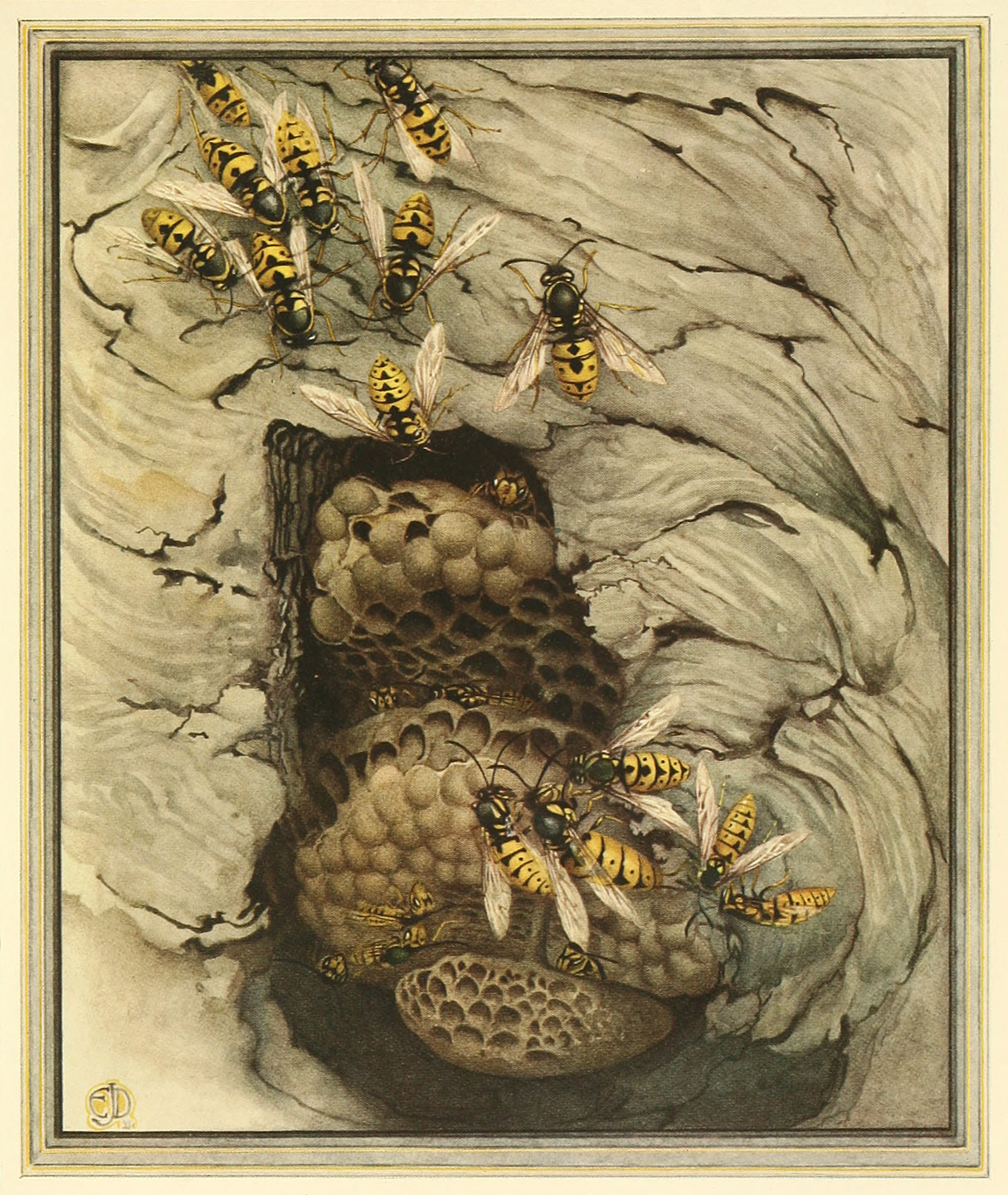
The Wasp, then, often acts in accordance with the laws of physics and geometry. She employs air, a non-conductor of heat, to keep her home warm; she made blankets before man thought of it; she builds the outer walls of the nest in the shape that gives her the largest amount of room in the smallest wrapper; and in the form of her cell, too, she economises space and material.
And yet, clever as these wonderful architects are, they amaze us by their stupidity in the face of the smallest difficulty. On the one hand their instincts teach them to behave like men of science; but on the other it is plain that they are entirely without the power of reflection. I have convinced myself of this fact by various experiments.
The Common Wasp has chanced to set up house beside one of the walks in my enclosure, which enables me to experiment with a bell-glass. In the open fields I could not use this appliance, because the boys of the countryside would soon smash it. One night, when all was dark and the Wasps had gone home, I placed the glass over the entrance of the burrow, after first flattening the soil. When the Wasps began work again next morning and found themselves checked in their flight, would they succeed in making a passage under the rim of the glass? Would these sturdy creatures, who were capable of digging a spacious cavern, realise that a very short underground tunnel would set them free? That was the question.
The next morning I found the bright sunlight falling on the bell-glass, and the workers ascending in crowds from underground, eager to go in search of provisions. They butted against the transparent wall, tumbled down, picked themselves up again, and whirled round and round in a crazy swarm. Some, weary of dancing, wandered peevishly at random and then re-entered their dwelling. Others took their places as the sun grew hotter. But not one of them, not a single one, scratched with her feet at the base of the glass circle. This means of escape was beyond them.
Meanwhile a few Wasps who had spent the night out of doors were coming in from the fields. Round and round the bell-glass they flew; and at last, after much hesitation, one of them decided to dig under the edge. Others followed her example, a passage was easily opened, and the Wasps went in. Then I closed the passage with some earth. The narrow opening, if seen from within, might help the Wasps to escape, and I wished to leave the prisoners the honour of winning their liberty.
However poor the Wasps’ power of reasoning, I thought their escape was now probable. Those who had just entered would surely show the way; they would teach the others to dig below the wall of glass.
I was too hasty. Of learning by experience or example there was not a sign. Inside the glass not an attempt was made to dig a tunnel. The insect population whirled round and round, but showed no enterprise. They floundered about, while every day numbers died from famine and heat. At the end of a week not one was left alive. A heap of corpses covered the ground.
The Wasps returning from the field could find their way in, because the power of scenting their house through the soil, and searching for it, is one of their natural instincts, one of the means of defence given to them. There is no need for thought or reasoning here: the earthy obstacle has been familiar to every Wasp since Wasps first came into the world.
But those who are within the bell-glass have no such instinct to help them. Their aim is to get into the light, and finding daylight in their transparent prison they think their aim is accomplished. In spite of constant collisions with the glass they spend themselves in vainly trying to fly farther in the direction of the sunshine. There is nothing in the past to teach them what to do. They keep blindly to their familiar habits, and die.